
An unfamiliar shape is an invitation
Open an old flatware drawer and the familiar rhythm of knives, forks and spoons can suddenly break. A narrow channel ends in another scoop. A blade spreads wide enough to look almost ceremonial. Two arms meet in little shells. These are not necessarily damaged versions of ordinary utensils: they may be tools made for a particular moment in a meal.
This visual guide follows four documented forms, not a universal identification key. Shape helps you ask better questions. A museum record, maker’s catalogue or securely identified comparison is what lets you give a more confident answer. The examples here also show why the name of a utensil and the name of its maker are separate discoveries.
For place settings and pattern collecting, begin with flatware and cutlery. For the vessels these tools served, explore servingware.
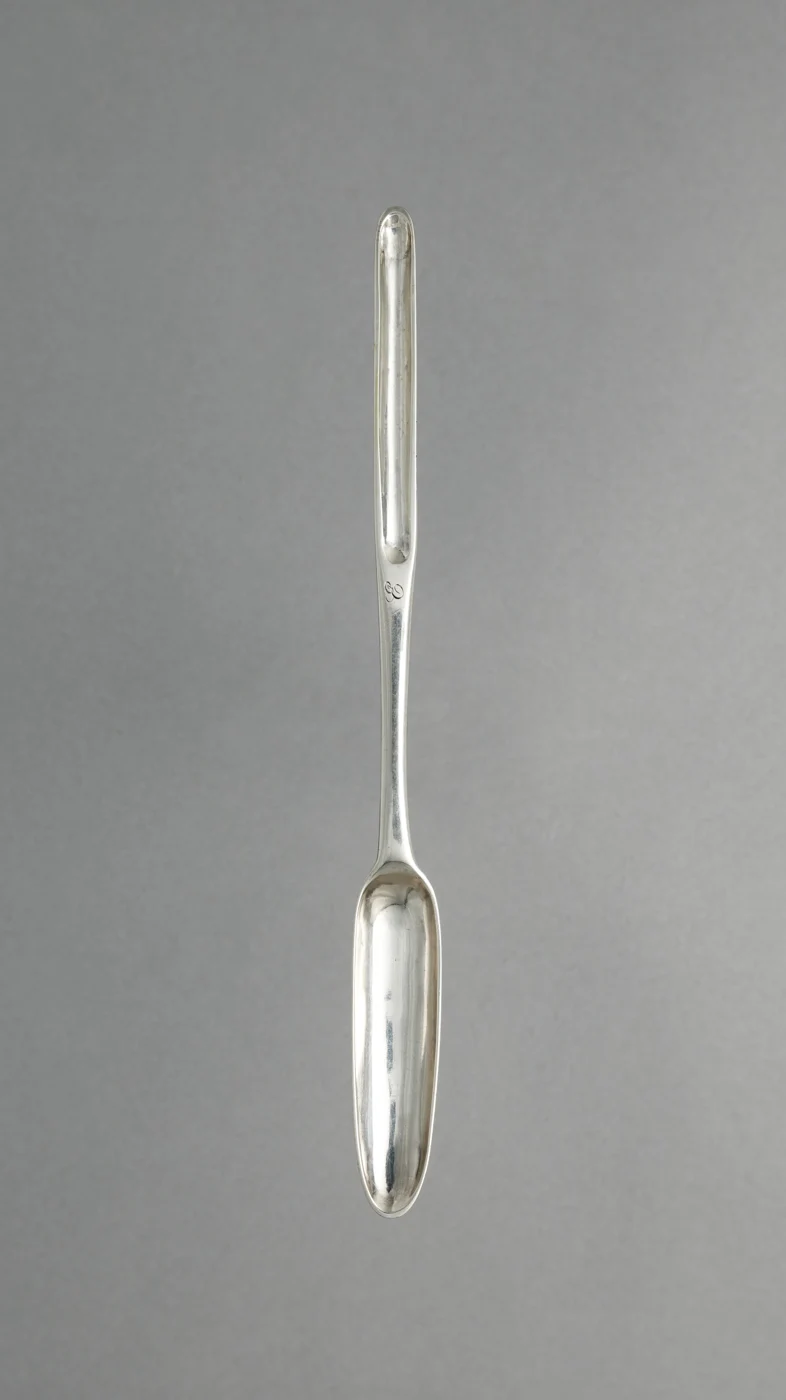
Marrow scoop: a channel, not a teaspoon
The long, recessed end is the clue. Where a teaspoon gathers liquid in a broad bowl, this form provides a slender channel. The Cleveland example has a narrower scoop at one end and a wider one at the other. Its undecorated stretches make the proportions unusually easy to read.
The museum dates this silver scoop to about 1790 and attributes it to Joseph Richardson of Philadelphia. Keep that qualification: it is not the same as a confirmed maker. A separate, well-marked marrow scoop by Ephraim Brasher, about 1770, is catalogued at The Met. That record explains the form’s use in drawing edible marrow from bones during the eighteenth and early nineteenth centuries.
Fish slice: a broad surface for serving
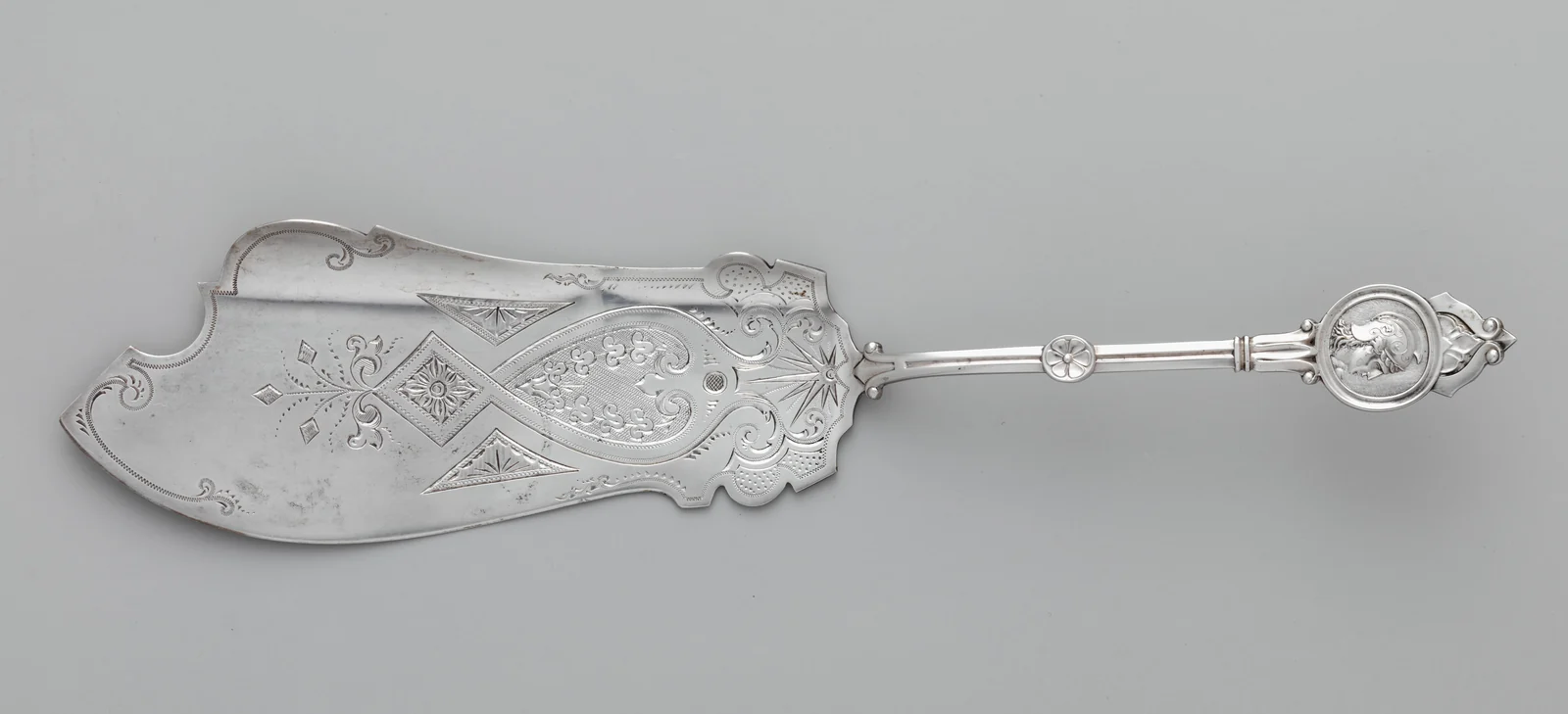
The broad blade changes the gesture. Instead of taking a small mouthful, the server offers a surface on which food can be lifted and transferred. This example is a fish slice made by Schulz & Fischer around 1872 and retailed by Hain & Pollard in San Francisco. The Met records its length as 31.1 centimetres.
Notice how much of the object is given over to the blade. Engraved panels decorate that working surface, while a portrait medallion finishes the handle. The result is both a utensil and a little presentation piece. Its silhouette is a better starting point than the decoration alone: a medallion handle can belong to many different forms.
Ice cream: a serving tool and its smaller companions
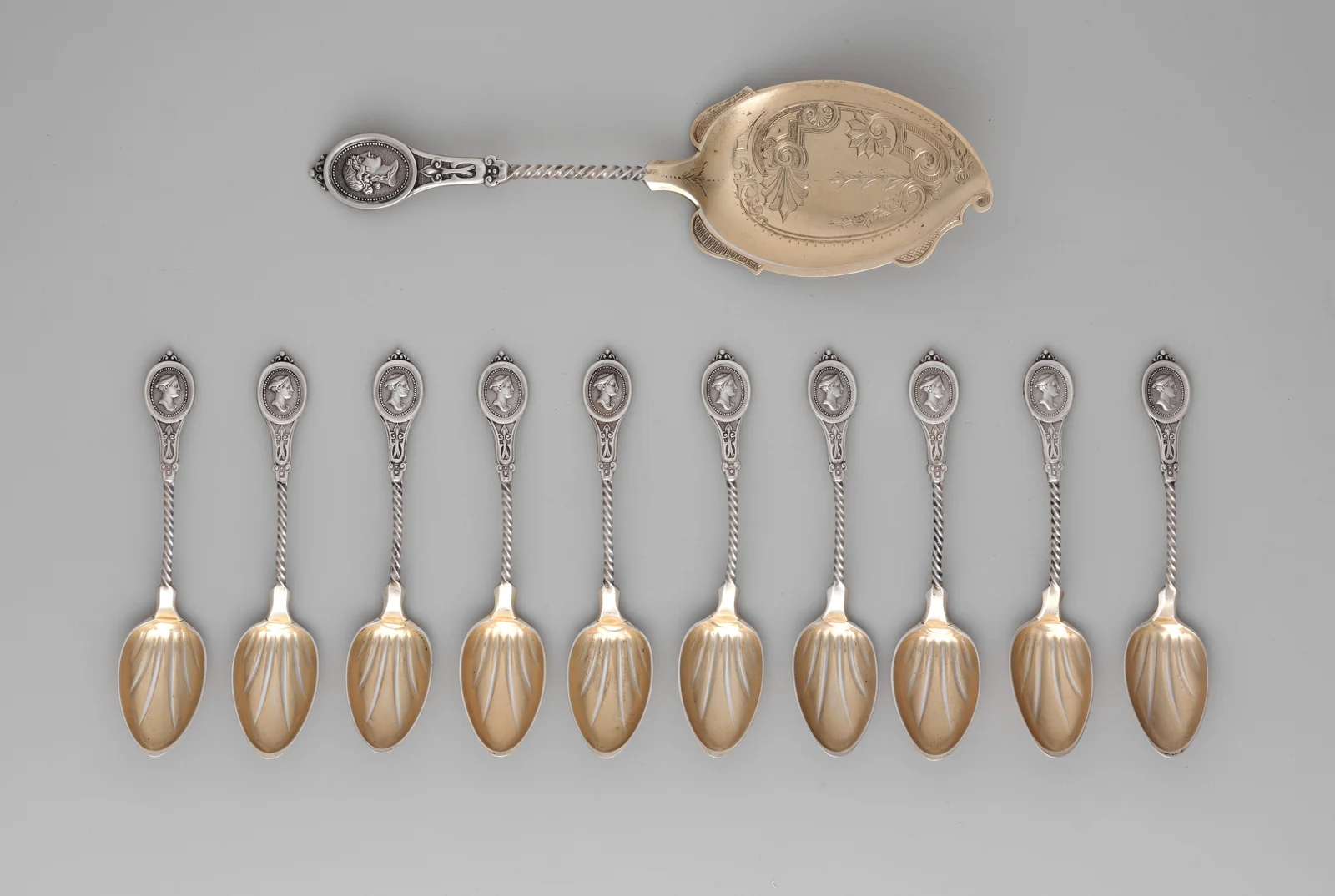
Here the story is in the group. A broad slicer sits above ten smaller spoons, linked by gilded bowls, twisted stems and portrait-medallion handles. The larger tool serves; the smaller pieces bring the dessert to individual diners. Together, they make a special occasion out of an otherwise brief course.
The Met dates this silver and silver-gilt set to about 1863. It connects the rise of specialized ice-cream flatware with the wider availability of the frozen dessert in nineteenth-century America. The objects are unmarked. Comparisons place the pattern with Kidney, Cann & Johnson, Kidney & Johnson, or Samuel H. Johnson, but the museum does not settle on one of those possibilities.
Tongs: a different way to take hold
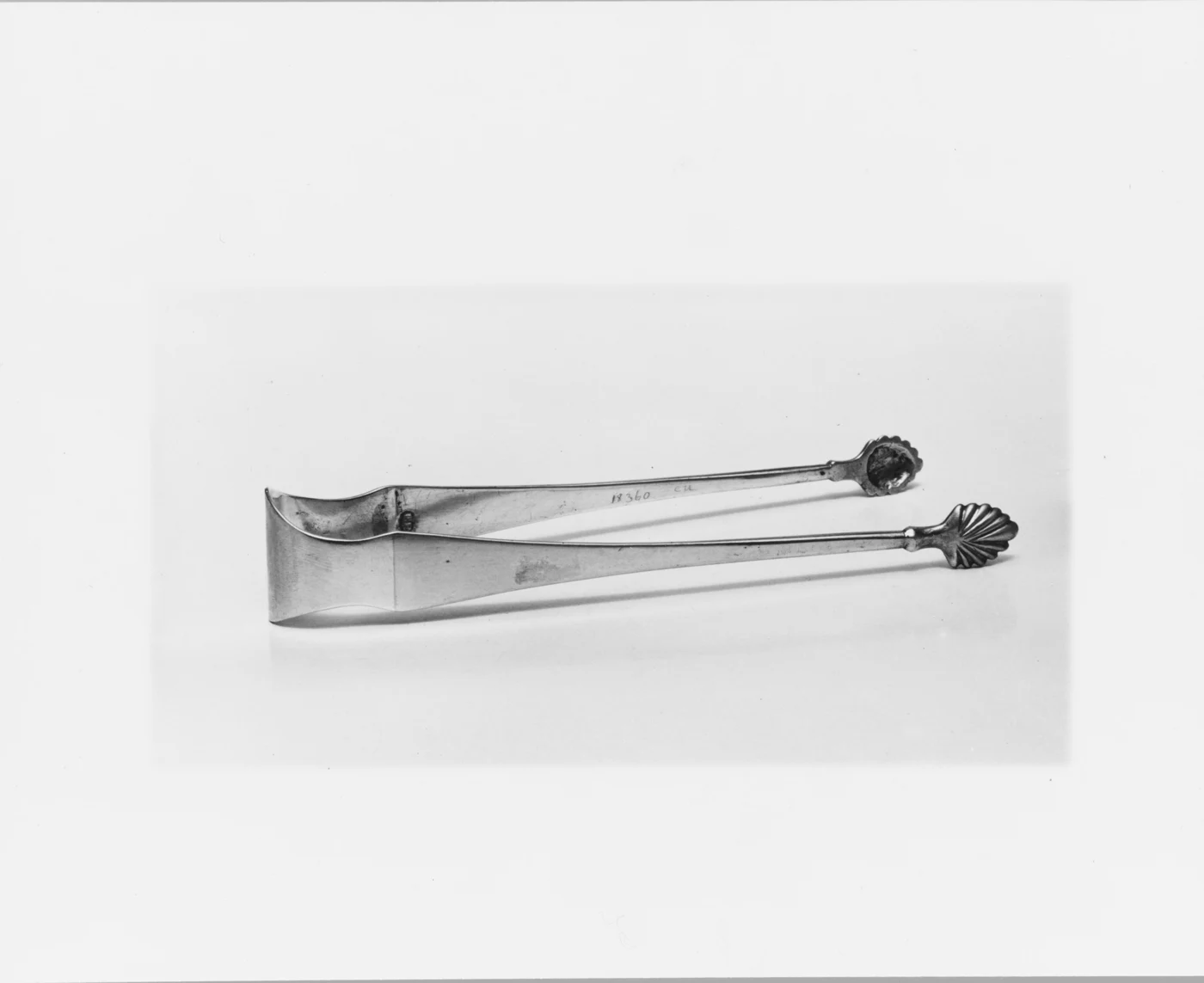
A pair of tongs replaces the bowl or blade with two opposing ends. On Ephraim Brasher’s silver example, made in New York around 1800, those ends have shell-like shapes. Long arms lead back to a folded bow. You can read the intended gripping action without knowing the name of every course on an old menu.
The Met identifies the object simply as Tongs and records a length of 16.2 centimetres. We keep that title rather than inventing a more specific food association for this particular piece. It is a useful reminder that a careful description may stop short of the most tempting label.
Give the next collector something to work with
The most useful record starts modestly: overall view, reverse, marks, working end, dimensions and any visible repairs. Add the source of the proposed identification. “Possibly a fish server, compared with this catalogue illustration” preserves the reasoning; an unsupported confident title hides it.
- Separate form from material. A silver-colored serving tool is not necessarily solid silver. Record the actual marks and any mixed materials.
- Separate maker from retailer. The fish slice has both, and neither should disappear into a single undifferentiated name.
- Keep uncertainty visible. “Attributed to” and “possibly” are meaningful parts of an object’s identity.
- Keep condition separate from intended use. A historical utensil’s original purpose does not establish that its present surface, repairs or materials are suitable for food.
Continue with patterns and makers when a mark or design offers the next clue. Before cleaning or bringing an inherited piece to dinner, consult care and use. The pleasure of specialized silver is not memorizing a drawer full of names. It is discovering how a small change in form can preserve a different way of living.
Sources & further reading
Museum records document the named examples. Looking and recording suggestions are editorial guidance, not an authentication or food-safety assessment.