
The story starts before silver
Chinese tea traditions gave the teapot its purpose long before a matched silver service became a European household aspiration. Yixing stoneware and porcelain supplied forms that travelled with the drink. The V&A’s history of teapot design places the spread of leaf-steeping and purpose-made pots in this wider ceramic story.
As tea and Asian ceramics reached European buyers, goldsmiths responded in more than one way. Some made whole vessels in silver. Others added precious-metal mounts to porcelain, emphasizing its value or protecting and adapting a fragile object. Materials could share the same object as readily as the same table.
That is why “influence” is more useful here than a neat family tree. Shapes crossed borders, but workshops adapted them to their skills, patrons and local habits. A silver pot can resemble a ceramic one without being a simple copy.
A small Paris pot and a New York connection
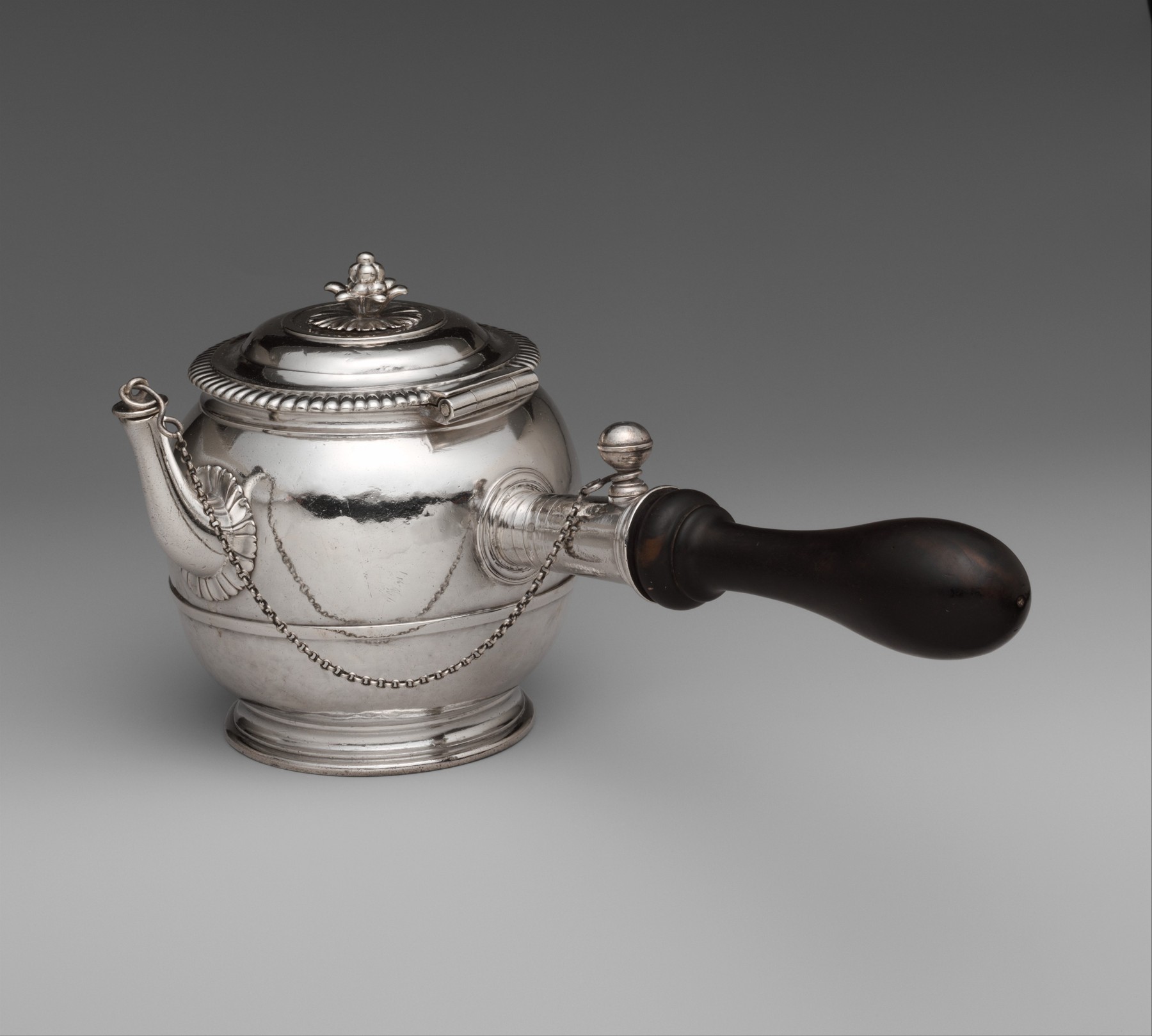
The Paris teapot stamped by master I. C. in 1699–1700 is small, richly modeled and fitted with ebony. The Met describes it as apparently the only surviving Parisian silver teapot of the late seventeenth century. That carefully limited statement concerns surviving evidence in a specific place and period; it does not make it the world’s first silver teapot.
Jacob Boelen’s New York teapot of 1690–1700 offers another early encounter between tea culture and metalworking. Its compact body belongs to the conversation between Asian ceramic forms and European-trained American smiths. Studying the two pots together is more rewarding than treating “antique teapot” as one timeless shape.
For a collector, these objects are reference points rather than templates for instant dating. A later revival can borrow an old silhouette. Form becomes persuasive evidence only when marks, construction and provenance support it.
The tea table and the world that supported it
The beauty of a tea service should not detach it from the systems that made it possible. Tea trading, colonial power and sugar produced through enslaved labor were intertwined in the Atlantic world. The vessels for sweetening and serving tea participated in that economy, even when their ornament looks domestic and serene.
Keep broad history separate from the biography of an individual pot. An object’s date and place alone do not establish the exact mine that supplied its silver, the plantation that produced its owner’s sugar or the experiences of everyone who used it. Those claims require their own evidence.
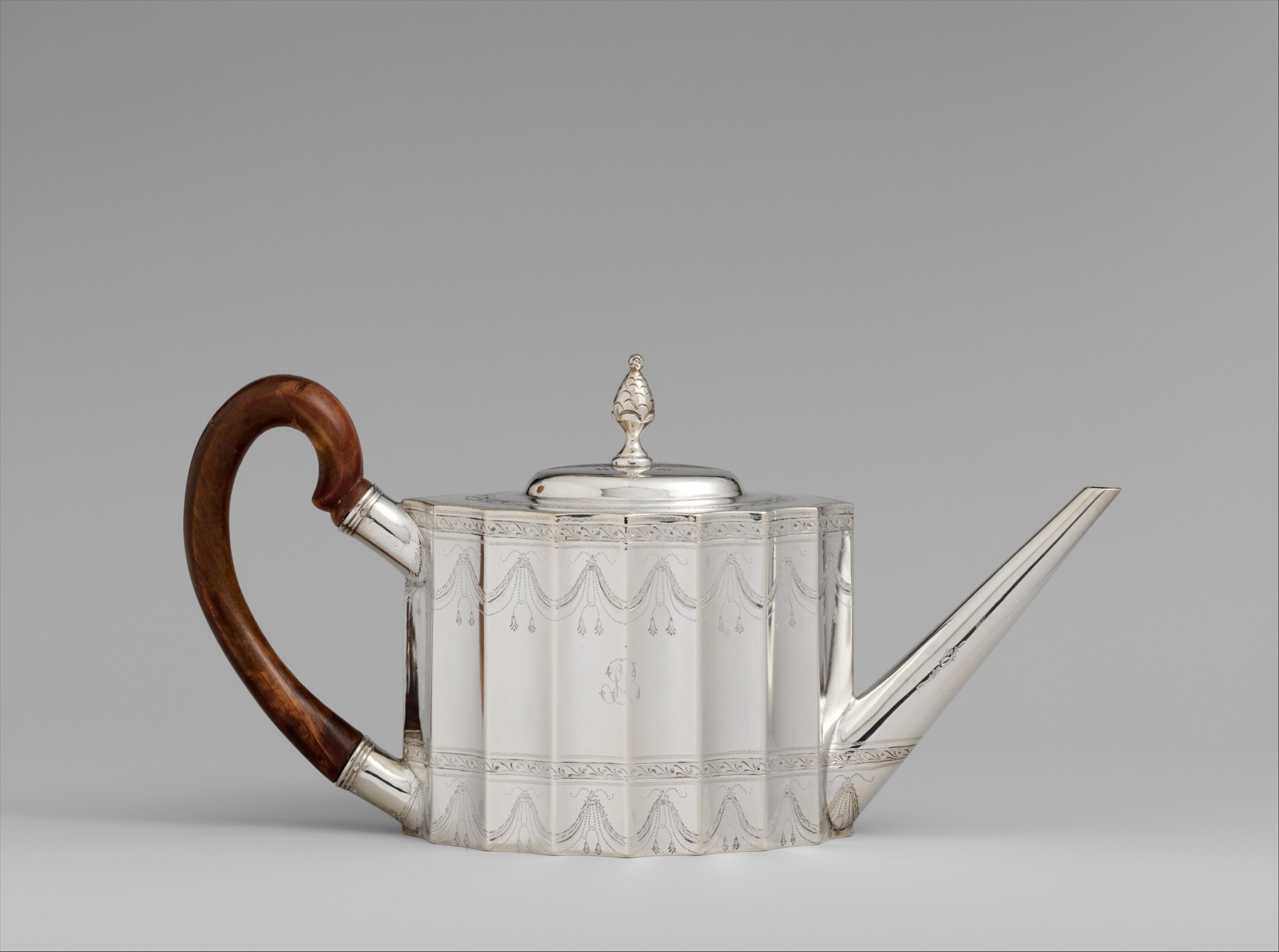
American tea equipment also changed with workshop practice and taste. Revere’s 1796 teapot uses rolled sheet and a joined body rather than asking a silversmith to hammer the entire form from one disc. Its fluted, oval design helps make the transition toward a coordinated Neoclassical table visible.
A Chinese service with an associated pot
Chinese export silver shows how a recognizable service format could carry distinctive ornament. A Wang Hing group sold by Case in 2017 combines figural decoration, floral relief and handles shaped with bamboo motifs. The catalogue identifies marks including WH and 90, along with Chinese characters.
The same record describes the coffee pot as associated. That is an important part of the story: the objects can make a handsome tea-table group without every piece having begun as one commission. Keep the catalogue’s qualifications when using it as a comparison.
For identification, photograph the Chinese characters as well as any Roman-alphabet stamp. A translated name is useful, but the full arrangement gives a specialist better evidence. Avoid assigning every object to a named artisan solely from a retail name or a familiar decorative motif.
Different traditions, different possibilities
The Met’s Japanese tea and coffee service, dated about 1880–1910, combines a group of Western-style serving vessels with richly worked iris decoration. It is a reminder that a familiar service format can carry a different artistic vocabulary. “Western form” does not make the metalwork or its cultural setting incidental.
Russian silver and enamel offer another change of pace. The Cleveland Museum of Art’s covered teapot, dated 1887–1896, combines silver-gilt with opaque cloisonné enamel. Here the metal supports a colored surface as well as a vessel. The collector’s questions widen from alloy and marks to enamel condition, repairs and the museum’s exact attribution.
These are selected examples, not a ranking of national traditions or a complete map of tea culture. Indian, Himalayan, Southeast Asian and other tea equipment add still more histories. The useful habit is to begin with a documented object and follow its particular evidence, rather than fit every service into the same English drawing-room story.
Keep exploring the silver table
Sources & further reading
Reviewed November 10, 2026. Museum records, official guidance and historical auction results answer different questions. They do not authenticate or appraise a privately owned object. Museum photographs used here are Public Domain under the Met’s CC0 Open Access terms. Images were resized proportionally without cropping or retouching. No institutional endorsement is implied.
- V&A: Teapot design through time
Chinese ceramic precedents, early British forms and the social history of tea.
- The Met: Teapot, master I. C., 1699–1700
Silver and ebony, Paris; accession 48.187.78.
- The Met: Jacob Boelen teapot, 1690–1700
Accession 61.246a, b. Keep the object’s documented attribution separate from broader trade history.
- The Met: Teapot, 1699–1700
The Metropolitan Museum of Art. Bequest of Catherine D. Wentworth, 1948, 48.187.78. Public Domain. CC0. Resized proportionally; not cropped or retouched.
- The Met: Paul Revere Jr. teapot, 1796
Accession 33.120.543. Rolled sheet and an overlapping, riveted and soldered seam.
- The Met: Teapot, 1796
The Metropolitan Museum of Art. Bequest of Alphonso T. Clearwater, 1933, 33.120.543. Public Domain. CC0. Resized proportionally; not cropped or retouched.
- Case Auctions: Chinese Export Silver Tea Set, 5 pcs, Wang Hing;
Includes buyer's premium, explicitly stated on lot page; no rate inferred.
- The Met: Japanese tea and coffee service, ca. 1880–1910
A five-piece Meiji-period service. Image not reproduced.
- Cleveland Museum of Art: Covered Teapot (part of a tea service)
Keep the museum’s attribution and material wording; do not turn a workmaster attribution into a signature claim.