
Make a record before making a claim
Photograph each object whole before taking close-ups. Give each piece a temporary label in your notes, not on its surface: teapot A, coffee pot B, sugar bowl C. Record its dimensions, gross weight if it can be safely weighed, inscriptions and condition. Keep detached parts beside the relevant object in a separate padded container.
Then photograph the marks in their full arrangement. Use even light and try a second angle when a reflective surface hides the punch. Include the surrounding metal, not only the letters. The location of a mark, its relationship to a seam and the way neighboring punches are arranged can matter.
Check lids, feet, rims, stands and burners where accessible without forcing anything. A second component may answer a question that the main body cannot. Do not polish hard, rub chalk into the marks or perform an acid test just to get a clearer photograph.
Who made it, who sold it, who stood behind it?
A modern UK hallmark combines a sponsor’s mark, a fineness mark and an assay-office mark. The sponsor identifies the registered person or organization responsible for submitting the piece. It need not be the person who physically made it. The date letter is optional in the modern system; older marks require period-specific references.
A retailer can sell work made by another workshop. A designer can supply a drawing without making the metal object. A later owner can add an inscription. Putting all those names into one maker field makes a complicated history look falsely simple.
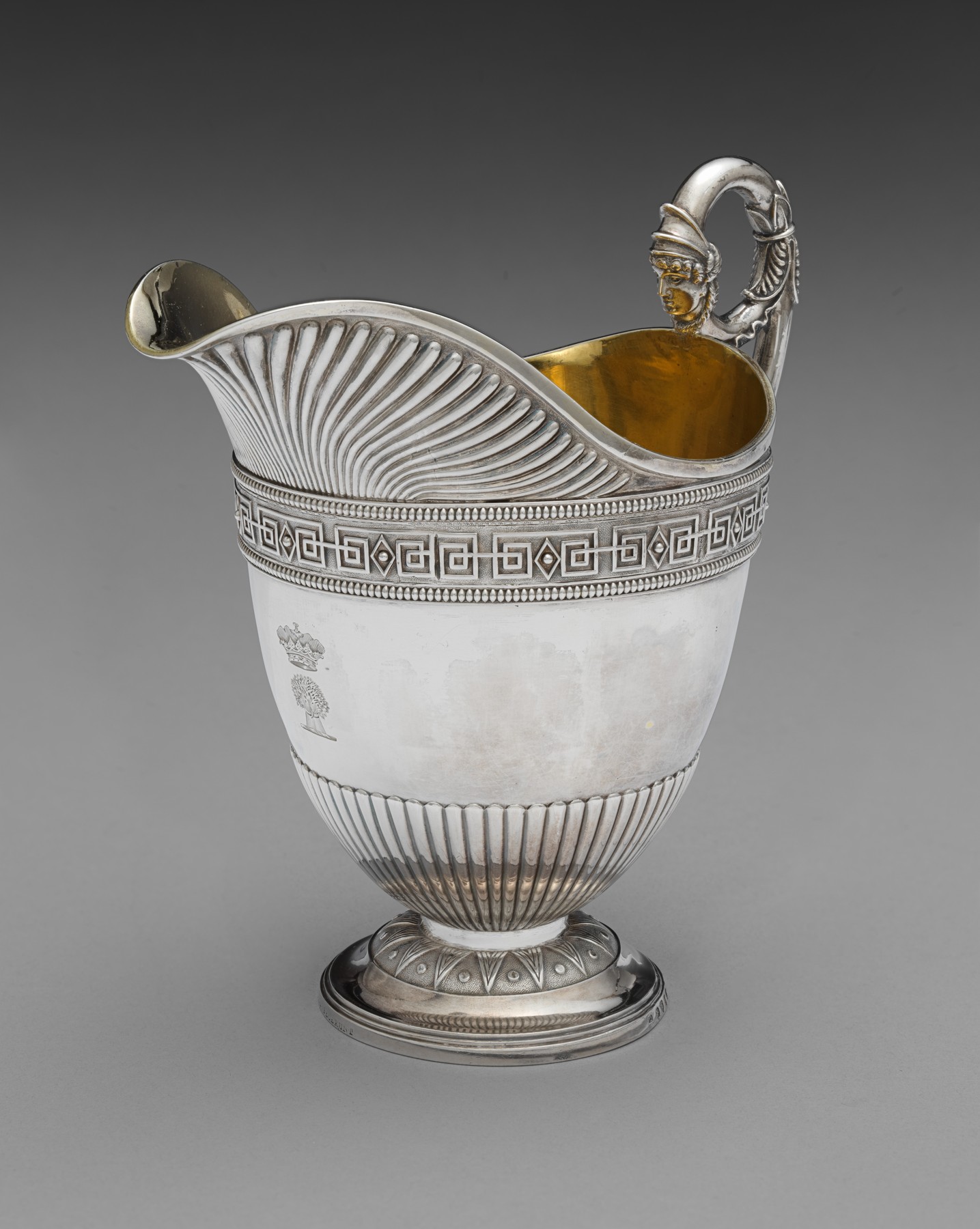
The Met’s milk jug of 1804 is a helpful case. It belongs to a silver-gilt service made by Digby Scott and Benjamin Smith II and supplied by Rundell, Bridge & Rundell. A design drawing relates to the tea urn in the service. Keep that particular connection precise rather than crediting every detail of every vessel to the designer.
Dates do not all date the same event
An assay date, an engraved presentation date, a design’s introduction and a later production date can coexist. The question is what each one records. An inscription dated long after the hallmarks may belong to a later gift, not prove that the hallmark is wrong.
The Scott and Smith service at The Met spans 1804 and 1805 hallmarks. This is direct evidence that a service can cross an assay-year boundary. It does not mean any assortment of dates is harmless; it means the difference needs an explanation supported by the object.
Factory numbers need the same discipline. A pattern or model number may recur across pieces, while order or production numbers may differ. Never turn an unfamiliar number into a year just because it has four digits. Find a reliable maker-specific reference or a catalogued comparable before assigning its role.
Three useful ways to read an object
The Revere teapot: its overlapping seam belongs to the original rolled-sheet construction. Here the lesson is to understand how the workshop built the form before treating a visible join as damage. The museum record makes a much stronger comparison than an unattributed image online.
The unmarked service: The Met attributes a tea service of about 1800 to Christian Wiltberger by stylistic evidence. Here the lesson is to preserve “attributed to.” A museum’s carefully qualified identification should not become a definite workshop signature when it is repeated in a sales description.
The modern design: Brandt’s tea infuser makes it necessary to separate the design from an individual edition. Here the lesson is to ask when this example was produced, by whom and under what authorization. A design date alone does not date the metal in your hand.
Let condition complicate the description
Handles, finials and hinges do a great deal of work and can be replaced. A replacement does not make every other part false. It does need to appear in a careful description, especially when original materials, safe handling or wildlife rules are involved.
Look for differences worth investigating: a patch near the marks, a softened or thinned area where engraving may have been removed, different decoration across the set, an altered spout or a handle that does not match a documented example. None is a conclusive diagnosis from a single photograph.
Avoid the temptation to turn a checklist into an authentication score. A genuine hallmark cannot tell the entire story of later repairs or alterations. Valuable or disputed objects deserve examination by a specialist who can compare marks, metal and construction together.
Keep exploring the silver table
Sources & further reading
Reviewed November 10, 2026. Museum records, official guidance and historical auction results answer different questions. They do not authenticate or appraise a privately owned object. Museum photographs used here are Public Domain under the Met’s CC0 Open Access terms. Images were resized proportionally without cropping or retouching. No institutional endorsement is implied.
- Canadian Conservation Institute: Care of Silver, CCI Notes 9/7
Conservation guidance, not a food-contact safety certificate for an individual vessel.
- London Assay Office: What is a hallmark?
The modern sponsor, fineness and assay-office marks, with optional date letter.
- The Met: Digby Scott and Benjamin Smith II milk jug, 1804
Accession 2023.601.5. A service with multiple makers’ roles and two assay years.
- The Met: Milk Jug (part of a service), 1804
The Metropolitan Museum of Art. Anonymous Gift, in remembrance of Eric N. Shrubsole, 2023, 2023.601.5. Public Domain. CC0. Resized proportionally; not cropped or retouched.
- The Met: Paul Revere Jr. teapot, 1796
Accession 33.120.543. Rolled sheet and an overlapping, riveted and soldered seam.
- The Met: Teapot attributed to Christian Wiltberger, ca. 1800
Unmarked service attributed on stylistic evidence. Family tradition is distinguished from firm attribution.
- The Met: Marianne Brandt tea infuser and strainer, ca. 1924
A design-history reference only. Its image is not reproduced here.