
Before the polish comes out
A tea service can arrive as a family treasure, a flea-market puzzle or a row of impressive pots in an auction photograph. The first question is often “Is it silver?” It is a good question, but only the beginning. A tray can bring together different metals, different makers and several generations of additions. The most interesting part may turn out to be the pot nobody recognized.
Start by keeping the group together. Photograph the whole arrangement, then each piece, its interior and its marks. Keep loose lids, pins, burners, old bags and family notes with it. A repaired handle or a later tray is useful evidence, not something to tidy out of the story.
There is no need to polish before doing that. Removing tarnish repeatedly removes some silver too, and a bath that suits an uncomplicated modern object may harm wood, ivory, enamel or a hollow fitting. Take the photographs first and decide on treatment once you know more.
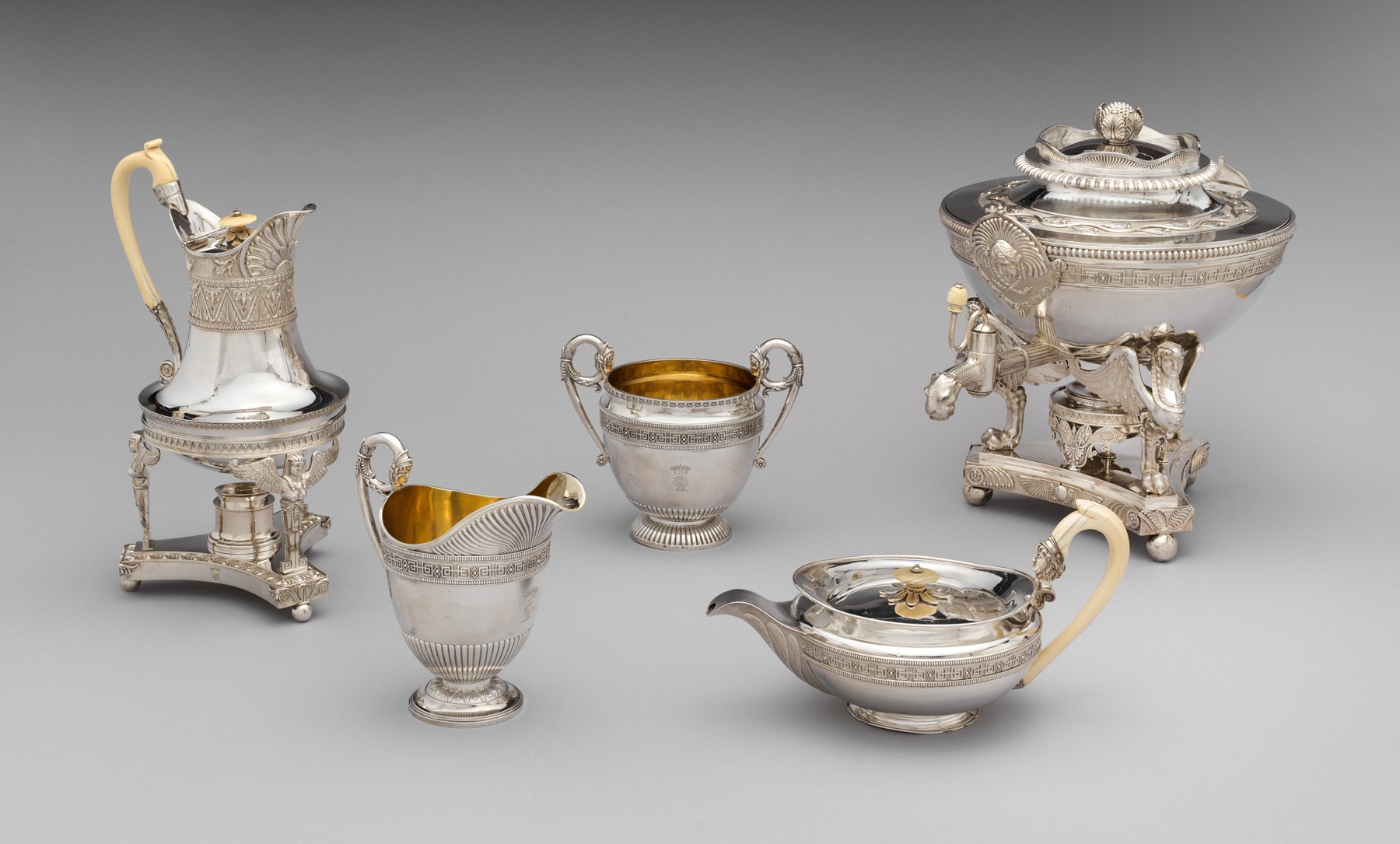
One tray, several different jobs
A small tea set commonly brings together a teapot, sugar bowl and cream jug. A tea and coffee service adds a coffee pot; a larger group may include a waste bowl, hot-water jug, kettle and stand, or an urn with a tap. Cups were often ceramic rather than silver. “Complete” depends on the particular service, not a universal number of pieces.
Look at how each vessel works. A lid with an opening for a stirring rod points toward chocolate. A tap suggests an urn. A kettle may sit over a separate burner. Broad and low often suggests tea, tall and narrow often suggests coffee, but early pots and later unusual designs can resist that shortcut.
Count the actual objects in the description, not just the headline. Does “six pieces” include the tray? Is the cover counted separately? Is the stand there but the burner missing? These small distinctions can change how you understand a group before they change its price.
A much bigger story than afternoon tea
The teapot’s history begins with Asian tea cultures and ceramic vessels, not a Victorian silver factory. European metalworkers borrowed, adapted and experimented. A small Parisian silver-and-ebony pot of 1699–1700 and an American service made a century later belong to that story, but they do not represent the same drinking habits or market.
Tea travelled through networks that also carried porcelain, metal, money and power. In Britain and the Atlantic world, its growing popularity became entangled with empire and sugar produced by enslaved people. In other settings, tea equipment served different ceremonies and tastes. Chinese domestic and export silver, Japanese metalwork and Russian enamel deserve to be read on their own terms.
Museum objects make those connections tangible. Follow a handle, a silhouette or a stamped name across the guides and a tea set starts to look less like a fixed household accessory and more like a record of changing relationships.
Silver, silver plate and a few misleading names
Sterling is a silver alloy containing 92.5% silver. Silver plate is a layer of silver over another material. Both can be beautifully designed. Their construction, care and metal value are different, so a famous brand or a bright surface cannot substitute for identifying the material.
Old Sheffield Plate was made from silver fused to copper and rolled into sheet. Electroplate uses an electrical process to deposit silver on a base-metal object. Nickel silver is itself a copper-based alloy, despite the name. Britannia metal is a tin-based alloy; Britannia silver is a high-fineness silver standard. That single extra word matters.
The handle complicates the picture in a useful way. Silver conducts heat readily, so makers used wood and other insulating materials, or inserted insulating sections into metal handles. A genuine sterling pot can therefore contain non-silver parts. The gross weight on your scale is not automatically its silver-alloy weight.
Read the service one piece at a time
A maker’s name, a retailer’s stamp, an assay mark and a factory number answer different questions. Photograph every mark in its original arrangement. A close-up that crops away the neighboring punches can make an identification harder rather than easier.
Different dates do not automatically mean a false set. A commission could span assay years; a family could extend a service; a shop could supply stock made at different times. Equally, matching decoration alone cannot prove that all the pieces began together. Compare form, material, marks and condition as a group.
An honest description can say “associated,” “later addition,” “replacement handle” or “attributed to.” These are precise descriptions of what is known, not reasons to stop enjoying the object.
An heirloom has more than one kind of value
A dealer’s asking price, an insurance replacement figure, an auction result and a scrap offer are not interchangeable. Neither are the price paid by an auction buyer and the money received by the consignor. Compare evidence with its date, currency and fees still attached.
Metal arithmetic has a place, but only after material and construction are understood. Weigh the pieces separately where practical, keep plated trays separate, and never guess the weight of hidden filler. Our worksheet works only with an identified unweighted alloy and a supported non-silver deduction. It is deliberately unwilling to turn an unknown object into an exact-looking valuation.
For an inherited service, preserve the family information before approaching buyers. Then seek advice suited to the object: a specialist in silver or decorative arts for an unusual design or old service, rather than relying on one number from a general precious-metal counter.
Before using it, selling it or sending it away
A sterling mark does not tell you whether a repaired handle will carry hot liquid or whether an old interior is suitable for food contact. Loose fittings, corrosion, exposed base metal, unknown repairs and coatings deserve an individual assessment. A display piece does not have to become a working teapot to be worth keeping.
Pale handle rings may be ivory, bone or a later replacement material. Do not identify them by color alone, and do not remove them to make a sale easier. Ivory-related sale and shipping rules can apply even when the amount is small. Establish the material and check the rules for both ends of a proposed transaction.
The best first move is usually modest: support the object from below, keep it dry and protected, and document what you have. The rest of this series helps you decide what comes next.
Keep exploring the silver table
Sources & further reading
Reviewed November 10, 2026. Museum records, official guidance and historical auction results answer different questions. They do not authenticate or appraise a privately owned object. Museum photographs used here are Public Domain under the Met’s CC0 Open Access terms. Images were resized proportionally without cropping or retouching. No institutional endorsement is implied.
- Canadian Conservation Institute: Care of Silver, CCI Notes 9/7
Conservation guidance, not a food-contact safety certificate for an individual vessel.
- The Met: The Duke of Buckingham Tea and Coffee Service, 1804/05
The Metropolitan Museum of Art. Anonymous Gift, in remembrance of Eric N. Shrubsole, 2023, 2023.601.1a–c–.5. Public Domain. CC0. Resized proportionally; not cropped or retouched.
- The Met: Coffee, Tea, and Chocolate in Early Colonial America
Beth Carver Wees, 2003. Beverage forms and the late-eighteenth-century American matched service.
- V&A: Teapot design through time
Chinese ceramic precedents, early British forms and the social history of tea.
- The Met: Jacob Boelen teapot, 1690–1700
Accession 61.246a, b. Keep the object’s documented attribution separate from broader trade history.
- The Met: Japanese tea and coffee service, ca. 1880–1910
A five-piece Meiji-period service. Image not reproduced.
- V&A: A guide to metalworking techniques
Raising, casting, chasing, engraving, fused plate and electroplating.
- London Assay Office: What is a hallmark?
The modern sponsor, fineness and assay-office marks, with optional date letter.
- The Met: Digby Scott and Benjamin Smith II milk jug, 1804
Accession 2023.601.5. A service with multiple makers’ roles and two assay years.
- GOV.UK: Dealing in items containing ivory or made of ivory
Official guidance checked November 10, 2026. Eligibility, registration and cross-border requirements need individual review.
- U.S. Fish and Wildlife Service: African elephant ivory FAQs
Federal guidance; state rules and import/export requirements may also apply.