
Start with the whole arrangement
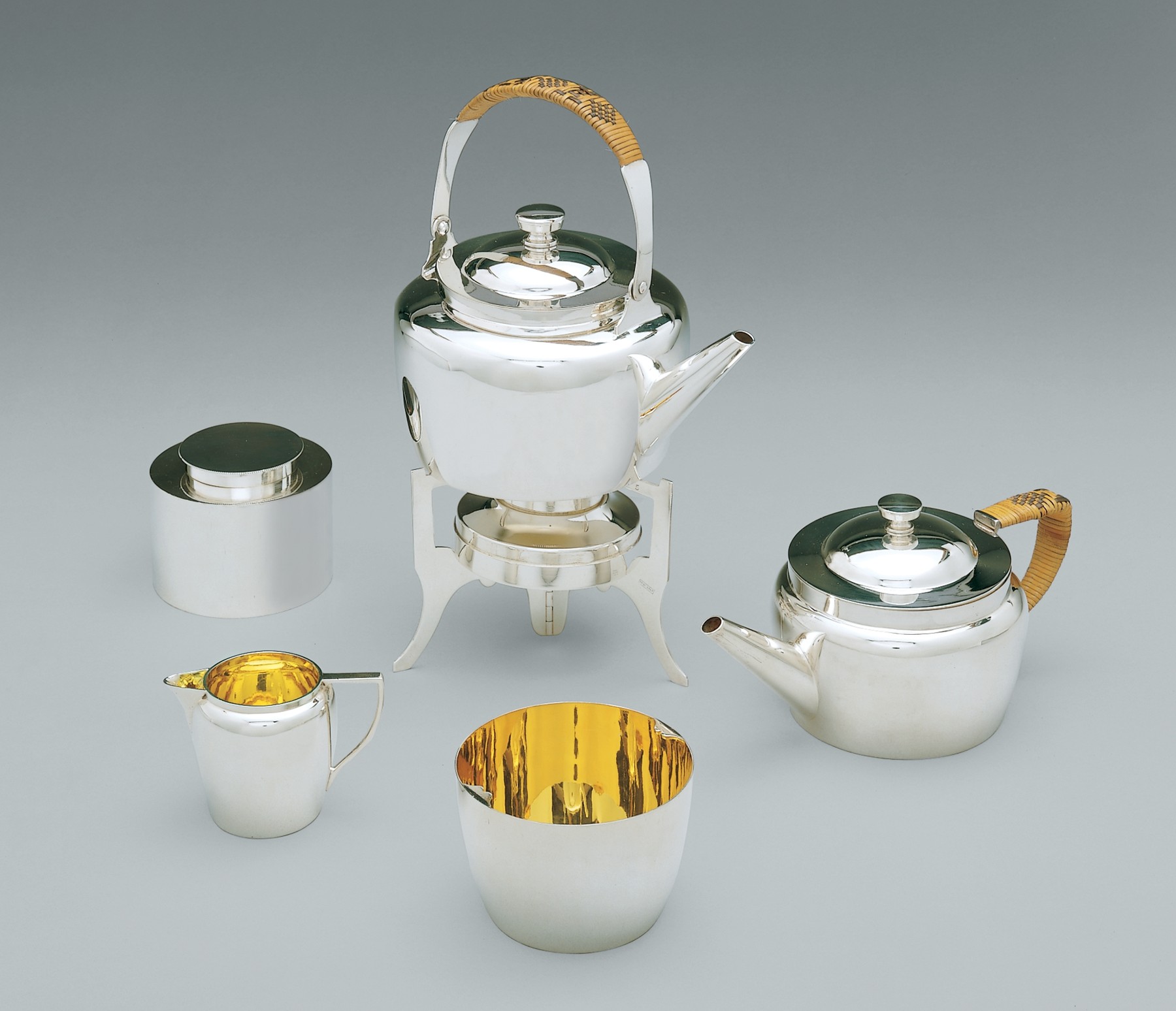
Before assigning names to the pieces, put the service in a safe arrangement and look at it as a group. Which forms repeat? Which pieces have covers? Which are meant to pour, and which are meant to receive? Photograph the answer before rearranging it into a more photogenic “complete set.”
Tea equipment has never had one fixed inventory. The Met’s study of early American beverage silver places the appearance of matching services in the 1790s. Earlier households could bring together separate vessels and ceramic cups. Later factories offered coordinated patterns, but owners could still add a coffee pot, replace a broken piece or choose a tray from another source.
A three-piece set can be exactly what was bought. A magnificent seven-piece group can have a complicated history. Completeness is a claim that needs a reference: a period catalogue, an original bill, a documented comparable service or a detailed description of the surviving components.
Tea, coffee and chocolate
The low teapot and tall coffee pot are useful starting points, especially when you can compare two vessels in the same pattern. They are not universal identification rules. The V&A’s early British silver teapot of 1670–71 looks remarkably like a contemporary coffee pot; its presentation inscription is vital evidence of its intended purpose.
A chocolate pot offers a particularly satisfying mechanical clue. Its cover may have a hinged or removable finial that opens a passage for a stirring rod. Chocolate needed stirring before it was poured. Edward Winslow’s Boston example of 1700–1710 makes that relationship between drink and design clear.
A third covered vessel could be a hot-water pot or a hot-milk jug. Avoid naming it solely because it sits between the other two in height. Compare its lip, spout, cover and handle with a documented example from the same maker or pattern. Keep the description provisional when the evidence is incomplete.
The kettle and the urn
A kettle on a stand brings the heat source to the table. Some examples have a removable burner beneath the vessel and pins that secure the kettle to its stand. Missing pins or a missing burner are worth recording even if the kettle is destined only for display. Do not test an old burner to find out whether the arrangement works.
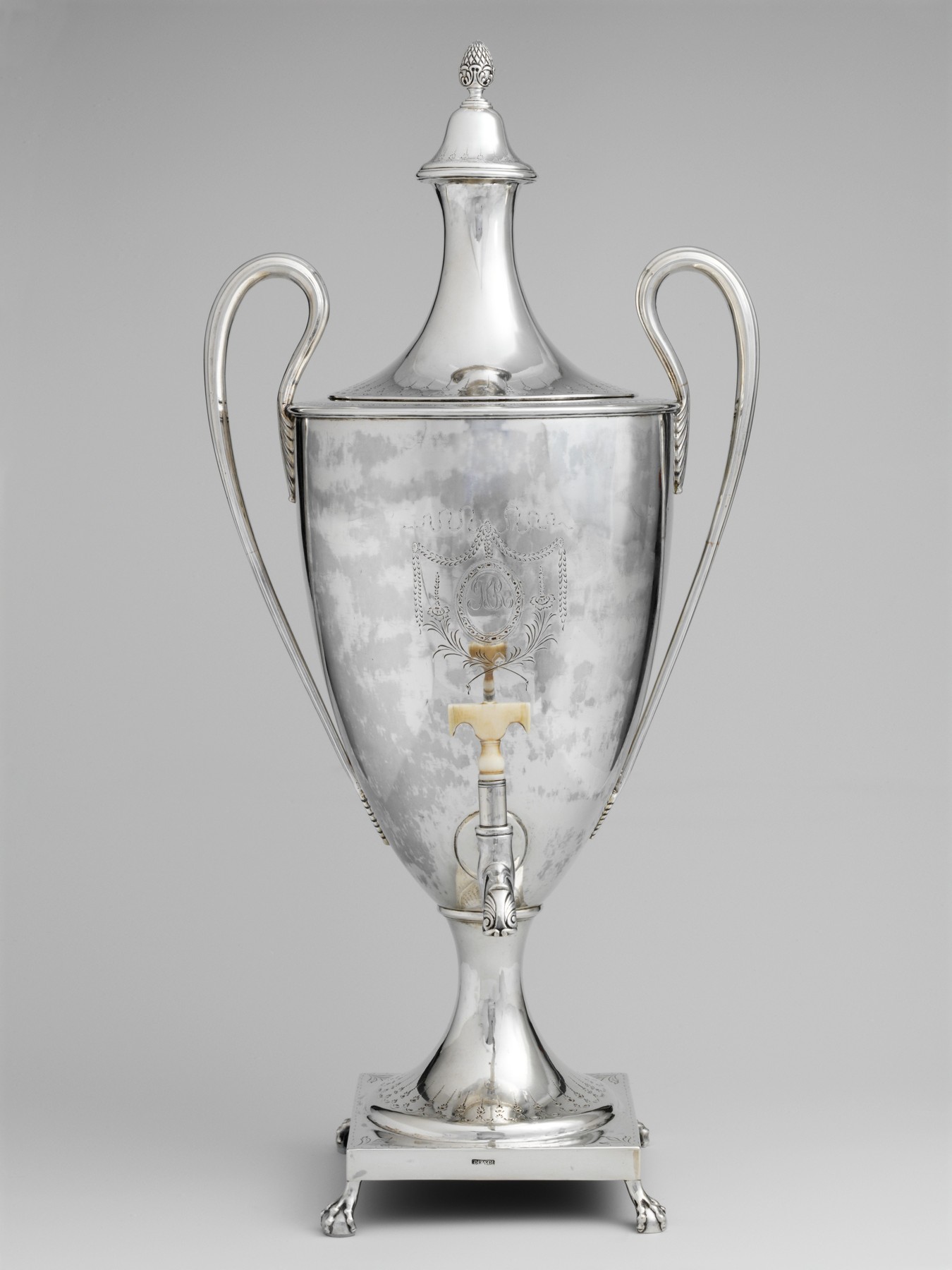
An urn solves the serving problem differently: it remains upright while water is drawn through a tap. Paul Revere Jr.’s 1791 tea urn for Hannah Rowe is a striking American example. Its height, handles and tap tell a different story from the compact pouring pot beside a guest’s cup.
In an auction photograph, inspect everything under the vessel as carefully as the vessel itself. Ask whether stand, burner, lid and fittings are included and whether they belong together. A handsome stand that happens to fit is not documentary proof of an original pairing.
The smaller pieces do the explaining
A creamer is a small pouring vessel. A sugar bowl may be open or covered and may have handles. An open bowl may instead be a waste or slop bowl, used to receive the remains of tea. Shape alone can leave room for doubt, particularly after a cover has been lost.
Look for a seating rim or other evidence that a lid was intended. Compare proportions and ornament with the other pieces. Do not assume that a round bowl is missing its cover just because the sugar bowl in a different service has one.
Caddies store dry tea. Caddy spoons, sugar tongs and strainers have their own jobs. A salver or a large tray supports the arrangement, but may be a separately acquired object. A silver-colored tray under sterling pots deserves its own material check. Never transfer a pot’s hallmark identification to the tray beneath it.
Original, extended or associated
An original commission can span more than one year. An extended service can consist of genuine matching pieces acquired over time. An associated service brings together objects that work visually or functionally but were not necessarily made as one set. These distinctions describe different histories, not a simple ranking from good to bad.
The milk jug in The Met’s Greco-Egyptian service belongs to a group hallmarked across 1804 and 1805. That is a useful warning against rejecting every difference in date. On the other hand, unrelated maker marks, inconsistent construction and a much later tray are reasons to investigate further rather than describe a group as uniformly original.
Write down what you can show. “Five vessels in a matching pattern, with an electroplated tray” tells another collector more than “complete antique sterling set.” If the relationship is uncertain, keep the pieces together while you research it.
Keep exploring the silver table
Sources & further reading
Reviewed November 10, 2026. Museum records, official guidance and historical auction results answer different questions. They do not authenticate or appraise a privately owned object. Museum photographs used here are Public Domain under the Met’s CC0 Open Access terms. Images were resized proportionally without cropping or retouching. No institutional endorsement is implied.
- The Met: Coffee, Tea, and Chocolate in Early Colonial America
Beth Carver Wees, 2003. Beverage forms and the late-eighteenth-century American matched service.
- The Met: Traveling tea set, ca. 1879
The Metropolitan Museum of Art. Anonymous Gift, in memory of Walter E. Stait, 2000, 2000.594.1a, b–.8. Public Domain. CC0. Resized proportionally; not cropped or retouched.
- V&A: Teapot design through time
Chinese ceramic precedents, early British forms and the social history of tea.
- The Met: Paul Revere Jr. tea urn, 1791
Accession 1990.226a–d; made for Hannah Rowe.
- The Met: Tea Urn, 1791
The Metropolitan Museum of Art. Purchase, The Annenberg Foundation Gift, Annette de la Renta, Mr. and Mrs. Robert G. Goelet, Drue Heinz, and Henry R. Kravis Foundation Inc. Gifts, Friends of the American Wing Fund, Margaret Dewar Stearns Bequest, Mr. and Mrs. Anthony L. Geller and Herbert and Jeanine Coyne Foundation Gifts, Max H. Gluck Foundation Inc. Gift, in honor of Virginia and Leonard Marx, and Rogers, Louis V. Bell and Dodge Funds; and Gift of Elizabeth K. Rodiger, 1990, 1990.226a–d. Public Domain. CC0. Resized proportionally; not cropped or retouched.
- The Met: Digby Scott and Benjamin Smith II milk jug, 1804
Accession 2023.601.5. A service with multiple makers’ roles and two assay years.