
Begin with the body, then the fittings
A tea vessel can bring several metalworking processes together. Raising shapes sheet through hammering. Casting produces forms in a mould. Sheet can also be shaped and joined, while later industrial techniques allow repeated forms. A body, spout, hinge, handle and feet do not have to share the same manufacturing method.
The distinction is useful because surface appearance can hide construction. A highly polished pot may reveal its seam more clearly inside than outside. A decorated surface may combine hand work with repeated components. “Handmade” and “machine-made” are often too blunt to describe the whole object.
Observe without scraping, bending or probing. Good photographs of the inside, foot, hinge and handle joins give a specialist more to work with than a destructive test on an inconspicuous corner.
A seam can be part of the achievement
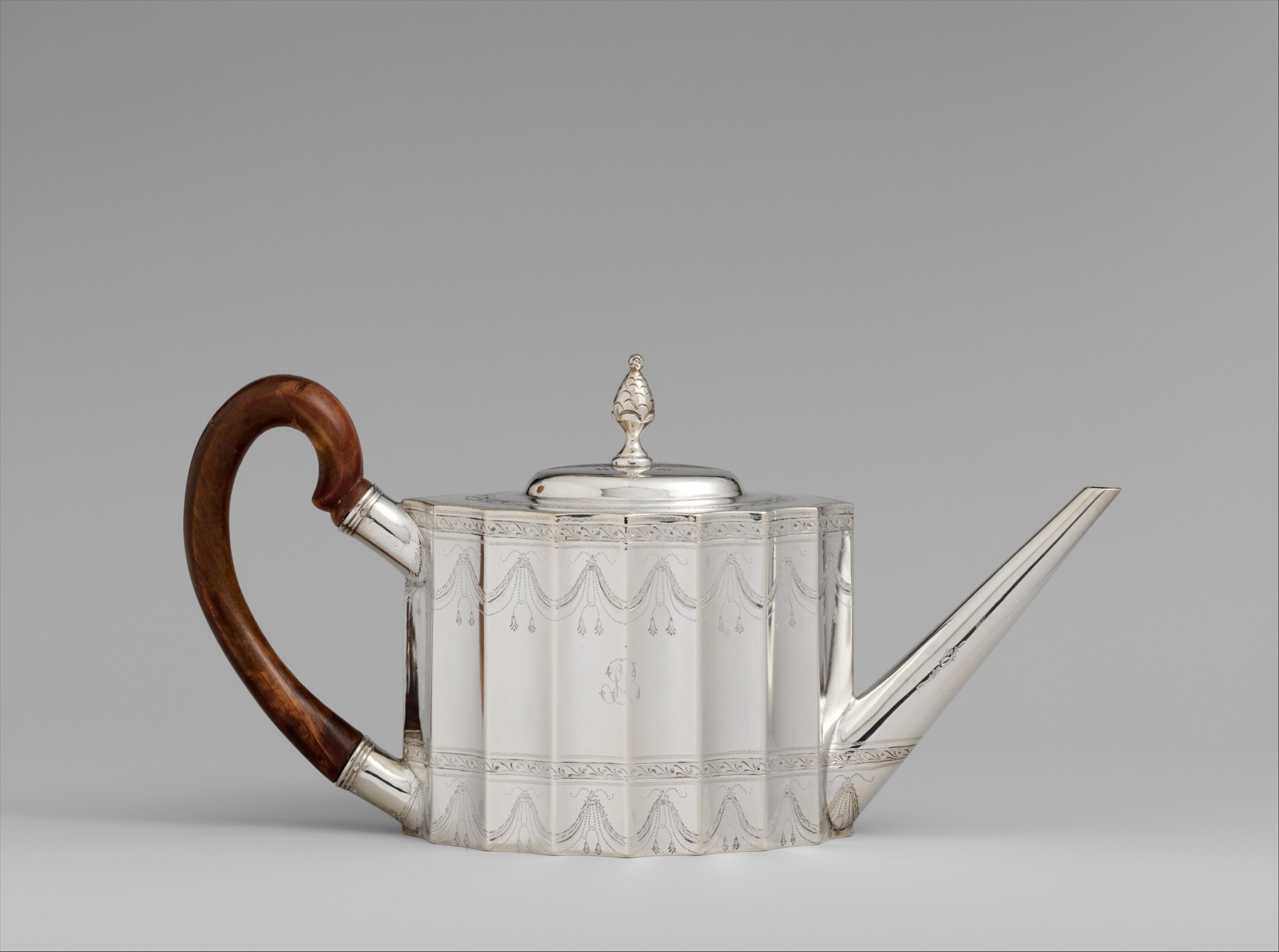
Paul Revere Jr.’s 1796 teapot shows why a seam is not automatically a repair. The Met describes an overlapping vertical join beneath the handle, secured with rivets and solder, in a body made from rolled sheet. Revere had purchased a flatting mill in 1785.
That construction belongs to the object’s original making. It helps explain how workshops could approach shapes, labor and repeatable production differently. A seam noticed during inspection needs interpretation, not an immediate verdict that the pot is damaged or fake.
A repair may have a different texture, color or relationship to the form, but photographs cannot establish every join’s history. Record what you see and let a qualified examiner distinguish manufacture from later intervention where it matters.
Four material distinctions worth learning
Sterling silver contains 925 parts silver per thousand. Other silver alloys exist, so a genuine solid-silver object does not have to carry a 925 stamp. A bare number, however, is not self-authenticating and may serve another purpose on the object. Read it in the appropriate mark system.
Old Sheffield Plate and electroplate reach a silver surface by different routes. The former joins silver to copper before the layered material is worked; electroplating deposits silver onto an object electrically. Neither can be valued by treating the whole vessel as sterling alloy.
Nickel silver is a base-metal alloy, not a lower purity of precious silver. Britannia metal is also a base metal. Do not confuse it with Britannia silver, whose name refers to a silver standard. “Silver soldered” is not a declaration that the entire object is solid silver.
Plate is not a failed version of sterling. It has its own manufacturing history and can carry serious design interest. The right description respects the object while keeping its composition clear.
| Description | What it tells you | What it does not tell you |
|---|---|---|
| Sterling / 925 | A claimed silver-alloy standard | Whether the mark is genuine or all components share it |
| Old Sheffield Plate | Silver fused to a copper substrate | That the whole weight is silver |
| EPNS | Electroplated nickel silver | A sterling fineness |
| Britannia metal | A tin-based base-metal material | Britannia-standard silver |
| Weighted / filled | Non-silver material contributes to the weight | The weight of the remaining silver shell |
Decoration moves metal or removes it
Repoussé or embossing creates raised work from the reverse; chasing refines a surface with tools from the front. Engraving cuts material away. These can coexist on the same pot, so a single decorative label may not describe everything you see.
Look at the relationship between the relief and the surrounding surface. Does the ornament continue around the vessel? Are the recesses intentionally dark? Has a monogram been polished away, leaving a thinned or uneven reserve? These are questions to take to an examiner, not invitations to scrape a test patch.
Cleaning can change the evidence. Brightening every recess may flatten the contrast a maker intended, while repeated polishing can soften an engraved line or a hallmark. A well-preserved surface is not necessarily the brightest one.
When the teapot becomes a design statement
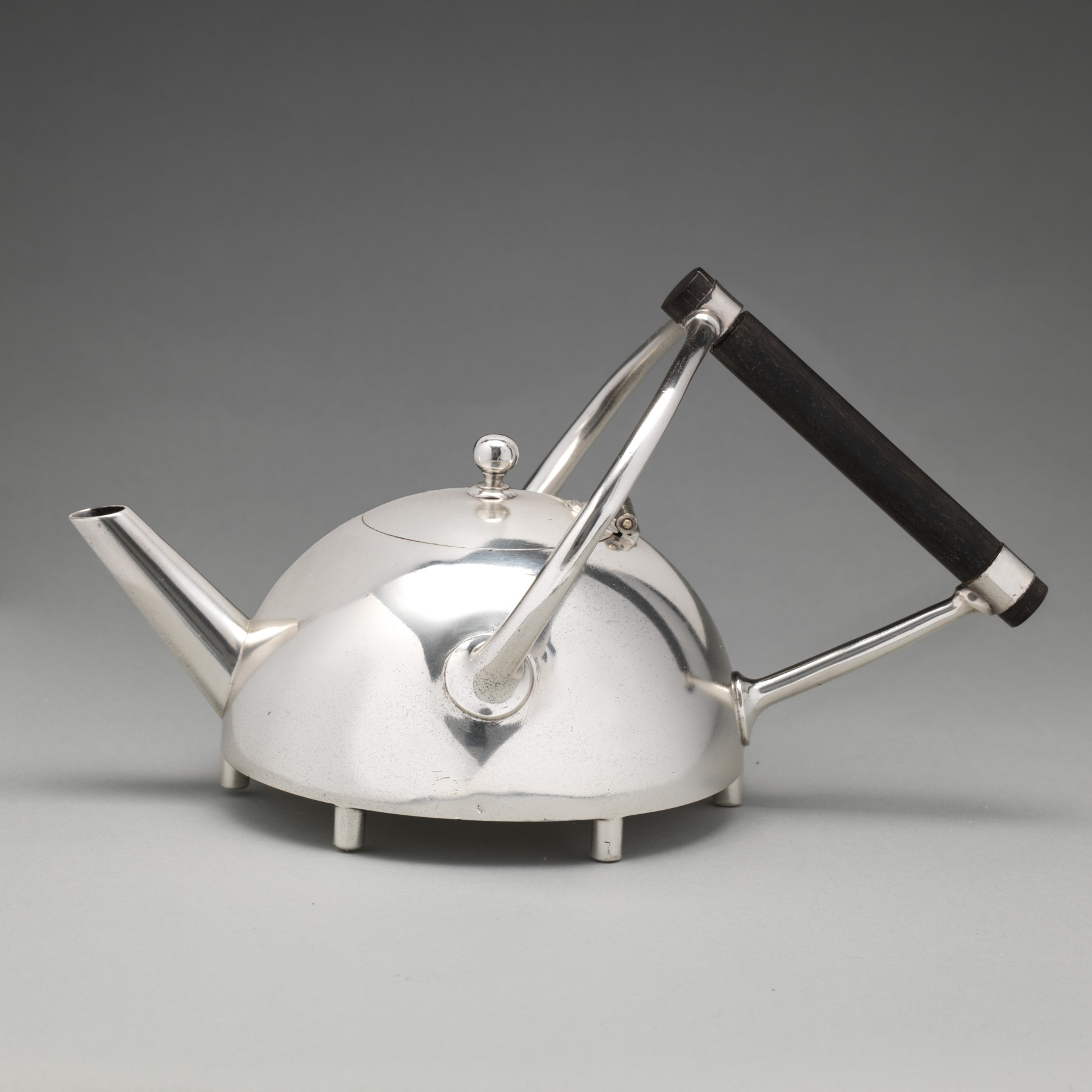
Christopher Dresser’s geometric teapots show how far design can move from the familiar rounded pot. The ca. 1879 example in The Met brings a sharply defined metal body together with an insulating handle. The plate is part of the object’s material identity, not a reason to overlook its design.
Marianne Brandt’s tea infuser and strainer of about 1924 takes a different route: silver and ebony organized into a small, carefully balanced composition. Treat the date of the design and the date of a particular manufactured example as separate questions. Later authorized editions are not automatically objects made at the Bauhaus.
Across these designs, heat remains a practical concern. Silver’s conductivity makes the handle and its insulating materials important. It does not establish that silver tea equipment improves health, sterilizes a drink or guarantees better flavor. Those claims require different evidence from a museum design history.
Keep exploring the silver table
Sources & further reading
Reviewed November 10, 2026. Museum records, official guidance and historical auction results answer different questions. They do not authenticate or appraise a privately owned object. Museum photographs used here are Public Domain under the Met’s CC0 Open Access terms. Images were resized proportionally without cropping or retouching. No institutional endorsement is implied.
- V&A: A guide to metalworking techniques
Raising, casting, chasing, engraving, fused plate and electroplating.
- The Met: Paul Revere Jr. teapot, 1796
Accession 33.120.543. Rolled sheet and an overlapping, riveted and soldered seam.
- The Met: Teapot, 1796
The Metropolitan Museum of Art. Bequest of Alphonso T. Clearwater, 1933, 33.120.543. Public Domain. CC0. Resized proportionally; not cropped or retouched.
- London Assay Office: What is a hallmark?
The modern sponsor, fineness and assay-office marks, with optional date letter.
- Canadian Conservation Institute: Care of Silver, CCI Notes 9/7
Conservation guidance, not a food-contact safety certificate for an individual vessel.
- The Met: Marianne Brandt tea infuser and strainer, ca. 1924
A design-history reference only. Its image is not reproduced here.
- The Met: Christopher Dresser teapot, ca. 1879
Manufactured by James Dixon & Sons. Silverplate and ebony, accession 2021.153.2.
- The Met: Teapot, ca. 1879
The Metropolitan Museum of Art. Gift of Lawrence A. and Janet Y. Larose, 2021, 2021.153.2. Public Domain. CC0. Resized proportionally; not cropped or retouched.