
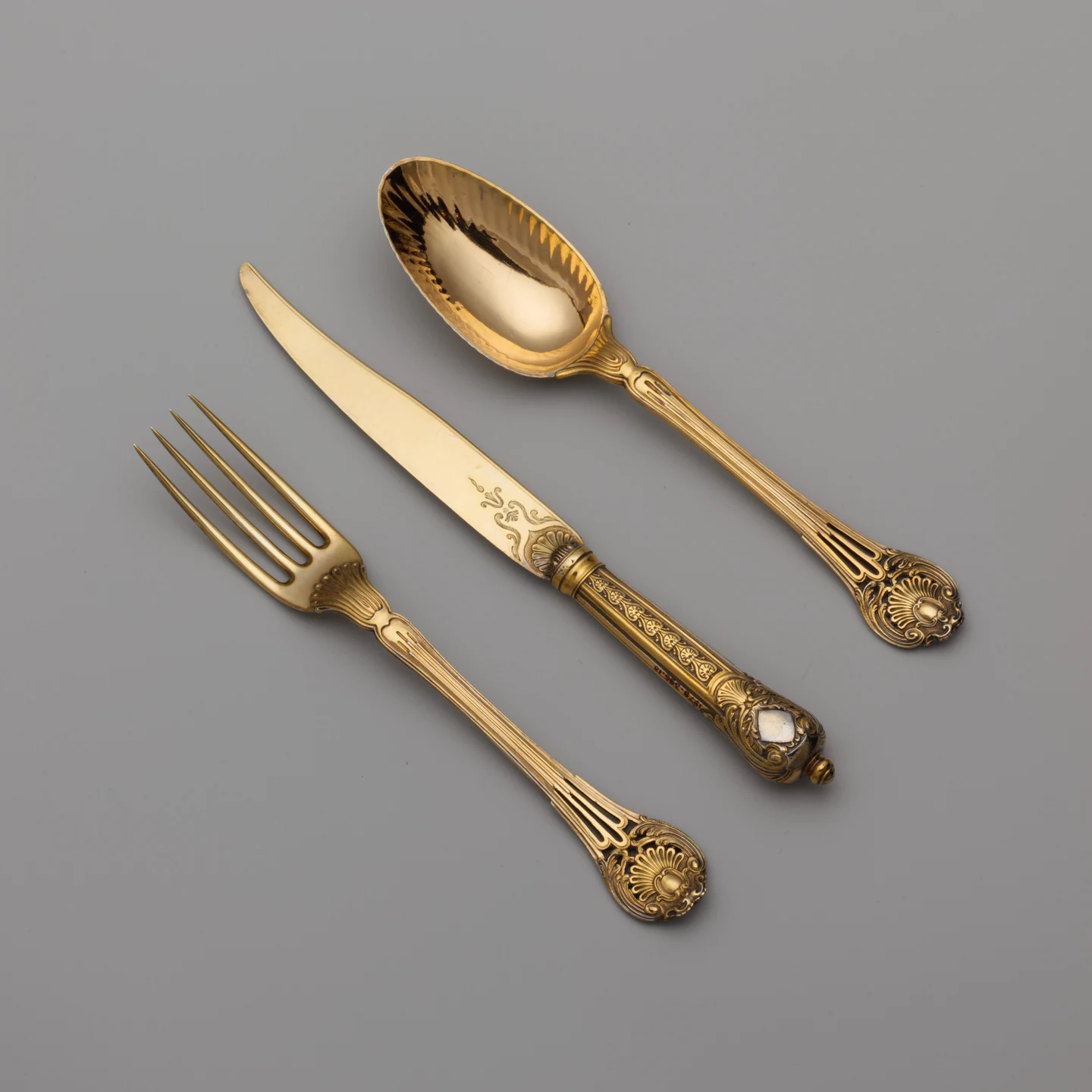
Turn it over before naming it
At first, the decoration does all the talking. A shell at the tip, a row of beads or a crowded tangle of flowers seems to offer an immediate answer. Then you turn the fork over and find a different clue: a maker’s stamp, a patent inscription, or a reverse that does not match the example you found.
Begin with a record, not a guess. Photograph both faces and the whole outline in even light. Add a close view of every mark, including faint or partly worn ones. Keep uncertain letters uncertain; a question mark is more useful than a confident mistranscription.
Five checks for a useful comparison
- Describe the form. Is it a spoon, fork, knife or server? Record the bowl, blade or tines as well as the handle.
- Measure it. Note overall length and the working end’s dimensions. Dinner, place, luncheon and dessert names vary between makers and periods.
- Read all the marks. Transcribe letters, numbers and symbols separately. A registration or patent date concerns a design; it need not be the manufacture date of your example.
- Compare front and reverse. Check the terminal, borders, neck, heel and any decoration on the back. A similar front is not enough.
- Find a named reference. Prefer a maker’s catalogue, archive or clearly identified museum example. Save the exact source and note where your piece differs.
The Sheffield Archives company-records guide is useful for locating catalogues and trade records. It is a research map, not a catalogue of every pattern. For British marks, begin with the hallmark reference rather than treating a lone number as a complete hallmark.
A useful search moves from the broad feature to the specific object: a shell-shaped terminal, then the maker or retailer suggested by the marks, then the form and length. When an archive lists a catalogue or pattern book, save its date and reference number. A listing tells you where to look next; it does not mean you have already compared the illustrated pattern.
The four names that can belong to one object
A name on a piece is a starting point. Work out which role it describes before using it to name the pattern.
- Maker
- The workshop or manufacturer responsible for production.
- Designer
- The person or studio responsible for the design.
- Retailer
- The business that sold it.
- Owner
- The person whose initials, crest or presentation inscription may have been added.
Gorham’s 1901 ewer and plateau make the maker–retailer distinction concrete. The Met records Gorham as manufacturer and Spaulding and Company as retailer. As the London Assay Office explains, on British hallmarked silver, the sponsor’s mark identifies the registered party submitting the work for hallmarking; do not automatically assume that person made it at the bench.
A trade name also cannot establish every component’s metal. Read handle and blade markings separately on knives, and keep material identification distinct from pattern identification.
A handle can tell a story without naming a pattern
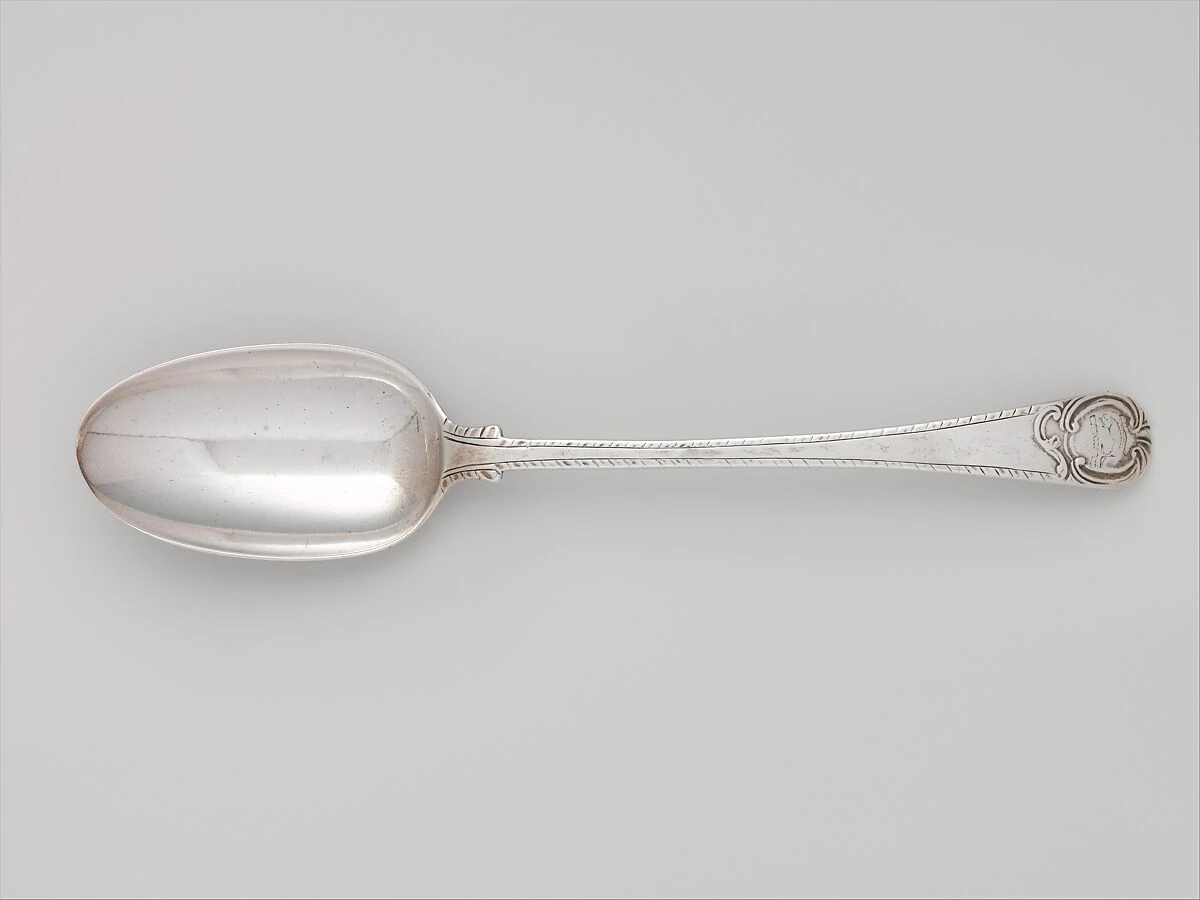
The Met’s Revere tablespoon of 1770–80 has a turned-back handle, feather edging and an engraved dolphin crest associated with the Sargent family. Its catalogue explains how a change in handle fashion accompanied the movement of engraving from the reverse to the front. The shape affected how the spoon was laid on the table and which side the owner’s crest displayed.
Look first at the feathered edges, then at the decorated space at the tip, called a cartouche. Those are useful observations even before you have a name for the pattern. Decoration, ownership and manufacture are different clues.
What the back adds to the story
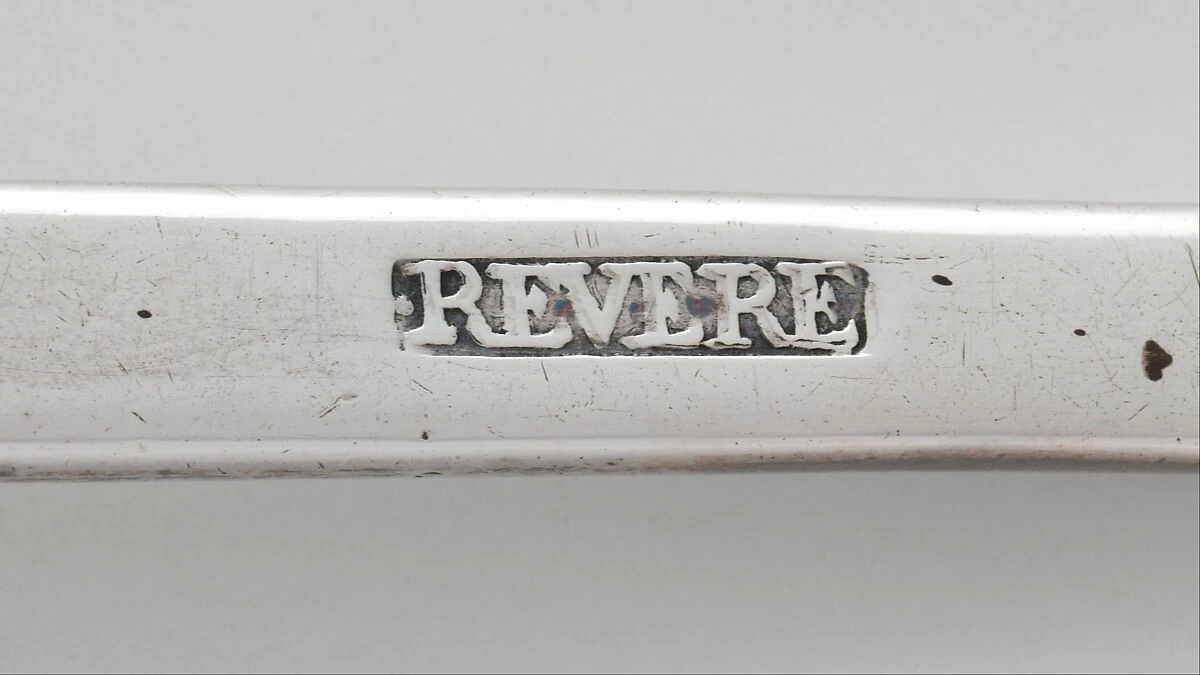
The museum’s detail photograph of the same spoon shows the stamped name REVERE. Keep this view with the full-object photographs and the museum’s object number, 38.98. A close-up makes the letters readable; the wider views establish which object you are examining.
This is a documented example, not a shortcut for dating every spoon with a similar silhouette or stamp. Long-lived designs, replacements and later alterations make exact attribution more demanding. Compare a group piece by piece before calling it an original matched set.
Match the piece you need
When looking for a replacement, keep one clear reference record: confirmed maker, pattern name or working hypothesis, form, exact length, front and back photographs, and the marks. Compare the replacement with that record before buying. A large photograph can conceal a small but noticeable size difference. Put the dimensions beside the photographs rather than judging size from two differently scaled images.
Keep monograms and wear in the description. Removing initials sacrifices metal and may remove historical evidence. A deliberately mixed table can be a pleasure; simply distinguish a collection assembled over time from a service known to have begun together.
If the comparison is close but incomplete, record the limit plainly: pattern resembles the catalogue example; reverse decoration not yet compared. That is a useful research note. It keeps the next step visible and stops a tentative name becoming a fact when the piece changes hands.
Sources & further reading
Reviewed 11 November 2026. Museum records support the named objects and their photographs. Sheffield’s guide identifies archive holdings; the London Assay Office explains hallmark roles. These references support comparison, not the authentication of a privately owned piece.
- Sheffield Archives: cutlery and silverware glossary and company records
- The Met: Paul Revere Jr., spoon, 1770–80
- The Met: Gorham, ewer and plateau, 1901; retailed by Spaulding and Company
- British Hallmarking Council: hallmarking and consumer protection
- Federal Trade Commission: silver-content descriptions, 16 CFR 23.5
- Goldsmiths’ Company Assay Office: the sponsor’s mark and the parts of a UK hallmark