
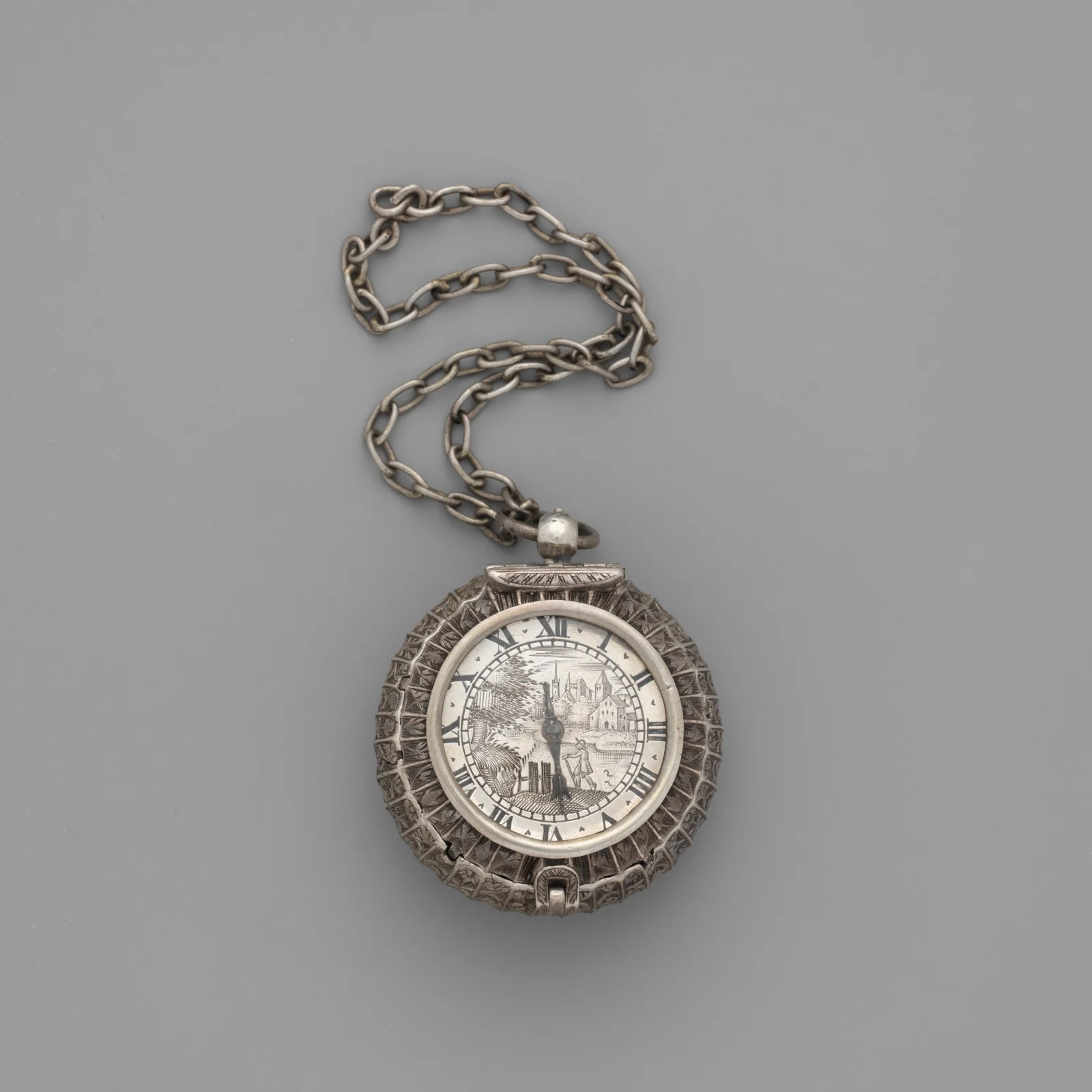
Beyond the watch itself
A watch chain is jewelry with a job. Its links connect the timepiece to clothing, but the part left visible can be just as personal as the watch. Length, link shape, a hanging seal or an engraved award can change the character of the whole arrangement.
The accessories also offer a different way into collecting. Someone drawn to chain construction may care less about a movement’s technical details than about the way a series of links bends and catches the light. Someone researching family history may find the most useful clue on a small engraved attachment rather than on the dial.
Start by laying out the association on paper: watch, chain, fastenings, key and any pendant. Describe each piece before describing the group. Items kept together may have a long shared history, but they can also have been brought together by a later owner or dealer.
Name the parts
- Chain
- The linked connection. Record its length, link form, wear and marks separately from the watch.
- T-bar
- A bar used to secure a chain through a buttonhole. Its marks and date need not match the rest of the arrangement.
- Fob
- A word used in several ways, including a hanging ornament or attachment. Say what the actual object is: seal, medal, charm or another form.
- Key
- A tool for an appropriate key-operated watch. Shape alone does not establish that it belongs to, or safely fits, a particular movement.
- Bow
- The loop at the watch’s pendant to which the chain attaches. Check it as part of the watch, not simply as another chain link.
Trade names such as “Albert” are useful search terms, but they are not a substitute for that physical description. Two listings using the same name can contain very different lengths, fastenings and combinations of parts.
A silver watch need not have a silver chain
Royal Museums Greenwich records a watch of about 1650 in a silver case with a cut-steel chain, two steel seal fobs and a key. It is a particularly good corrective to the assumption that every bright metal component in a group must be silver.
Inspect each attachment in its own right. A hallmark on a T-bar is evidence about that marked component; it does not alone establish the composition of every link or hanging ornament. A replacement clasp or a later-added pendant can be part of an object’s genuine history without being original to it.
That distinction matters when a chain is sold by weight. A complete group may include a watch, glass, enamel, stones or other materials. Even an apparently simple chain needs a clear description before its gross weight is treated as silver weight. The silver chains guide follows link forms and construction in more detail.
The small attachment with the big story
An inscription changes the questions worth asking. Instead of beginning with “What is it worth?”, begin with “Who was this for?” Transcribe initials, dates, club names and presentation wording exactly, including the reverse. Then keep the transcription alongside photographs rather than replacing the inscription with an expanded name that has not been proved.
A medal or coin attached to a chain can cross several collecting interests. Its interest as an accessory does not erase its identity as a medal or coin, and a later mount is part of its condition. Record whether the piece is drilled, soldered, enclosed in a bezel or attached in another way. Those distinctions can matter to a future owner even when the finished arrangement looks similar.
This is where silver jewelry and Pocket Silver meet. A chain can lead toward a necklace; a hanging case can lead toward the history of small carried objects. Keep those connections without assuming that everything with a loop was originally made to accompany a watch.
Wear, safety and reuse
Look closely where metal moves against metal: inside links, at connecting rings, beside the clasp and at the watch bow. A chain can look substantial while one small attachment is worn. A visually attractive pairing is not necessarily secure enough to carry a valuable watch.
If you want to wear an old chain as jewelry, ask a jeweler to assess its condition and the proposed fastening. Prefer a reversible arrangement when possible, especially if a historically associated group survives intact. Keep removed parts rather than discarding them.
Photograph the complete arrangement before changing it. Then photograph each component and its marks. That simple record preserves the relationship between objects even if they are later displayed, worn or stored separately.