
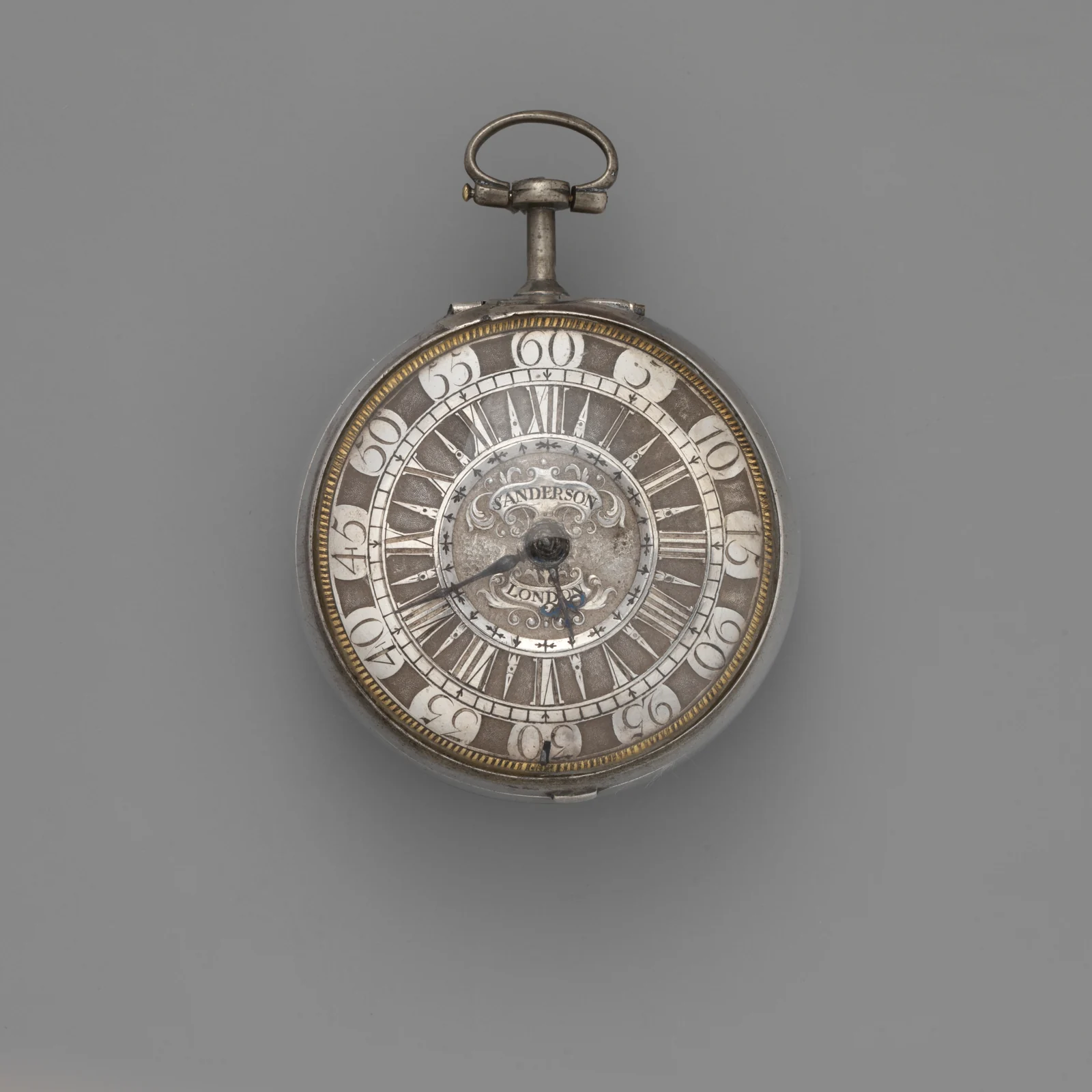
A small world in the hand
A watch asks to be looked at twice. First there is the face: hands, numerals and the small drama of time passing. Turn it over and another kind of work appears. A silver case might carry a chased scene, a monogram worn almost smooth, or a pattern that only becomes clear when the light moves across it. The mechanism tells time; the outside tells something about the person who wanted to carry it.
That meeting of mechanical and decorative art makes timepieces an especially rewarding part of collecting silver. A plain case can be just as revealing as an ornate one. Its curves were made to fit a hand and a pocket. Its hinges had a job to do. A chain kept the watch attached to clothing, while a key or seal could turn an everyday arrangement into a small collection of its own.
Start with the object, not just the metal. A silver watch is normally an assembly of different materials and different kinds of workmanship. Its value and interest lie in that relationship, not in treating the entire object as an amount of silver.
Explore the collection
Where the silver actually is
“Silver watch” is a useful starting description, but it leaves an important question open: which part? The case, dial, hands, chain and movement need their own descriptions. A silver case can surround brass and steel clockwork; a silver-colored dial may instead be silvered brass. A gold-colored case may be silver gilt, meaning silver beneath a gilded surface. None of those distinctions is a contradiction.
Edward East’s watch and key of about 1640 is a particularly clear example. The Met records silver, gilded brass and blued steel together. Looking at such a watch as a mixed-material object helps explain why a silver-cleaning routine cannot simply be applied to the whole thing.
The same care with language matters for clocks. Silver-mounted can describe silver ornament or a silver front on a supporting structure. It does not mean that the supporting structure, movement or base is silver. For marks and fineness, continue to Silver markings; for composite construction, see weighted and mixed-material silver.
One object, many hands
A watchmaker’s name is not automatically the name of the person who formed its silver case. A designer, case maker, enameler, movement maker and retailer may all belong in the story. The Met’s pair-case watch of about 1715–19 separates Daniel Delander, the watchmaker, from William Jaques, the case maker. That distinction gives both crafts their due.
It also changes how an object should be recorded. Copy the signature on the dial or movement separately from the punches on the case. Keep an engraved presentation inscription separate again. A gift date tells us when something was presented; it need not be the date every component was made.
Where an attribution is uncertain, keep the uncertainty. A clear photograph and a faithful transcription are more useful than a confident name borrowed from a superficially similar watch online.
Look before you wind
There is a strong temptation to see whether an old watch still ticks. Resist making that the first test. An unfamiliar opening system, an ill-fitting key or a stiff mechanism is a reason to stop and ask a specialist, not to use a little more force.
Begin with photographs of the closed object, its dial, visible marks and any associated chain, key or box. Record what is present and what is missing. A watch that is not running may still be an important historical object; a watch that runs briefly has not thereby proved that it is ready for regular use.
For an inherited piece, keep the family notes as well as the object. A modest watch with a documented working life can tell a richer story than a more elaborate watch whose history has disappeared. The Collector’s Object Record is a useful place to bring those details together.