
Look inside first.
A silver box small enough to disappear in a palm can hold a surprisingly large history. It might once have offered a pinch of tobacco, protected a visiting card or kept a sponge scented with aromatic vinegar. The decoration catches the eye; the interior usually gives the better clue to what the object did.
Pocket silver is a useful collecting umbrella rather than a single historical category. It brings together portable boxes and personal accessories, including objects carried in the hand or suspended from a chain. Many surviving examples belong to the eighteenth and nineteenth centuries, but the forms overlap in date and continue beyond those boundaries.
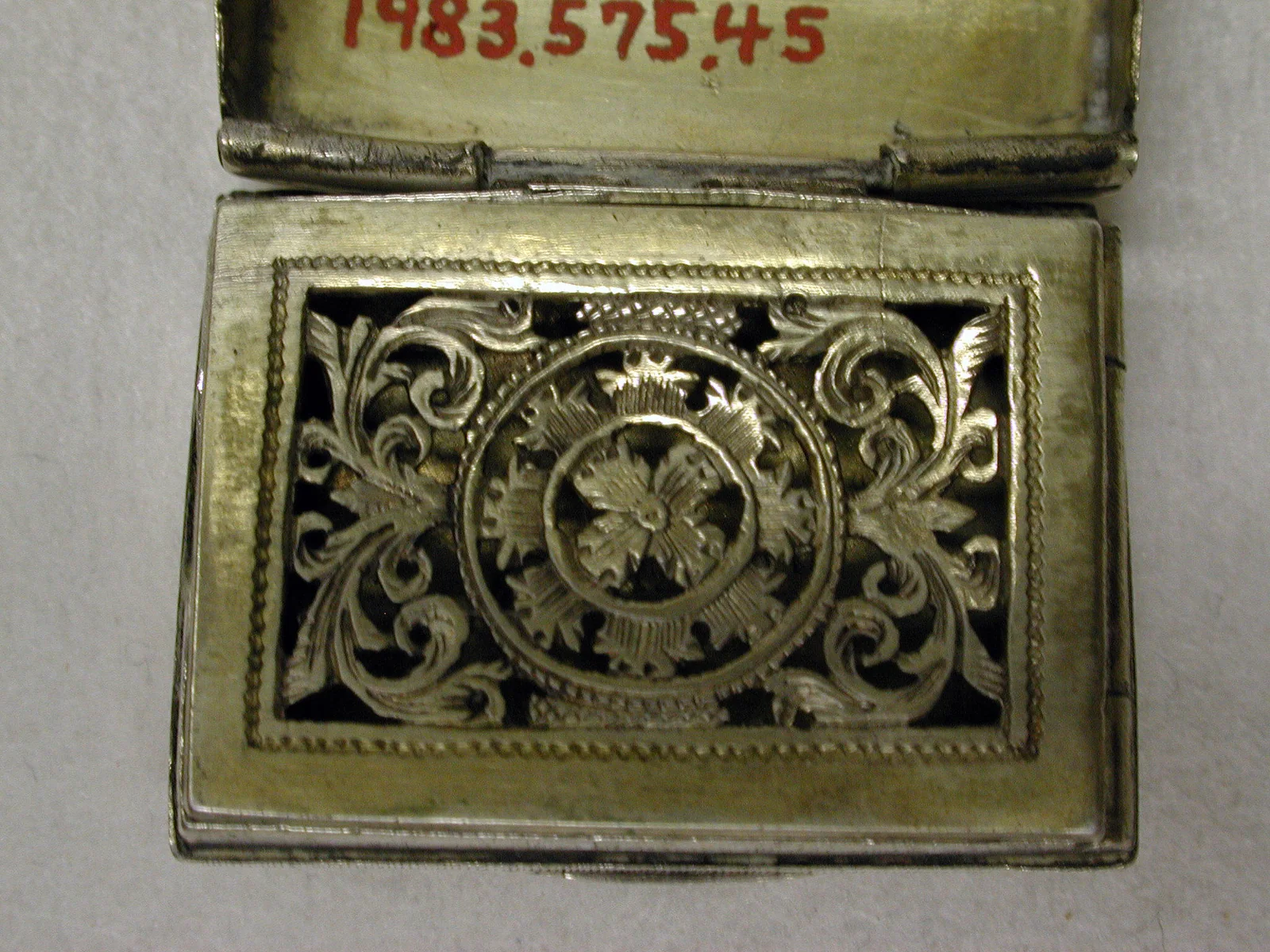
Start with the fittings. A pierced inner grille suggests a vinaigrette. A steel rasp suggests a nutmeg grater. A roughened striking surface points toward a matchsafe. A shallow card-sized interior suggests a calling card case. None of those observations, on its own, establishes age, silver purity or maker. Missing and replaced parts can change the apparent identity completely.
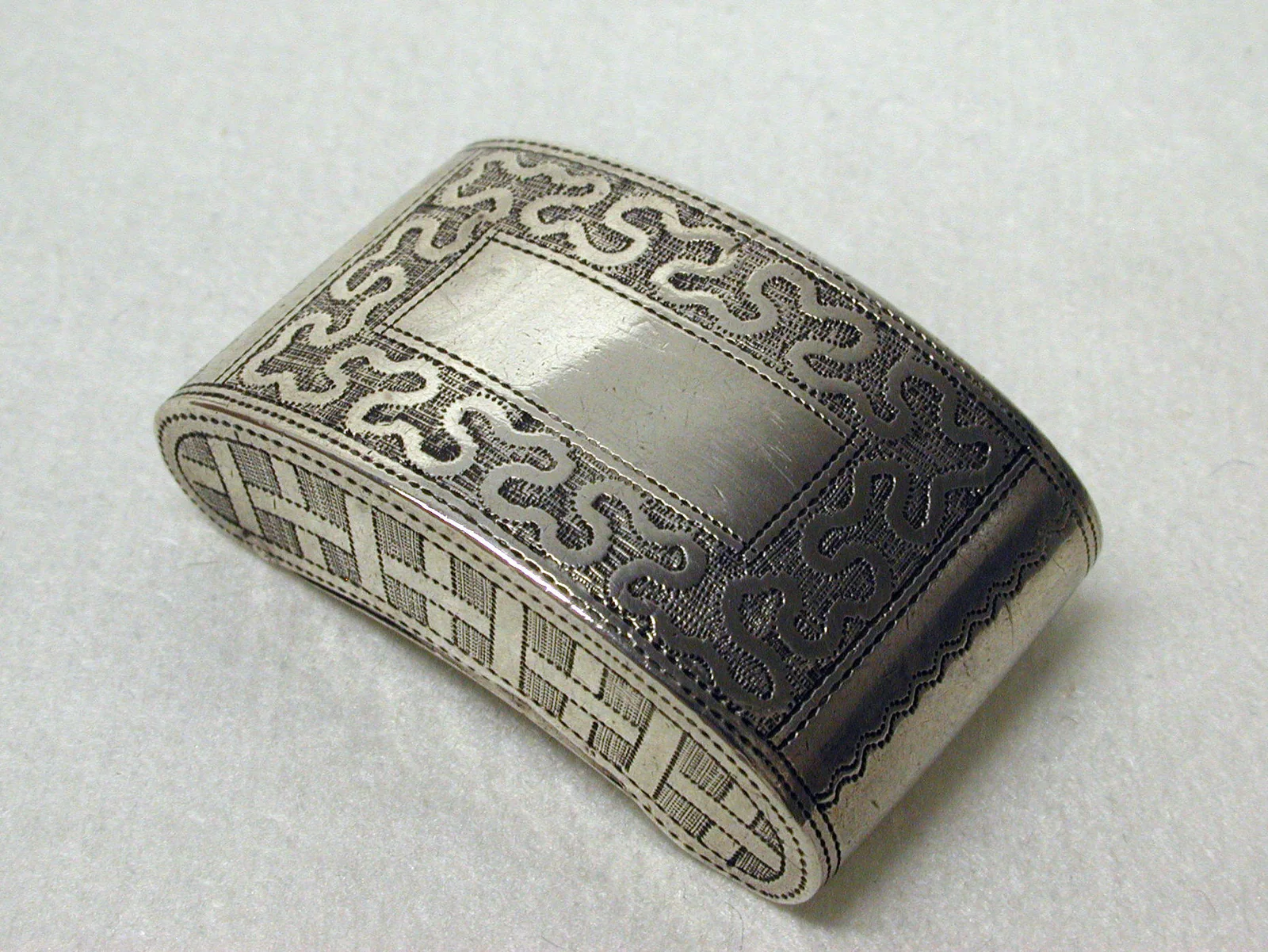
Seven forms, and the clues that separate them.
Use this comparison as a starting point, not a set of rigid measurements. A small snuffbox can be smaller than a large vinaigrette. A card case can open like a book. A novelty matchsafe can disguise itself as almost anything. Ask what the surviving construction supports before adopting a seller’s label.
| Form | Useful evidence | What can mislead |
|---|---|---|
| Snuff box / snuffbox | Close-fitting lid and a compartment for powdered tobacco; some have gilded or other lined interiors. | Gilding and a tight lid are not exclusive to snuff boxes. Small examples overlap other forms. |
| Vinaigrette | Pierced inner grille over a compartment for a scented sponge, often with gilding. | A missing grille can leave an ordinary-looking empty box. A lift-out cover may have another explanation. |
| Vesta case / matchsafe | Match compartment and a striker; many have a spring-loaded lid. | Novelty shapes hide the striker. A magnetic spring does not identify the body metal. |
| Calling / visiting card case | Thin case sized for paper cards; top, pull-off or book-like opening. | Cigarette and cheroot cases can overlap in size or opening style. Inspect the fittings. |
| Nutmeg grater | Steel or iron rasp, sometimes a separate compartment for the nutmeg. | A lost grater can leave a shell that resembles a scent or pill box. |
| Patch / pill / cachou box | Small container; some patch boxes have a mirror. | An empty interior rarely proves the original contents or date. Keep the description provisional. |
| Cigarette / cheroot case | Space and fittings for tobacco cylinders, sometimes retaining bands or arms. | Lost bands and changed fittings can obscure the purpose. Do not identify from depth alone. |
A small object in a larger life.
The pocket was more than a storage compartment. Taking out a snuffbox, offering its contents and closing it again made a small performance of hospitality. A silver vinaigrette gave its owner a portable scent. A calling card case belonged to the social business of visiting, introductions and leaving a name at a door. These objects record gestures that are less familiar than the metal itself.
Women’s pockets complicate the familiar story. The Victoria and Albert Museum describes large, separate tie-on pockets worn beneath skirts, reached through openings in the clothing. They could contain money, papers, food and personal possessions. In one eighteenth-century theft account discussed by the museum, a nutmeg grater contained pawn-related papers. A container’s intended use and the way a particular owner used it need not be the same.
Silver’s attraction here was partly practical and partly social. A workable sheet could become a thin case, an engraved surface or a tiny hinge. Gilding, enamel and shell added other materials and colors. A novelty shape could turn an ordinary habit into a joke. These are excellent reasons to collect a piece even when the amount of silver in it is modest.
Read marks without outrunning the evidence.
Photograph every mark in its location: base, lid, inner rim, grille and any detachable part. Transcribe what you can actually see before assigning a name. A British sponsor’s mark identifies the party responsible for submitting an article for hallmarking; it need not name the individual who formed every part. Similar initials can belong to different registrants.
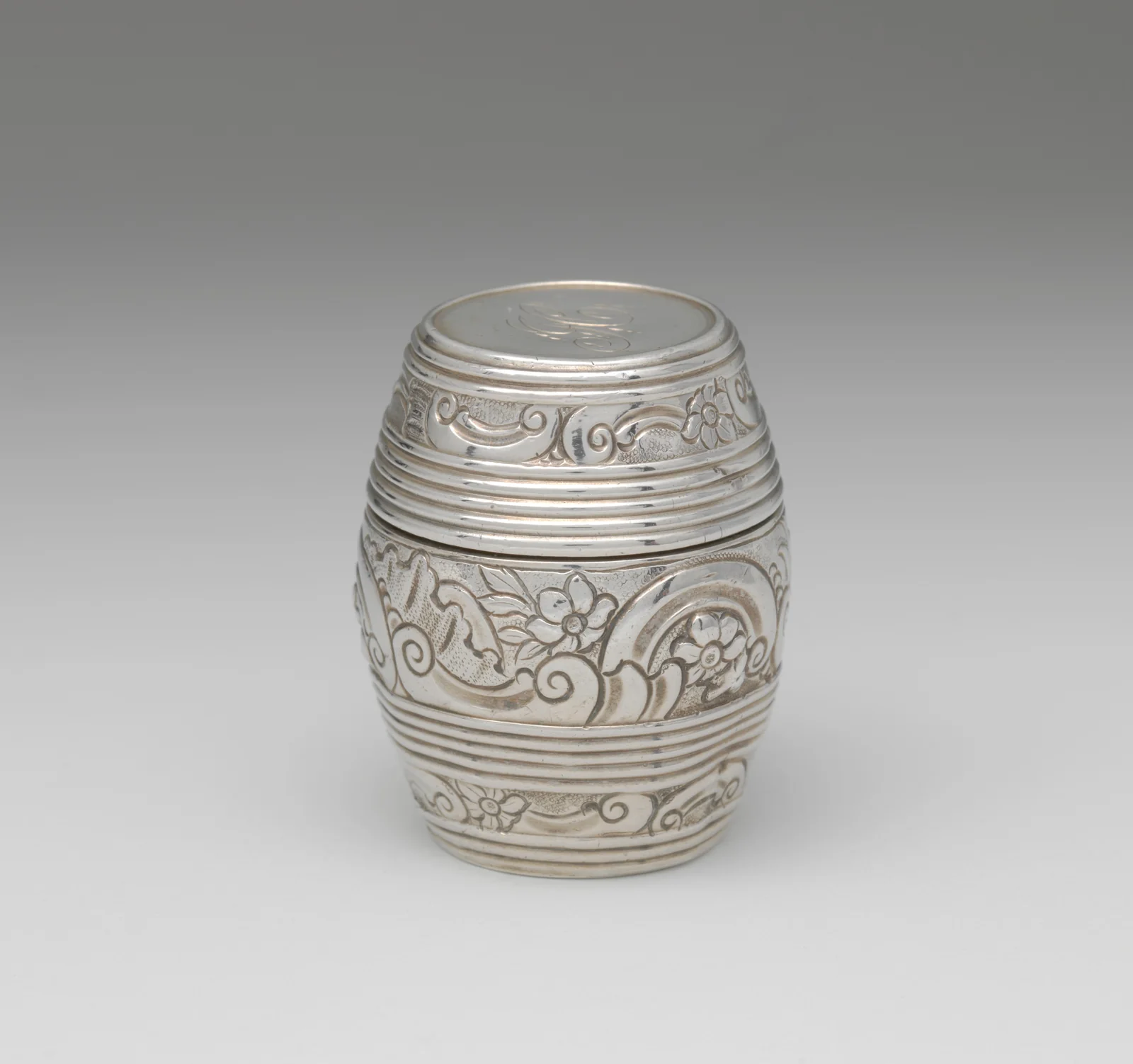
An engraved date is not automatically a manufacturing date. The Met’s Philadelphia nutmeg grater marked D. F. is dated 1780–1850 in the catalog, although its inscription includes 1678. The inscription commemorates the Cripps family’s arrival in America. A date letter, a patent date, an inscription and a stylistic estimate answer different questions.
Absence of a mark leaves a question, not a verdict. Exemptions and marking practices vary by country, date and object. The present UK silver hallmarking exemption threshold is 7.78 grams; it should not be used by itself to explain an unmarked Georgian box. Neither an impressive maker’s name nor a nonmagnetic body proves sterling.
For a matchsafe, magnetic attraction concentrated at the hinge can come from a steel spring. For any composite object, the scale weighs everything: silver alloy, steel, enamel, shell and linings. Do not subtract an assumed spring weight, and do not dismantle an antique to obtain a bullion calculation. Unknown non-silver weight remains unknown.
Buy the object, not just the name.
A useful comparison begins with form, maker attribution, date, dimensions and completeness. A plain but intact case may be a better purchase than a spectacularly decorated example with a torn hinge, erased inscription or replacement grille. A monogram can preserve a personal history. Its effect on price depends on the object and the buyer; removing it also removes metal.
Compare like with like. Dealer asking prices are offers, auction estimates are expectations, and recorded sale results are historical transactions. Check whether a result is hammer-only or includes the buyer’s premium, and keep tax, shipping and currency separate. An old auction result is not a current appraisal. “Rare” is a claim to investigate, not a substitute for evidence.
Use the checklist below while reviewing photographs or inspecting a piece with the owner’s permission. A checked box records that you considered a question; it is not an authentication score. Stop if a lid or grille resists movement. Request better photographs rather than forcing it.
Keep the evidence as well as the silver.
Old boxes are assemblies, not lumps of metal. Liquid can lodge in hinges, reach a steel spring or soak a textile lining. Abrasive polish removes material and can wear through gilding or soften the engraving you are trying to preserve. Avoid immersion, chemical dips and ultrasonic cleaning of these antique composite objects. A conservator should assess unstable enamel, corrosion, loose parts and delicate finishes.
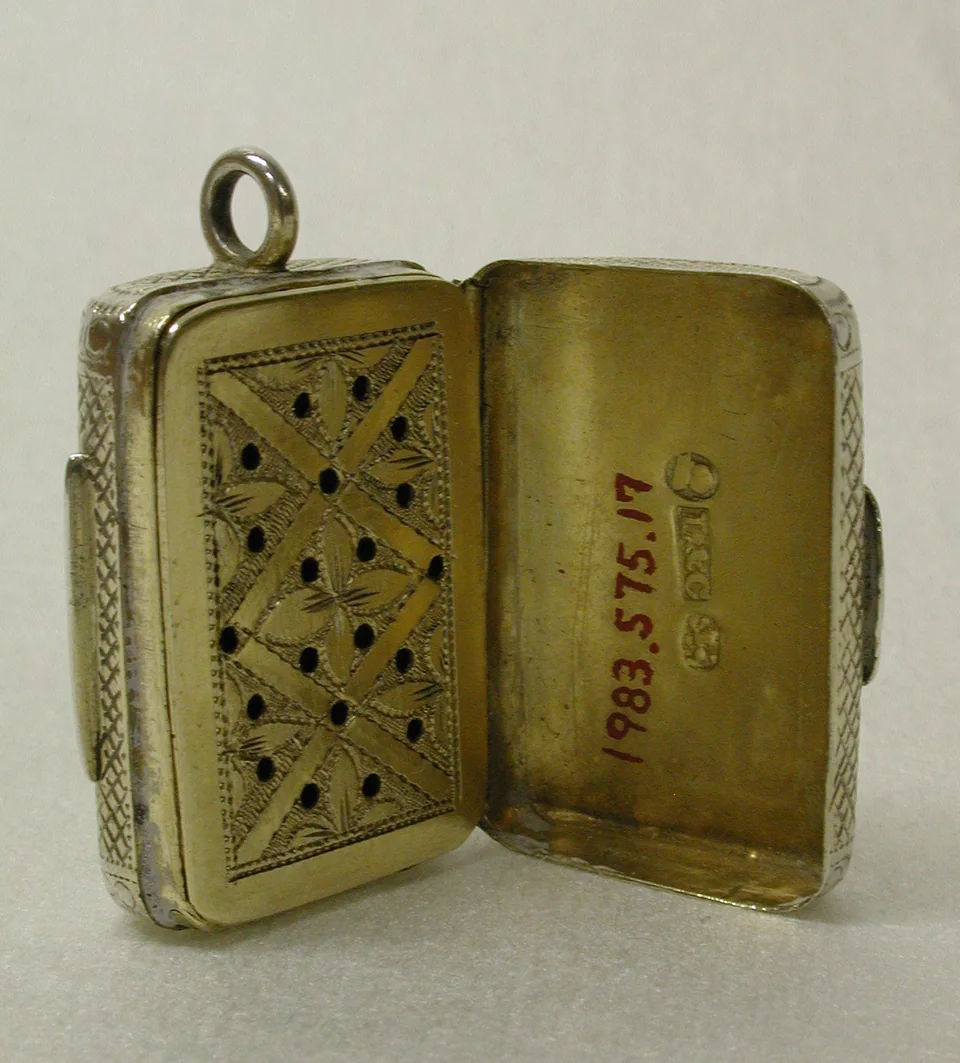
Keep a retained sponge, an old label or residue in place until it has been assessed. The Met’s 1816 William Lea & Co. vinaigrette still contains a sponge, but the catalog does not establish that the sponge itself dates to 1816. That distinction matters: physical survival is evidence; an appealing story about its origin requires more.
Handle over a padded surface, support both halves when opening and keep pressure off the hinge. Store separately in a dry, stable setting with suitable, nonabrasive archival materials. Do not refill a vinaigrette with vinegar or fragrance, or test a matchsafe by striking matches. If a piece contains ivory or tortoiseshell, check current official rules before buying, selling or moving it across borders. Age alone does not settle legality.
Keep a record someone else can understand.
A good object record keeps observation apart from attribution. “Letters D. F. on the base” is an observation. A named maker is an attribution that needs a reference. Record uncertainty plainly and retain the seller’s original description separately from your own conclusions.
Photograph the front, reverse, interior, hinge, fittings and all marks. Add dimensions, gross weight if useful, condition, repairs, provenance and the acquisition cost with fees separated. The downloadable template gives those details a home. Keep your completed record privately with your own photographs and receipts.
Your object, your evidence.
The plain-text template includes identity, marks, dimensions, gross weight, uncertain attributions, condition, provenance, acquisition costs and photographs. Save a copy and edit it in any text editor.
Download the object record (.txt)Sources & image credits
Reviewed November 10, 2026. Institutional records support the named examples; they do not authenticate or appraise a privately owned piece. Historical beliefs are described as history, not medical advice. Check current official requirements for regulated materials.
- The Met: Joseph Taylor, Snuffbox, 1808, 1983.575.3
Object date, dimensions, decoration and maker attribution.
- The Met: Thomas Willmore, Vinaigrette or nutmeg box, 1798–99, 1983.575.46a–c
The catalog preserves uncertainty about original function.
- The Met: Albert Coles, Card case, about 1840, 1983.575.57
American maker attribution and object description.
- Victoria and Albert Museum: Women’s tie-on pockets
Social history of separate pockets and documentary accounts of their contents.
- Victoria and Albert Museum: Gold boxes
Courtly and social history of snuffboxes; not evidence that all silver boxes had the same use.
- The Met: Joseph Taylor, Vinaigrette, 1806, 1983.575.45
Satchel form, gilding and pierced grille.
- The Met: Nutmeg grater, marked D. F., 1780–1850, 24.109.42a, b
Retrospective Cripps family inscription, attribution history and composite weight.
- GOV.UK: Hallmarking in the UK — consumer protection
Current UK marking requirements, sponsor marks and exemptions; not a retrospective explanation for all antiques.
- Canadian Conservation Institute: Silver — Care and Tarnish Removal, CCI Notes 9/7
Treatment risks, gilding, mixed materials and storage. Treatment must fit the particular object.
- The Met: William Lea & Co., Vinaigrette, 1816, 1983.575.17
Records a retained sponge; does not establish when the sponge was inserted.
- GOV.UK: Dealing in items containing ivory or made of ivory
Check current scope, exemptions and registration requirements before a transaction.
- U.S. Fish & Wildlife Service: Can I Sell It?
Wildlife-material restrictions and antique exemptions require case-specific checking.
Museum photography
These photographs are museum-supplied Open Access or public-domain images. They have been resized proportionally and converted to WebP, without retouching or cropping. The credits identify the object and institution; no endorsement is implied.
- The Metropolitan Museum of Art, Gift of Herbert K. Reis, in memory of Rose-Frances K. Reis (Mrs. Ralph A. Reis), 1983 (1983.575.3). CC0. Image rights
- The Metropolitan Museum of Art, Gift of Herbert K. Reis, in memory of Rose-Frances K. Reis (Mrs. Ralph A. Reis), 1983 (1983.575.45). CC0. Image rights
- The Metropolitan Museum of Art, Bequest of Charles Allen Munn, 1924 (24.109.42a, b). CC0. Image rights
- The Metropolitan Museum of Art, Gift of Herbert K. Reis, in memory of Rose-Frances K. Reis (Mrs. Ralph A. Reis), 1983 (1983.575.17). CC0. Image rights