
A little case for a striking new habit.
A matchsafe turns the convenience of a match into a portable object. British collectors commonly call these cases vestas or vesta cases; American collections often use matchsafe or match safe. The vocabulary overlaps. Search both terms rather than assuming they identify different classes of silver.
The development of friction matches in the nineteenth century changed the practical business of making a flame. John Walker’s surviving daybook records sales of friction lights from 1827. Matchsafes emerged around 1830 as a way to keep matches dry and reduce the hazards of carrying them loose. Their useful task soon made room for decoration, advertising and miniature visual jokes.
For the collector, the important evidence is tangible: a compartment intended for matches, an appropriate closure and often a textured striking surface. Many cases use a spring, but neither a particular spring mechanism nor a particular body shape should be treated as a universal rule.
The genre invites jokes. A case can impersonate a book, a parcel or a rolled newspaper. Novelty is part of the appeal, but its disguise makes an inspection of the working parts more important, not less.
Read the striker, then the hinge.
Look around the base, sides and ends for a roughened area. Some strikers are conspicuous file-like grooves; others are integrated into the novelty design. A smooth area may be worn, repaired or simply the wrong place to look. Inspect the interior and compare a documented example before deciding that a missing feature proves a fake.
A spring can explain a puzzle that often worries an owner of hallmarked silver. The body may be silver alloy while a steel part near the hinge attracts a magnet. Conversely, a nonmagnetic body does not prove silver. The location of the response is a clue about construction, not a purity test.
Watch the lid move only through its natural travel, with permission and without force. Record looseness, a lid that will not align, a visibly damaged hinge or an unreliable catch. Do not repeatedly snap an old lid, release it from a prescribed angle or assume every mechanism was designed to operate the same way.
Steel, enamel and other fittings belong in the gross weight. There is no defensible universal deduction of a few grams for a spring. An intact antique is worth assessing as an object before contemplating its metal content.
A hand of cards, hiding a useful object.
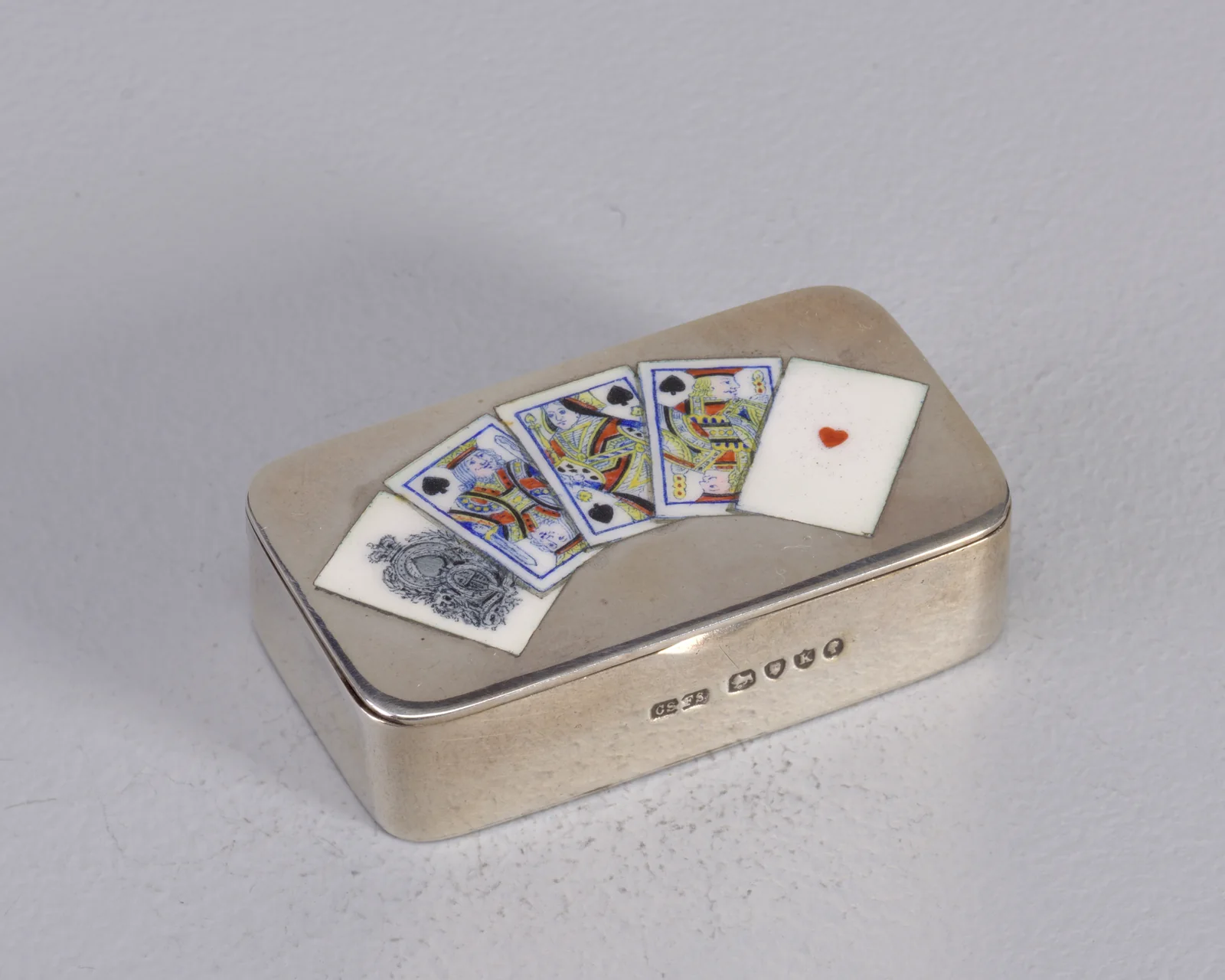
The Cooper Hewitt’s Playing Cards matchsafe, dated 1885–86, brings the pleasure of a game to a small silver-and-enamel case. Its catalog associates the marks with Cornelius Saunders and Frank Shepherd. Color and foreshortened cards make the lid look playful before the viewer notices the practical container beneath.
The five enamel cards include the ace, king, queen and jack of spades and an ace of hearts. The small red heart enlivens the darker suits. Color and the simulated overlap give a tiny surface some of the liveliness of an actual hand of cards.
The museum records the striker on the right side. The example demonstrates why “look at the bottom” is not a complete identification method. The maker worked the functional surface into the form rather than insisting on one standardized layout.
Enamel also changes the condition questions. Look for chips, cracks, areas of different gloss or repairs, and ask for photographs under more than one lighting angle. A shiny photograph can hide losses. Silver polish, vigorous rubbing and heat are poor experiments for a delicate mixed-material piece.
Scientific American, delivered in silver.
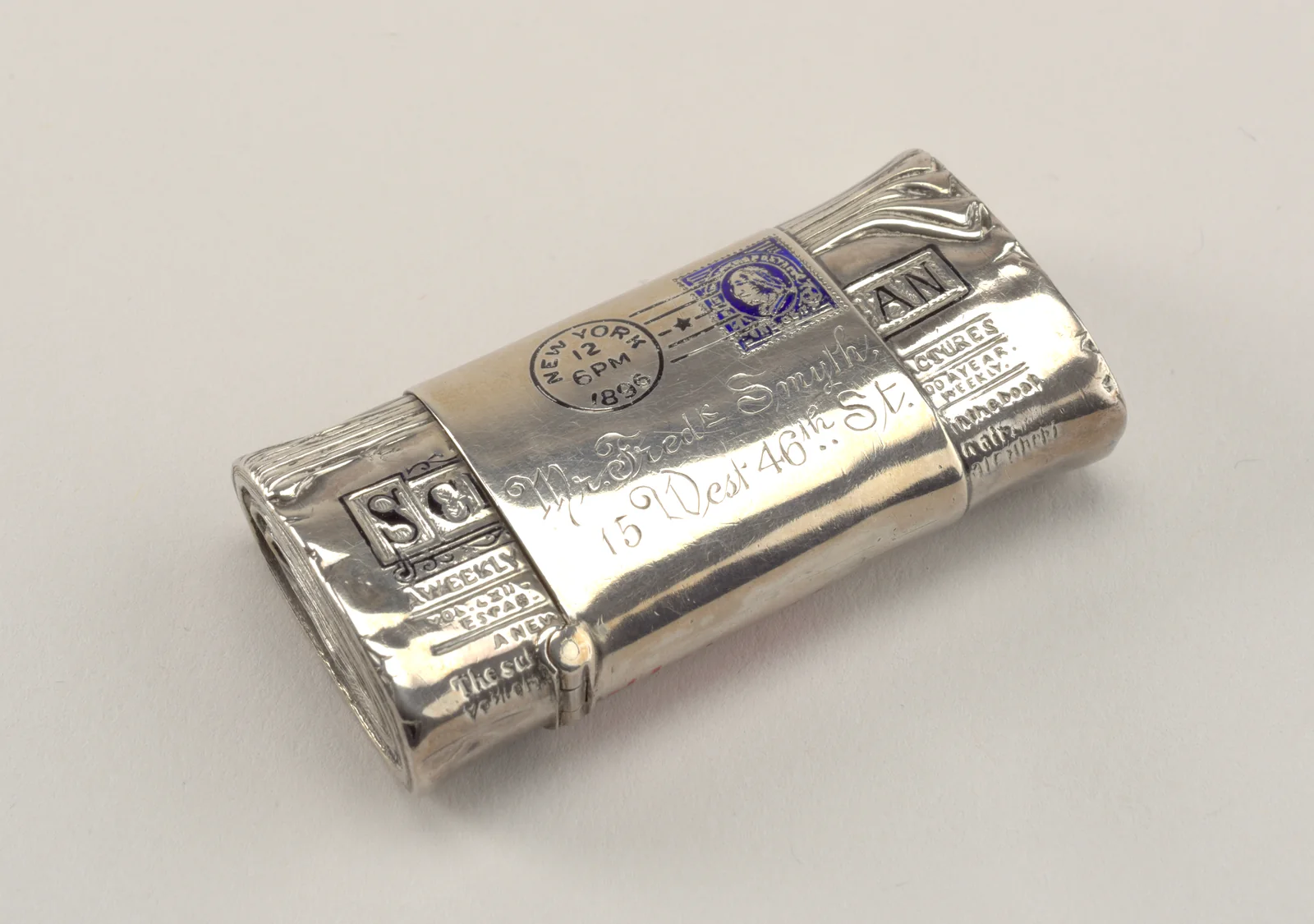
Enos Richardson & Company’s “Scientific American” matchsafe, about 1890, imitates a rolled postal copy of the magazine. An address, stamp, postmark and simulated sealing details make the joke legible. It is an ordinary piece of printed matter translated into something durable and precious.
The Cooper Hewitt description says the coiled ends likely served as striking surfaces. Keep that qualifier. A plausible reading of a feature is still an interpretation when the source presents it that way.
The recorded patent inscription includes October 14, 1890. Patent information can help research a design or mechanism, but the date does not necessarily tell us when this particular example was made. Production could continue after a patent, and an inscription must itself be evaluated in the wider object.
Novelty cases make rewarding focused collections: printed matter, animals, sporting themes or miniature containers. They also make close comparison essential. Compare the marks, seams, dimensions, internal construction and surface detail with securely cataloged examples. Weight or casting alone cannot give a universal authentic-versus-reproduction verdict.
The maker’s name is the beginning of the inquiry.
British and American workshops produced a broad range of personal cases, from restrained engraving to relief and enamel. A famous name can attract attention, but it does not establish the metal standard, originality or condition. Read the complete mark rather than stopping at the manufacturer or retailer.
Cooper Hewitt’s Bollinger-crate matchsafe is cataloged as plated metal and bears a “Tiffany & Co, Silver-Soldered” stamp. That specific example is a useful reminder that a prestigious name alone does not establish sterling. Read the full material description and marks, not just the retailer’s name.
Marks can be worn, copied or misread. Reproductions can also vary in construction. There is no reliable shortcut in the claim that an original must be thin die-stamped sheet while every heavier cast example is modern. A specialist comparison should consider the complete object and the documented production method for that design.
An inscription may give a case a club, occasion or person to research. Keep it in the record even when the identity is unresolved. Removing a monogram sacrifices surface and history; it does not reliably improve the value.
Collect the fire without lighting it.
Do not test an antique striker with a modern match. Safety matches are formulated for the matching striking surface on their packaging, and trying to recreate the old use can scratch, scorch or damage the case. Photograph the striker instead.
Keep water and chemical dips out of a case containing a steel mechanism. Residual liquid can be difficult to remove from the assembly, and abrasive polishing can wear gilt or engraved surfaces. Active corrosion, a sticking hinge or unstable enamel deserves professional attention rather than more force or a stronger cleaner.
Before buying, ask for the underside, both sides, the open interior, the closed lid seam and every mark. Ask whether the spring, hinge, catch or enamel has been repaired and whether the seller can describe the evidence. Keep price comparisons tied to the same form, material, condition and date.
The best first matchsafe need not be the most elaborate. A coherent, well-documented example can teach more than a spectacular case with an uncertain mark and no interior photograph. Understanding the small mechanism is part of the pleasure of owning it.
Sources & image credits
Reviewed November 10, 2026. Institutional records support the named examples; they do not authenticate or appraise a privately owned piece. Historical beliefs are described as history, not medical advice. Check current official requirements for regulated materials.
- Science Museum Group: The day book of John Walker
Surviving records of friction-light sales beginning in 1827.
- Cooper Hewitt: Utility and Marketing — A Matchsafe Made in Heaven
Historical context for match containment and the emergence of matchsafes.
- Cooper Hewitt via Wikimedia Commons: Playing Cards Matchsafe, 1885–86, 1978-146-228
Museum description, marks, enamel decoration and right-side striker.
- Canadian Conservation Institute: Silver — Care and Tarnish Removal, CCI Notes 9/7
Treatment risks, gilding, mixed materials and storage. Treatment must fit the particular object.
- Cooper Hewitt via Wikimedia Commons: “Scientific American” Matchsafe, about 1890, 1978-146-190
Enos Richardson & Company attribution; coiled ends described as likely strikers.
- GOV.UK: Hallmarking in the UK — consumer protection
Current UK marking requirements, sponsor marks and exemptions; not a retrospective explanation for all antiques.
- Cooper Hewitt via Wikimedia Commons: Bollinger Champagne Crate Matchsafe, 1978-146-218
The museum catalog transcription describes plated metal and records the Tiffany & Co, Silver-Soldered stamp.


Museum photography
These photographs are museum-supplied Open Access or public-domain images. They have been resized proportionally and converted to WebP, without retouching or cropping. The credits identify the object and institution; no endorsement is implied.