
Three habits, three interiors.
A snuffbox, a vinaigrette and a nutmeg grater can look like close relatives when their lids are shut. All may fit in a pocket; all may carry a monogram or a beautifully worked surface. Open them carefully, and the different jobs become clearer. Snuff needed a container. Aromatic vinegar was commonly held in a sponge under a pierced grille. A nutmeg needed a grating surface.
These differences make the interior more useful than a romantic name in a listing. A gold-colored lining is not enough to identify a vinaigrette, and a small empty box is not automatically a pill box. Missing fittings are common enough that uncertainty belongs in an honest description.
The most satisfying examples reward a second look. A miniature satchel has a simulated fastening; a book-shaped box opens to a pierced interior; a grater turns an expensive spice into something its owner can carry. The pleasure is in understanding how the miniature mechanism and the outer disguise work together.
The snuffbox as a social object.
Snuff is powdered tobacco taken through the nose. Its use became an important part of European social and courtly life, and its containers could carry gifts, portraits and messages as well as tobacco. The V&A’s history of gold boxes describes the elaborate culture surrounding them. Silver examples belong to that broader world, although a modest pocket box and a diplomatic presentation box should not be treated as interchangeable.
A well-fitted lid helped contain the contents. Some boxes were curved for carrying, while others were more suitable for a table. A compartment without a grille is consistent with a snuffbox, but the conclusion should rest on several features and a close comparison with securely cataloged examples.
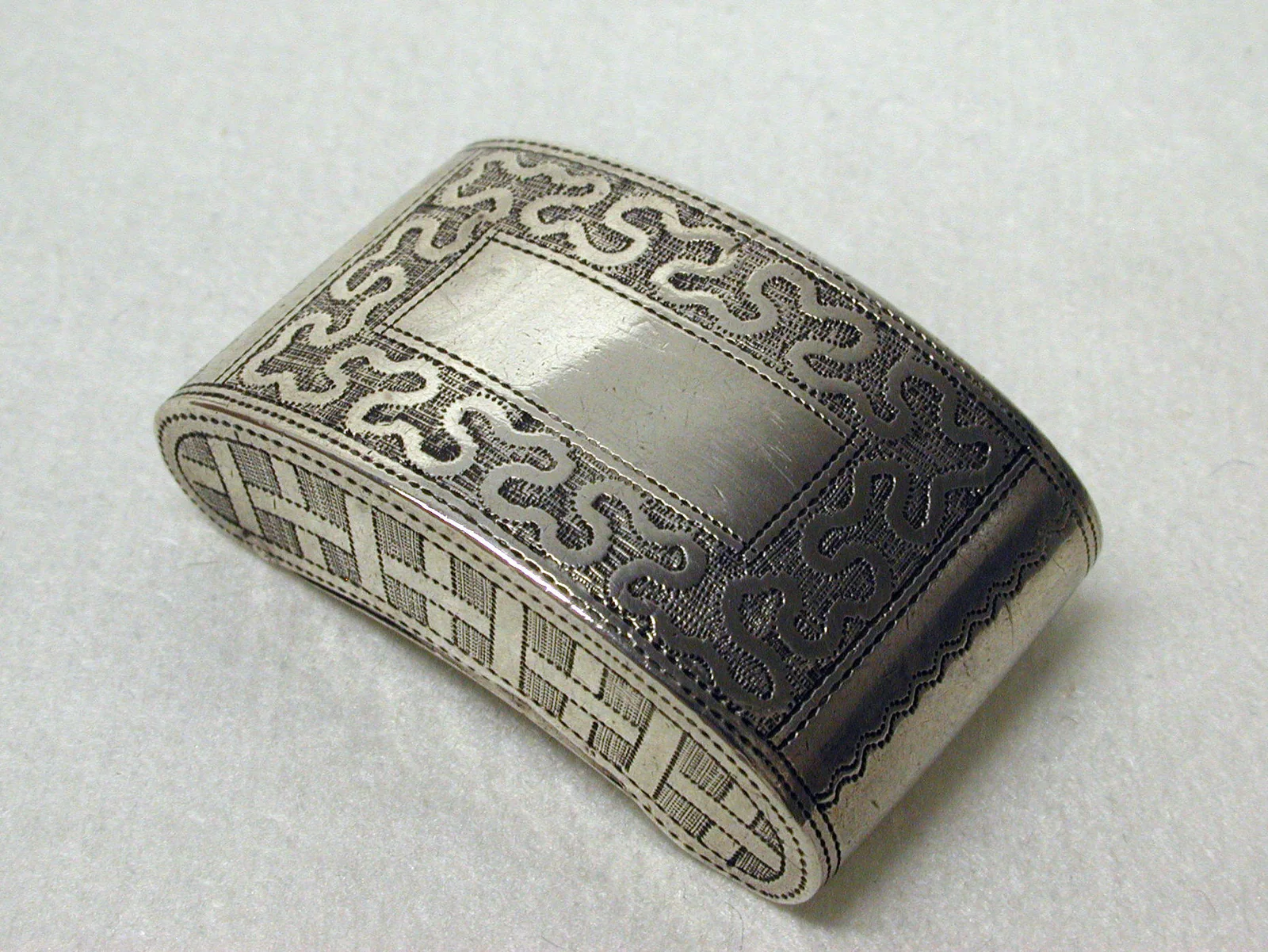
Joseph Taylor’s Birmingham snuffbox of 1808 at The Met is only 3.8 centimeters long. That is a useful correction to the idea that snuffboxes must be large. Its wrigglework engraving creates a lively pattern across the lid; basket-weave decoration works around the sides, and animal motifs appear underneath. The underside turns a public accessory into a private amusement.
Wrigglework describes a zigzag line made by rocking an engraving tool as it advances. It is worth looking at under gentle raking light. Crisp lines, rounded wear and areas rubbed smooth tell different stories about use and later polishing. They are observations to record, not a clock that can date the object by itself.
A scent carried under a pierced grille.
A vinaigrette commonly held a sponge moistened with aromatic vinegar. Opening the outer lid allowed the scent through the pierced inner cover while the sponge stayed contained. Gilding helped protect the silver surface. The name refers to vinegar; it should not lead us to treat every smelling-salts container, pomander or perfume flask as the same object.
The historical setting included unpleasant smells and beliefs about the protective power of strong scents. These beliefs explain the appeal of the accessory; they are not evidence that vinegar vapors prevented infection. An antique scent container is a historical object, not a device to recreate old medical practices.
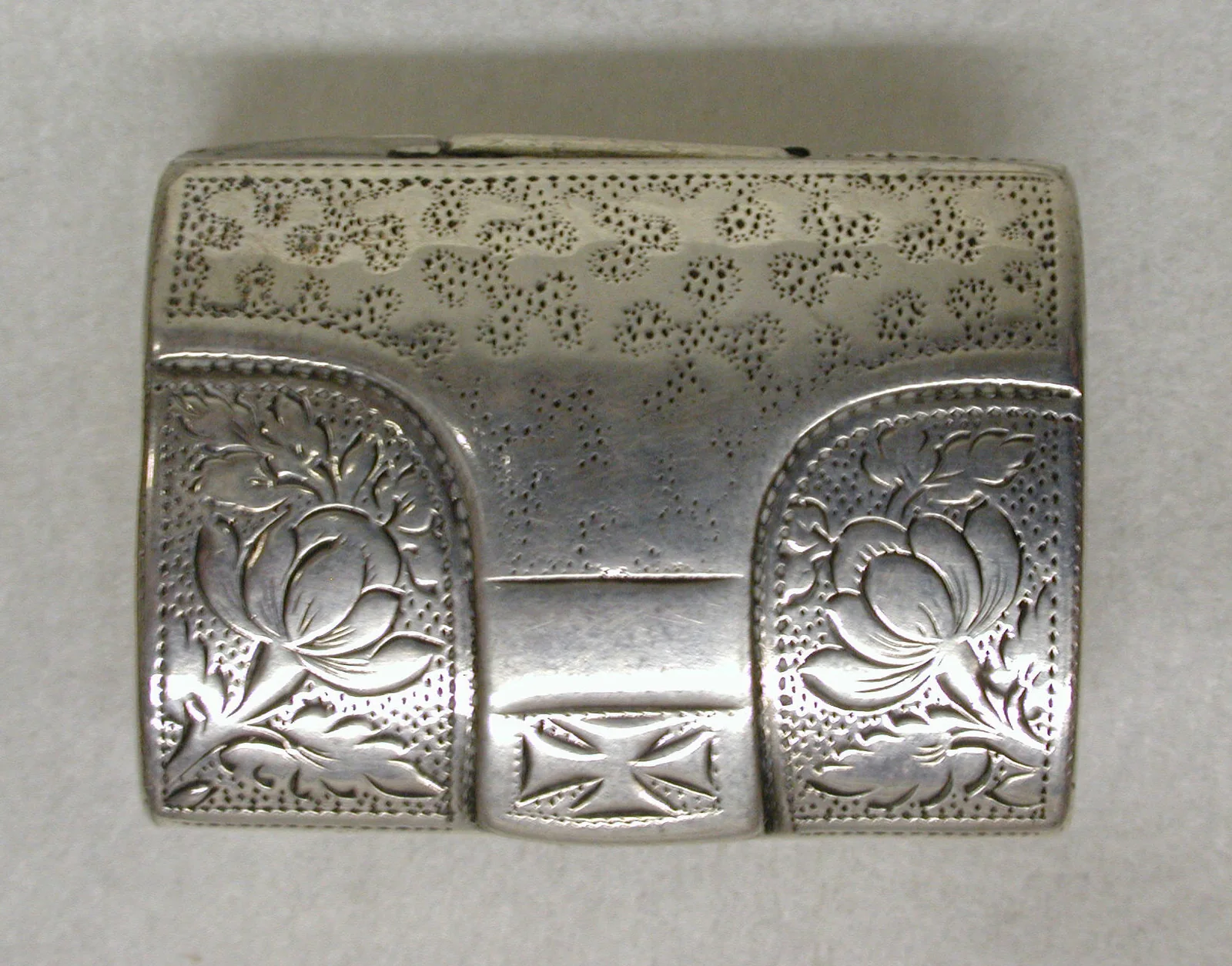
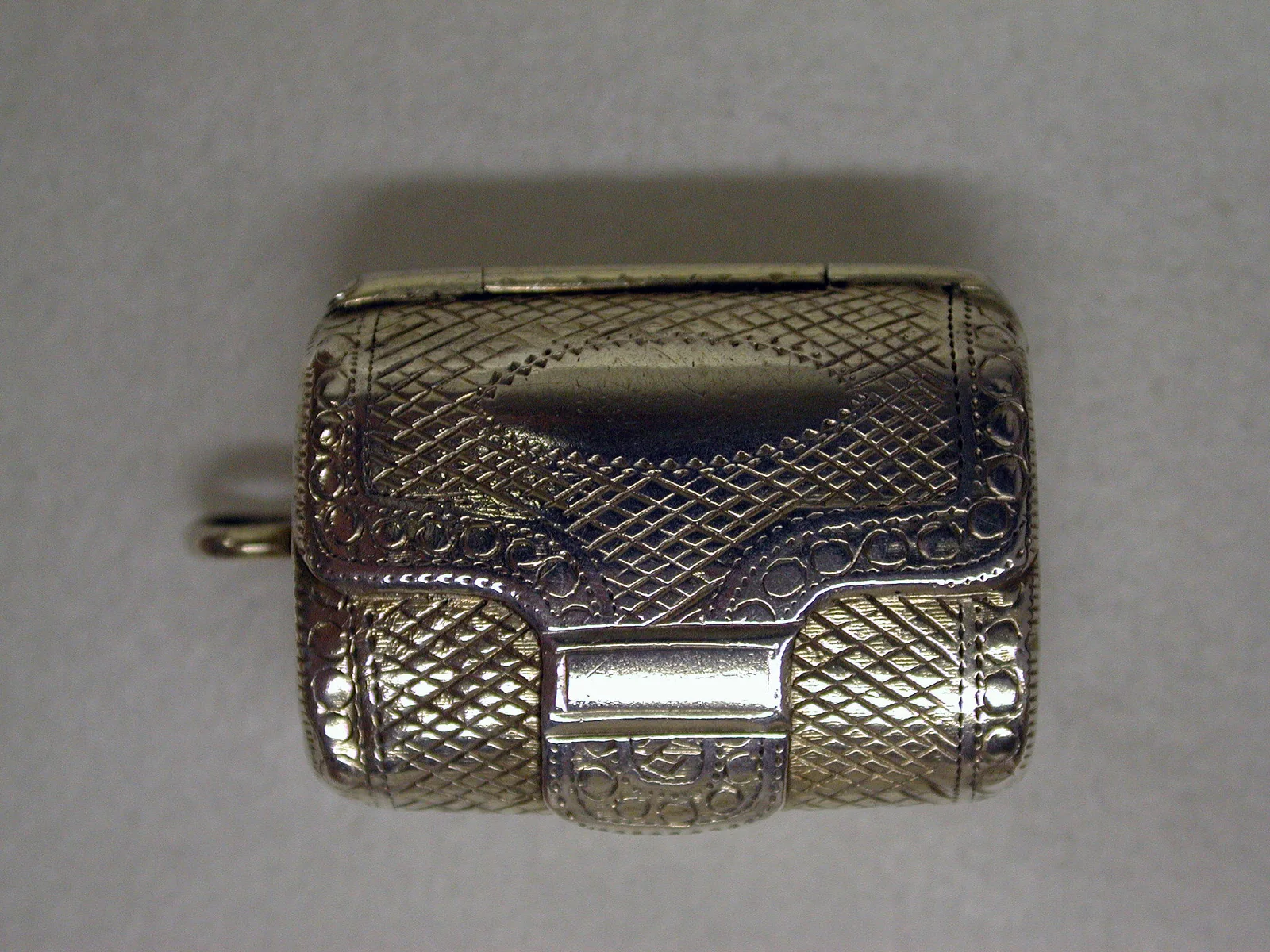
The Met’s Joseph Taylor vinaigrette of 1806 takes the form of a tiny satchel. At 2.5 centimeters long it compresses a familiar everyday shape into a piece of jewelry-scale metalwork. The pierced inner grille and gilded interior supply the functional explanation that the satchel disguise conceals.
William Lea & Co.’s 1816 example makes the construction especially tangible because a sponge survives inside. Retain such material rather than tidying it away. It may tell us something about use, but neither its presence nor the case’s hallmark proves when it was inserted.
When two workshops used a similar grille.
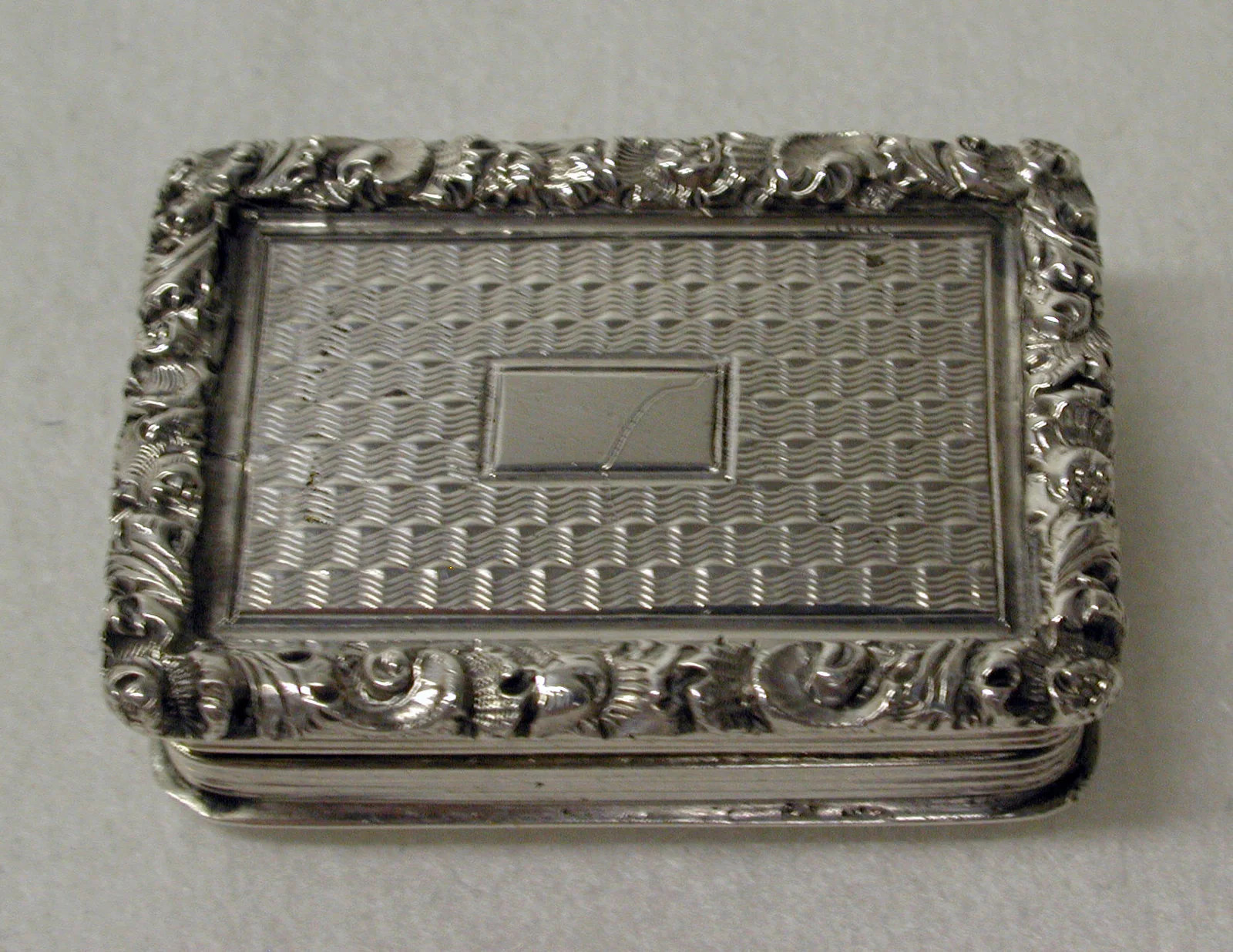
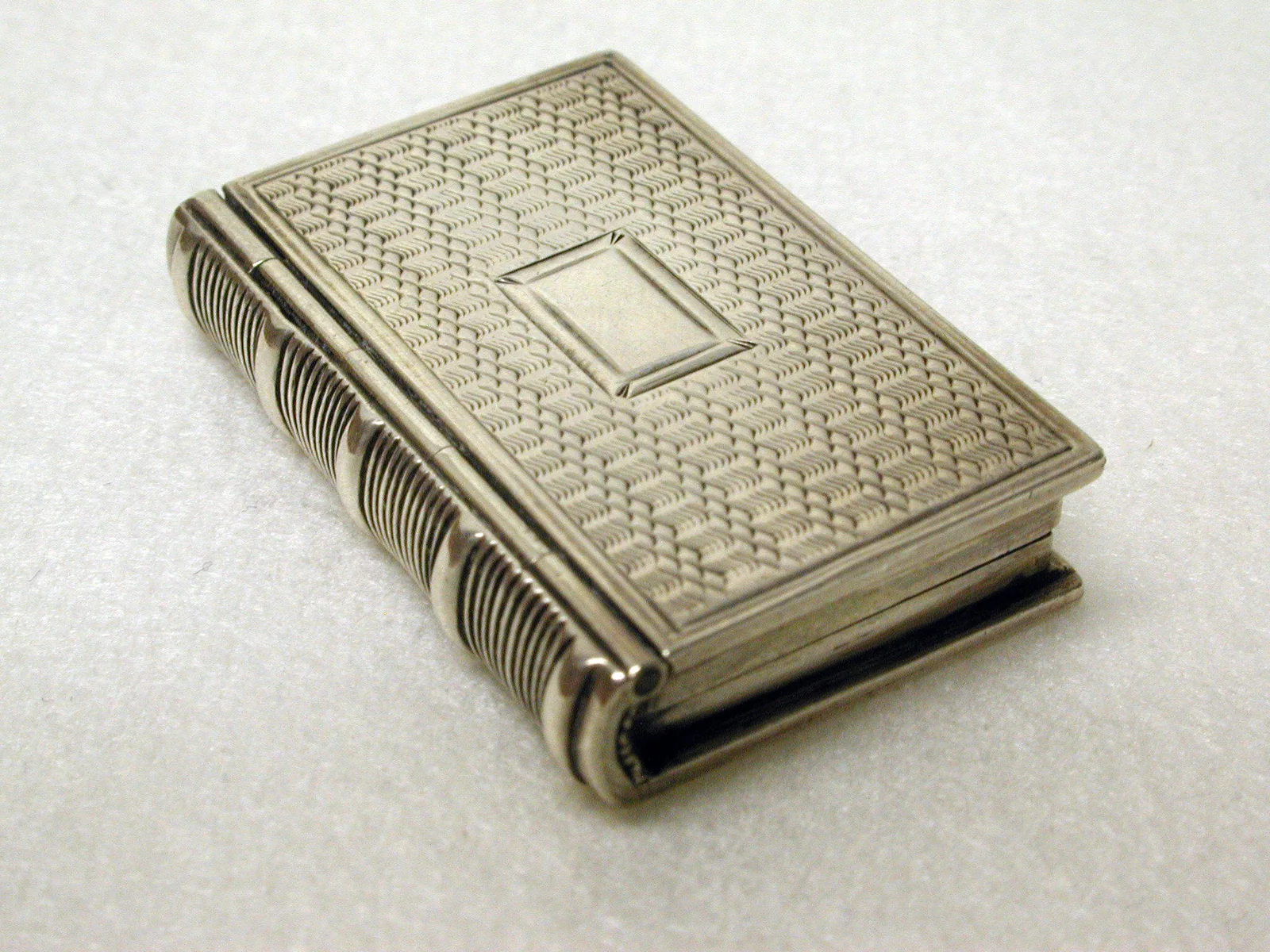
In 1834, Taylor & Perry and Nathaniel Mills produced vinaigrettes now in The Met. One resembles a book; the other is a rectangular box with engine-turning and an ornamental border. The museum notes that their pierced grilles are very similar.
That comparison opens an intriguing view into Birmingham’s trades. Shared patterns, specialized component making or workshop supply networks could explain the resemblance. The catalog carefully says it might suggest mass production or pattern books. Two similar parts do not prove that both firms bought blanks from the same supplier.
This is also a useful collecting discipline. A familiar grille pattern may support a comparison without establishing a maker. Read the mark, its shape and the rest of the hallmark sequence, and compare the complete object. A matching decorative motif is not a signature.
Smallworking depended on a combination of hand skills and repeatable methods. Engine-turning, engraving, stamping and assembly can coexist in one object. “Handmade” and “factory-made” are often too blunt to describe what is happening at this scale.
The nutmeg, the rasp and the date that misleads.
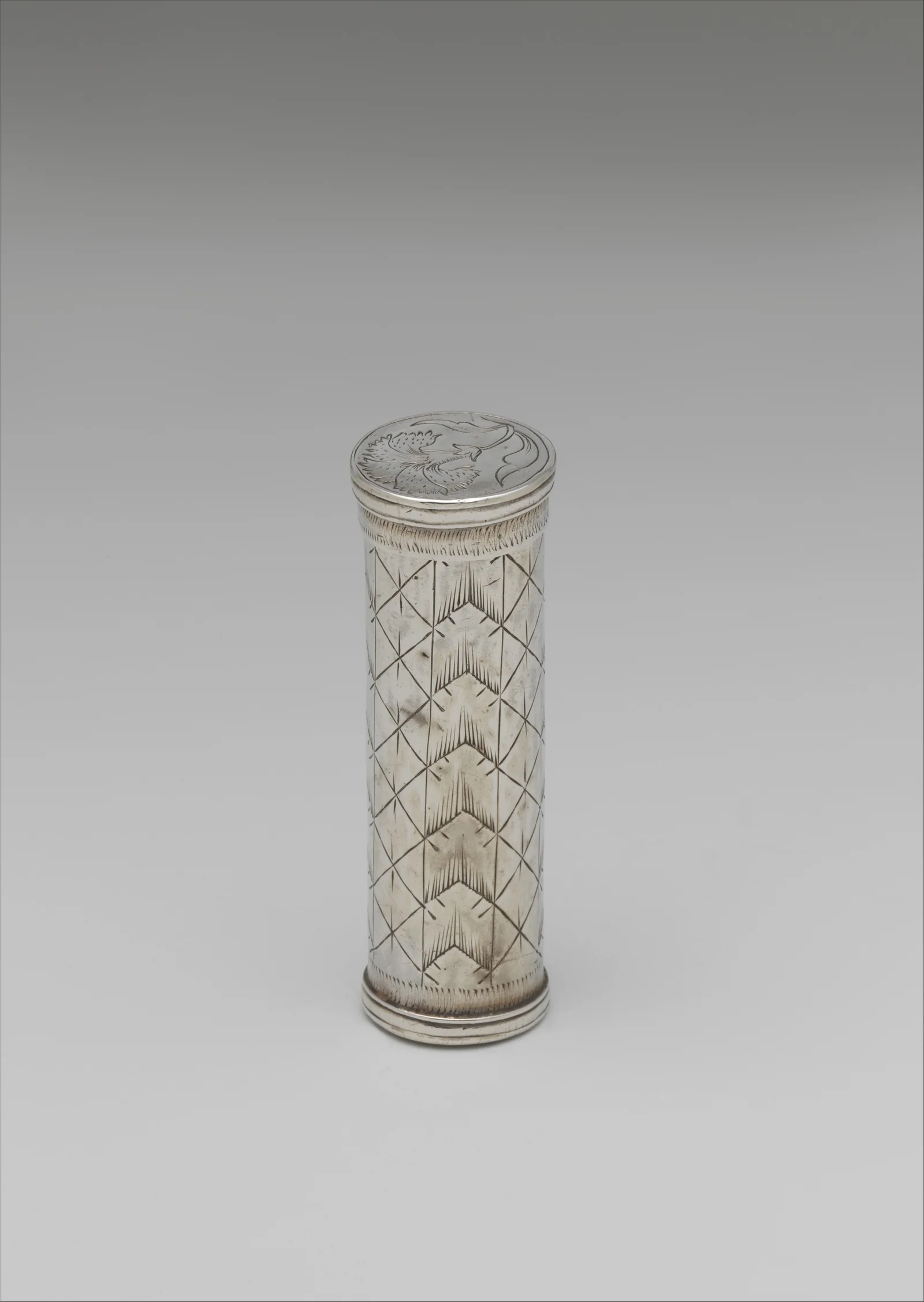
A pocket nutmeg grater puts another sensory habit into silver. The owner could carry a whole nutmeg and grate a little where it was wanted. The essential working surface was typically steel or iron rather than silver. That combination matters both for identification and for care: a silver case can conceal a rusting ferrous component.
William Cowell Sr.’s Boston nutmeg grater of 1705–10 at The Met is cataloged as silver and steel. Its narrow, elongated shape differs sharply from the little domed box one might expect. Museum examples are valuable precisely because they broaden the range beyond a dealer’s standard thumbnail.
Another Met grater, marked D. F. and dated 1780–1850, carries an inscription referring to 1678. The earlier year commemorates family history, not manufacture. The catalog also records differing maker attributions. Preserve both the observed mark and the attribution history instead of selecting the most attractive name.
For weight, the lesson is equally simple. A scale reading for a silver-and-steel grater is gross object weight. Even a separate weight for the body does not necessarily isolate silver if the grater is still fitted. Do not subtract a guessed amount for steel or take the object apart to improve a scrap estimate.
A museum label that leaves the question open.
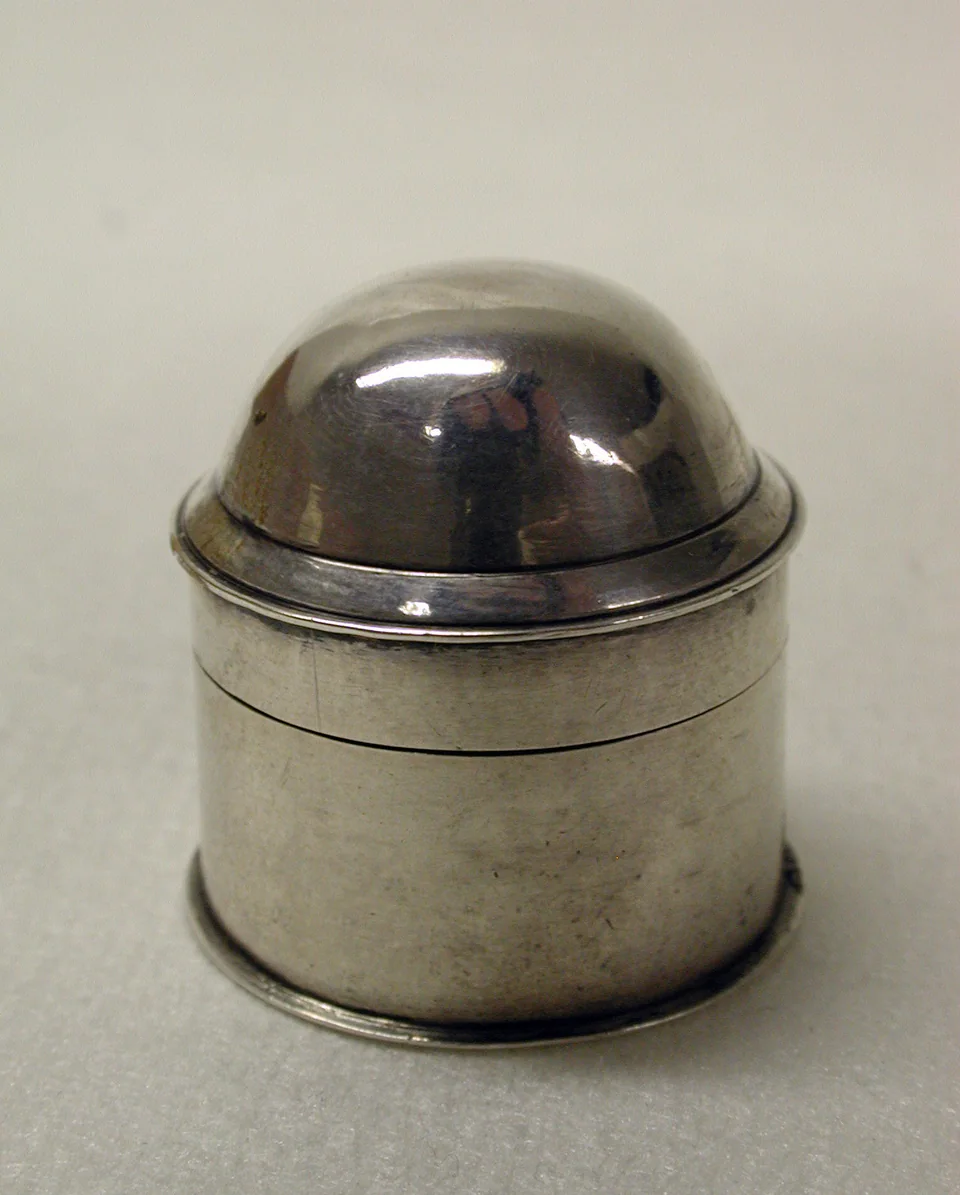
Thomas Willmore’s 1798–99 Birmingham box is cataloged by The Met as “Vinaigrette or nutmeg box.” The title is not a failure to choose. It preserves a real construction problem: the pierced inner cover is not hinged, and comparable domed boxes had graters that could be lost.
That is a better model for a collector’s description than certainty based on shape. Write what survives: domed cover, pierced removable interior part, marks, dimensions and any evidence of fittings. Then explain the possible functions and the reference supporting each. Do not repair away an ambiguous feature simply to make the object match a preferred label.
When buying, request open-interior photographs, a view under any safely removable cover and close-ups of hinge attachment points. Ask whether the grille or grater is believed original and what supports that view. Different gilding, a poor fit or solder marks warrant investigation; none proves replacement by itself.
Avoid pressing thin cartouches, bending fittings or testing old hinges through a fixed angle. If movement is resistant, stop. Do not add fresh vinegar, oils or tobacco. Loose parts, rust, fragile gilding and historic residues are reasons to seek a conservator’s assessment before cleaning.
Sources & image credits
Reviewed November 10, 2026. Institutional records support the named examples; they do not authenticate or appraise a privately owned piece. Historical beliefs are described as history, not medical advice. Check current official requirements for regulated materials.
- The Met: Joseph Taylor, Vinaigrette, 1806, 1983.575.45
Satchel form, gilding and pierced grille.
- The Met: Thomas Willmore, Vinaigrette or nutmeg box, 1798–99, 1983.575.46a–c
The catalog preserves uncertainty about original function.
- Victoria and Albert Museum: Gold boxes
Courtly and social history of snuffboxes; not evidence that all silver boxes had the same use.
- The Met: Joseph Taylor, Snuffbox, 1808, 1983.575.3
Object date, dimensions, decoration and maker attribution.
- The Met: William Lea & Co., Vinaigrette, 1816, 1983.575.17
Records a retained sponge; does not establish when the sponge was inserted.
- The Met: Nathaniel Mills, Vinaigrette, 1834, 1983.575.40
Construction and comparison with other Birmingham vinaigrettes.
- The Met: Taylor & Perry, Vinaigrette, 1834, 1983.575.2
Similar grilles might suggest mass production or pattern books; this remains a hypothesis.
- The Met: William Cowell Sr., Nutmeg grater, 1705–10, 33.120.238
Boston attribution and silver-and-steel construction.
- The Met: Nutmeg grater, marked D. F., 1780–1850, 24.109.42a, b
Retrospective Cripps family inscription, attribution history and composite weight.
- Canadian Conservation Institute: Silver — Care and Tarnish Removal, CCI Notes 9/7
Treatment risks, gilding, mixed materials and storage. Treatment must fit the particular object.
Museum photography
These photographs are museum-supplied Open Access or public-domain images. They have been resized proportionally and converted to WebP, without retouching or cropping. The credits identify the object and institution; no endorsement is implied.
- The Metropolitan Museum of Art, Gift of Herbert K. Reis, in memory of Rose-Frances K. Reis (Mrs. Ralph A. Reis), 1983 (1983.575.45). CC0. Image rights
- The Metropolitan Museum of Art, Gift of Herbert K. Reis, in memory of Rose-Frances K. Reis (Mrs. Ralph A. Reis), 1983 (1983.575.3). CC0. Image rights
- The Metropolitan Museum of Art, Gift of Herbert K. Reis, in memory of Rose-Frances K. Reis (Mrs. Ralph A. Reis), 1983 (1983.575.17). CC0. Image rights
- The Metropolitan Museum of Art, Gift of Herbert K. Reis, in memory of Rose-Frances K. Reis (Mrs. Ralph A. Reis), 1983 (1983.575.40). CC0. Image rights
- The Metropolitan Museum of Art, Gift of Herbert K. Reis, in memory of Rose-Frances K. Reis (Mrs. Ralph A. Reis), 1983 (1983.575.2). CC0. Image rights
- The Metropolitan Museum of Art, Bequest of Alphonso T. Clearwater, 1933 (33.120.238). CC0. Image rights
- The Metropolitan Museum of Art, Gift of Herbert K. Reis, in memory of Rose-Frances K. Reis (Mrs. Ralph A. Reis), 1983 (1983.575.46a–c). CC0. Image rights