
A name presented before its owner.
A calling card case protected a small piece of paper that could speak for its owner. In the nineteenth century, a name left at a door could announce a visit, sustain an acquaintance or mark a departure. The case made the act of producing that card into a moment of display.
The familiar silver form is a thin, often rectangular container, but calling card cases were also made with shell, wood and other materials. Some were carried in a pocket; others could be carried in the hand or on a chain. The distinction matters when a collecting category called “pocket silver” starts to sound more literal than the objects allow.
Identification begins with interior capacity and construction, not a fixed external dimension. Many cases have a short top lid or a removable cap; others open like a little book. Cigarette and cheroot cases can overlap in size. Surviving retaining bands, compartments, linings and period comparisons are more useful than a simple thickness rule.
Do not confuse an ordinary visiting card with the photographic carte de visite, the small mounted portrait format popularized in the nineteenth century. The two share vocabulary, but a museum source about portrait photographs is not automatically evidence for the etiquette or dimensions of engraved calling cards.
A building small enough to carry.
Architectural or “castle-top” silver turned a compact surface into a recognizable place. The term extends beyond literal castles to churches, houses and other views. A visitor could carry an image of a landmark in a form that was both useful and visible.
London Museum records a silver-gilt card case made by Taylor & Perry in Birmingham in 1845, chased with images of Warwick Castle. The record identifies both the maker and the architectural subject, giving collectors a documented comparison rather than a landmark guessed from appearance.
The interest lies in the relationship between building and metalwork. Highlights travel across the raised scene while recesses hold shadow. Repeated polishing can soften both. When buying, inspect the high points, outer edges, seams and marks rather than judging only the subject of the view.
A seller’s landmark identification also deserves checking. Compare the architecture with a documented example instead of letting a familiar name settle the question. A view may be stylized, and a maker’s attribution needs the mark and its context rather than a shared subject alone.
Albert Coles and the American case.
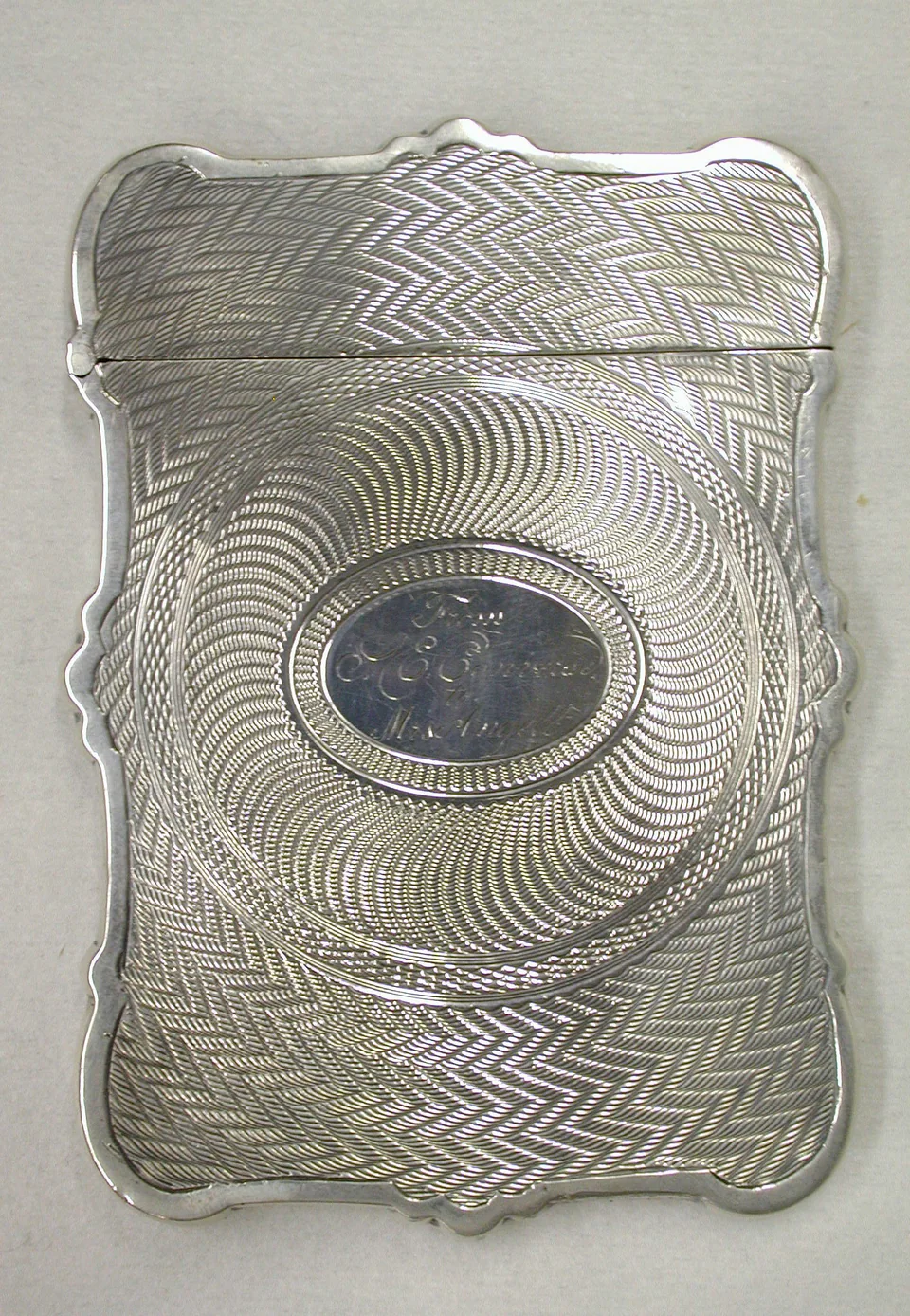
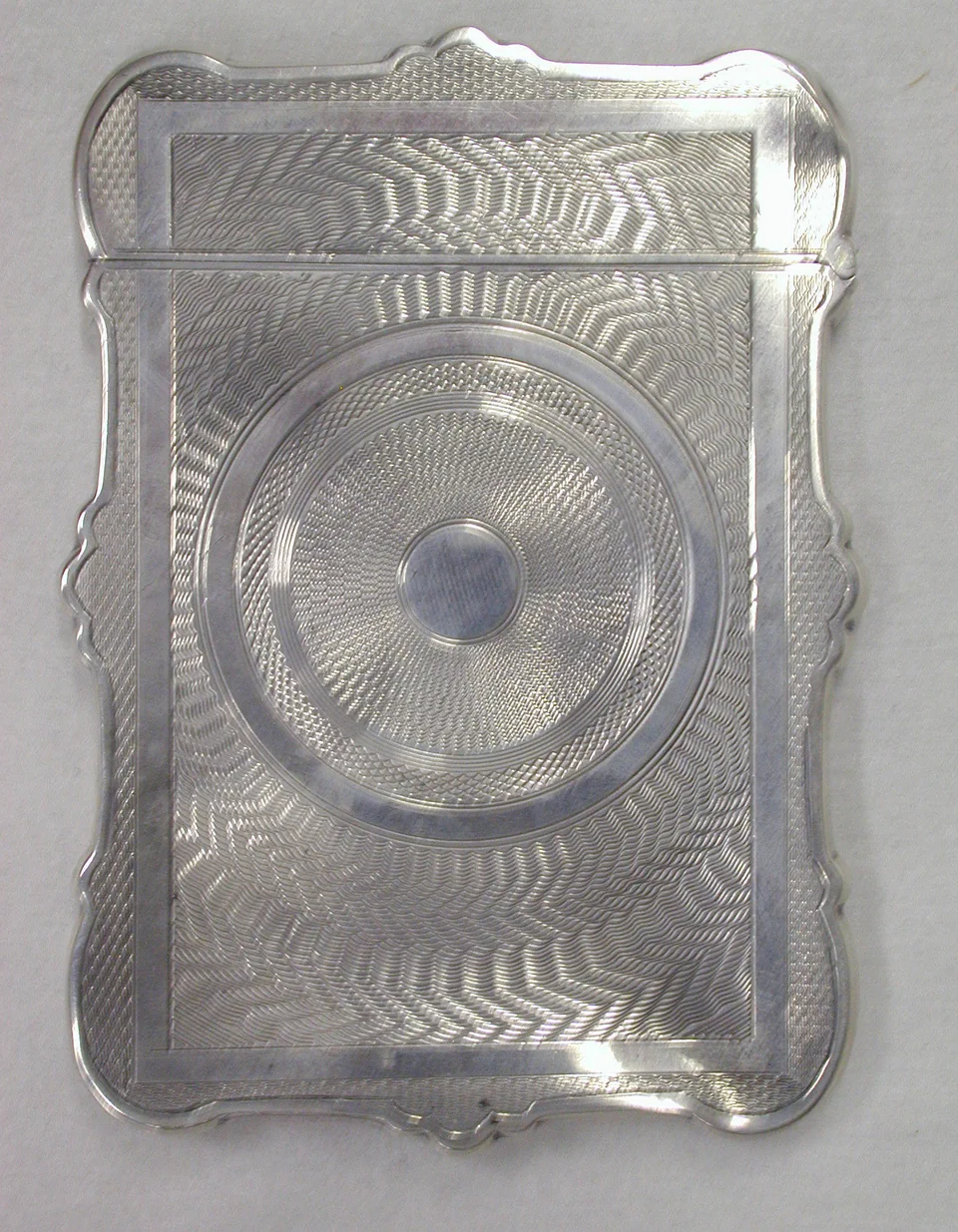
The Met’s silver card case by Albert Coles, about 1840, places the form in an American workshop context. Its ornament and slim outline invite comparison with British examples, but the comparison should not erase the object’s own catalog history or marks.
A maker’s broader output can be a useful research path. Coles is also represented by other kinds of silver in museum collections. Following a name across tableware and personal accessories can reveal a wider business than a single specialty suggests. It does not establish that every similar unmarked case came from that workshop.
American silver marks do not follow the British assay sequence. A maker’s name or initials alone may not establish the exact fineness, and “coin silver” should not become an automatic numerical claim attached to every early American piece. Record the mark as seen and distinguish documentary attribution from testing.
For an inherited case, the family’s account may be as valuable as an unresolved maker. Preserve who supplied the story and when. A remembered owner, a dated receipt or a presentation inscription is a lead that another researcher can follow; a polished-away inscription is not.
When the case is only partly silver.
Calling card cases can combine silver with mother-of-pearl, tortoiseshell, textiles and writing fittings. Some are more accurately described as silver-mounted cases than silver cases. A shiny mount around a shell panel does not make the whole object sterling, and the gross weight includes every material.
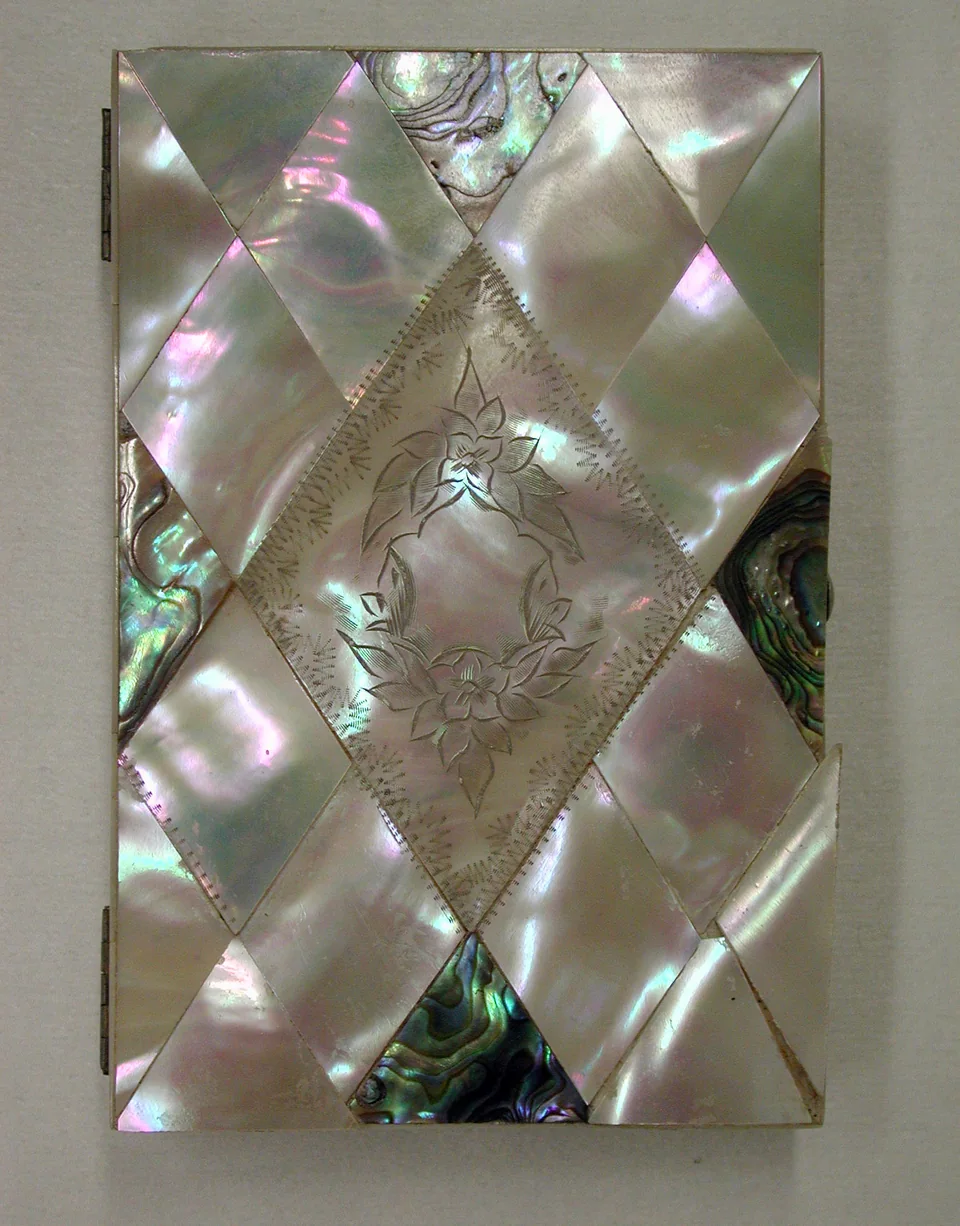
The mother-of-pearl card case shown here is cataloged by The Met as an 1860 example with no maker recorded. Its stated medium is mother-of-pearl, not silver. It is included as a comparison of materials and form, not as a claim that its pale surfaces are precious metal.
Book-opening examples may have gussets or additional fittings. A combined note-taking object is often described as an aide-mémoire. Describe the actual interior: pockets, leaves, pencil fittings and any missing parts. Do not assume that every pale writing leaf is ivory, or identify a material from color alone.
Mixed materials need different care. Water or cleaner can penetrate joins, stain fabric and disturb a core or adhesive beneath a veneer. Loose shell, cracked panels and weakened hinges should be supported and assessed rather than soaked or rubbed. The safest next step for a fragile composite is often documentation, not treatment.
If ivory or tortoiseshell may be present, check the rules that apply to the material, activity and jurisdictions involved. Buying, selling, import and export can have different requirements. “Antique” is not an all-purpose permission slip, and a seller’s willingness to ship does not settle the issue.
The thin edges tell you a great deal.
The broad faces attract attention, but examine the narrow edges first. A dropped case may have a crushed corner, a split seam or a lid that no longer meets the body evenly. Look with a light at an angle and ask for clear photographs of all four edges.
Check the hinge without bending it backward or asking it to reach an arbitrary angle. Support the lid as it moves. A loose catch, missing button or torn attachment deserves an explicit condition note. A functioning closure is useful evidence, but it does not prove that every component is original.
Inspect the reserve where initials might have been engraved. Uneven reflections, a shallow depression or disturbed decoration may prompt questions about an erased inscription. Do not press the panel to test whether it is thin. Physical probing can turn a suspicion into a dent.
Condition affects the meaning of a comparison price. Two cases with the same maker and architectural subject may differ substantially in surface, completeness and repairs. Ask whether a cited auction result includes premium, and date the comparison. A photograph of a similar object offered at a high price is not a valuation.
Can it carry a modern card?
Measure the usable opening and interior, not merely the exterior outline. A border, narrowed throat or lining can reduce the space. Even if a modern card fits, the hinge, surface and material may make regular use unwise. Do not force stiff plastic into an old case or remove fittings to make room.
For a robust, unlined case, suitability is an individual judgment. For a fragile, enameled, shell-mounted or historically important example, keeping it as a collection object may preserve more than everyday use adds. A modern case can do the daily job while the antique retains its evidence.
A satisfying object record includes dimensions, material description, marks, condition and the source of the attribution. Add photographs of the open and closed case and transcribe any inscription exactly. If a personal connection is only a possibility, say so.
The appeal of a calling card case is that the social world is visible in its construction. It protected a name, but it also displayed a place, a pattern or a taste. Read the fitting and the surface together, and the small rectangle becomes considerably more interesting.
Sources & image credits
Reviewed November 10, 2026. Institutional records support the named examples; they do not authenticate or appraise a privately owned piece. Historical beliefs are described as history, not medical advice. Check current official requirements for regulated materials.
- The Met: Albert Coles, Card case, about 1840, 1983.575.57
American maker attribution and object description.
- Victoria and Albert Museum: Every donkey has his carte de visite
Photographic cartes de visite are distinct from ordinary visiting cards.
- London Museum: Taylor & Perry card case, 1845, 36.183/7
Silver-gilt card case with Warwick Castle views. Cited for its object record; the licensed museum photograph is not reproduced.
- Canadian Conservation Institute: Silver — Care and Tarnish Removal, CCI Notes 9/7
Treatment risks, gilding, mixed materials and storage. Treatment must fit the particular object.
- GOV.UK: Dealing in items containing ivory or made of ivory
Check current scope, exemptions and registration requirements before a transaction.
- U.S. Fish & Wildlife Service: Can I Sell It?
Wildlife-material restrictions and antique exemptions require case-specific checking.
Museum photography
These photographs are museum-supplied Open Access or public-domain images. They have been resized proportionally and converted to WebP, without retouching or cropping. The credits identify the object and institution; no endorsement is implied.
- The Metropolitan Museum of Art, Gift of Herbert K. Reis, in memory of Rose-Frances K. Reis (Mrs. Ralph A. Reis), 1983 (1983.575.57). CC0. Image rights
- The Metropolitan Museum of Art, Gift of Herbert K. Reis, in memory of Rose-Frances K. Reis (Mrs. Ralph A. Reis), 1983 (1983.575.57). CC0. Image rights
- The Metropolitan Museum of Art, Gift of Herbert K. Reis, in memory of Rose-Frances K. Reis (Mrs. Ralph A. Reis), 1983 (1983.575.24). CC0. Image rights