
Between vessel and jewel
A small silver vessel can ask us to look as closely as a bracelet. A bracelet can organize space as deliberately as a sculpture. The useful question is not simply which cabinet an object belongs in, but what its maker has done with surface, volume and the body.
This guide brings together a few documented works by Indigenous North American artists, from a Haida bracelet to Diné seed pots and contemporary Chugach Sugpiaq jewelry. These are distinct artistic histories, not variations of one universal “Native style.” The examples offer several ways into the relationship between silver sculpture and adornment; they are not a survey of every nation or community.
Begin with an individual work and the person who made it. Materials and techniques can connect objects across our jewelry hub and sculpture guides, while names, places and cultural context keep those connections meaningful.
Norbert Peshlakai: silver as a small vessel
The Heard Museum includes Norbert Peshlakai’s silver seed pots in its jewelry collection. It identifies him as Diné and dates the illustrated group to the 1980s–1990s. Their presence there is a welcome reminder that a jeweler’s practice need not end at things made to be worn.
Consider what changes when a silver object is approached as a vessel rather than an ornament. There is an inside and an outside, a lip and a base, an opening that helps establish the scale of the body. A surface design meets that volume rather than occupying a flat sheet. Looking around the object becomes as important as looking at its front.
“Seed pot” supplies a form name; it should not, by itself, become a story about how this particular object was used. The documented maker and museum date give us firmer ground. For related questions about volume, joins and construction, continue to how silver sculpture is made.
Overlay and inlay: look closely, name carefully
Overlay is an important technique in Hopi silverwork, creating a striking contrast of light and dark. The Heard describes a pierced upper sheet laid over a solid backing, with the exposed lower areas darkened to emphasize the design. It also makes a crucial distinction: jewelers from other cultures use overlay too. A technique is not proof of an artist’s identity.
The same collection highlights Zuni lapidary work, including mosaic and needlepoint arrangements of turquoise, jet, coral and shell. These comparisons invite different kinds of close looking: the cut edge and shadow of layered metal, or the meeting of small pieces of stone and shell.
Neither observation replaces attribution. In a description, separate what you can see from what a reliable record establishes. “Overlay construction” describes the work. “Made by a named Hopi artist” identifies authorship and requires evidence. Our marks guide provides a starting point for keeping those questions apart.
Charles Loloma: the bracelet as a composition
Charles Loloma, a Hopi artist, offers another route from jewelry into sculpture. The Smithsonian American Art Museum records his Bracelet, about 1960, as silver alloy, stone and ivory, accession 2023.8.2. This is a specific mixed-material work, not a reason to describe every Loloma bracelet as silver.
The museum supplies several views. Looking from one angle and then another is a useful exercise: trace the band, then look at how the other materials meet it. Ask where the eye pauses, which edges project, and how the composition changes as it turns. A bracelet has a relationship to a moving wrist that a single frontal photograph cannot fully convey.
The material description matters aesthetically as well as technically. Silver is part of a conversation with the other components, rather than a neutral support to be ignored or a metal total to be calculated. A study of the whole object should preserve that complexity. For practical handling questions, see our composite silver care guide.
Charles Edenshaw: a design around the wrist
On the Northwest Coast, Charles Edenshaw’s Haida silverwork opens a different artistic history. The McMichael Canadian Art Collection identifies the bracelet shown here as silver and dates it to about 1910. Its engraved forms move around a curved surface, with textured areas setting off broader, smoother passages.
Follow the upper and lower borders before exploring the shapes between them. The bracelet’s curve is not an inconvenience hiding a flat picture: it is part of the object you are looking at. This view offers an entrance into the composition rather than its whole circumference.
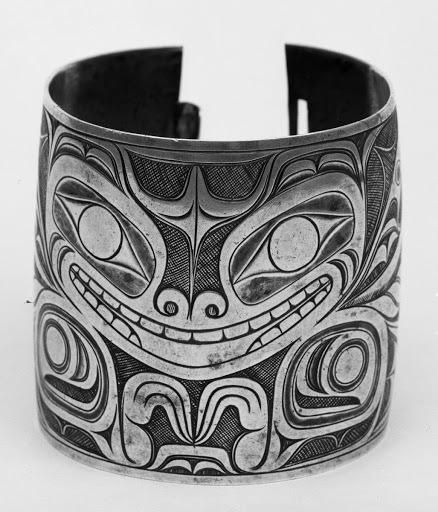
The Edenshaw object study compares the museum descriptions, including a differing published date, and places this bracelet beside other documented works. That deeper context is more useful than treating an isolated design as a motif detached from its maker and community.
Denise Wallace: adornment with a sculptural presence
Denise Wallace’s work takes us to another meeting of figure, material and adornment. The National Museum of the American Indian identifies her as Chugach Sugpiaq (Alutiiq). Its 1992 bolo tie Large Fetish, catalogue 26/5420, combines silver, fossil ivory, a leather thong and paint. The record lists carving, incising, inlay, hammering and braiding: several kinds of making brought into one wearable object.
The museum’s 2006 exhibition Arctic Transformations surveyed 25 years of Denise and Samuel Wallace’s jewelry, including 16 elaborate belts. Its account connects their work both to Denise’s heritage and to contemporary concerns. That matters: tradition and invention need not be treated as opposites.
These examples also challenge the assumption that a wearable work is less ambitious than a freestanding sculpture. A belt or bolo has to address the body, movement and the joining of parts while sustaining its visual presence. Rather than removing that function from the story, it is worth asking what the function makes possible.
Follow the artist, not just the category
The most rewarding next step is often a name rather than a search for more objects that look similar. The Heard Museum’s Native American Artists Resource Collection brings together artist files, biographical reports, exhibitions and bibliographic references. It is a research resource, not a service that authenticates an object from a photograph.
For a piece you own, keep the maker’s name, the wording of any attribution, material descriptions and the object’s documented history together. Preserve a question mark when a source uses one. An unsigned piece need not acquire a confident maker simply because its form resembles a published example.
Then return to the object itself. The seed pot, engraved bracelet and mixed-material bolo offer different experiences of silver: enclosing space, carrying a design around the wrist, or bringing several materials into a wearable form. Their connection is not sameness. It is the range of individual choices that this metal allows us to encounter.
Sources & further reading
Object identifications and image rights were checked against the named institutions. Maker descriptions are attributed to the maker; they are not independent appraisals.
- Heard Museum: jewelry collection and Norbert Peshlakai seed pots
- Smithsonian American Art Museum: Charles Loloma, Bracelet, 2023.8.2
- McMichael Canadian Art Collection: Charles Edenshaw, Bracelet
- National Museum of the American Indian: Denise Wallace, Large Fetish, 26/5420
- National Museum of the American Indian: Arctic Transformations
- Heard Museum: Native American Artists Resource Collection