
Material and construction are different questions
“Silver” can describe a metal, an alloy, a surface or simply a colour in a casual listing. “Solid” is equally slippery: it may distinguish an alloy from plating without proving that the object is solid rather than hollow. Ask for a precise description instead of relying on either word alone.
Sterling normally means an alloy containing 925 parts of silver per thousand. Fine-silver descriptions such as .999 refer to a higher silver fraction. Neither figure tells you whether an object contains a hollow space, a supporting armature, a resin filling or a wooden base. A fineness statement and a construction statement answer different questions.
For a documented, entirely sterling component, its metal mass multiplied by 0.925 gives the calculated fine-silver mass. The important word is component. You cannot safely apply that calculation to the total weight of a figure on a base when the mass of the base and any non-silver contents is unknown.
The silver markings guide explains the next step. A stamped number is evidence to assess alongside the object, maker and provenance, not a complete authentication report.
Cast, shaped, assembled
In casting, metal takes the shape of a mould. Lost-wax casting uses a wax form that is removed to leave the space for the metal. Raising begins from sheet metal worked into a three-dimensional form. A finished object can combine these approaches: a shaped body, cast feet and separately made details.
The V&A’s metalworking guide is a useful introduction to these processes. Electroforming is another distinct method, building metal through deposition. The word does not establish that the deposited metal is silver; the exact material still needs documentation.
A seam, vent, fixing or change in texture is a question to investigate, not an instant verdict. It may belong to original manufacture, a later repair, or the way separate parts were intended to meet. A smooth surface does not prove a one-piece casting, and a visible join does not automatically mean damage.
Photograph the front, back, sides and underside before trying to explain the process. Record observations in plain language: “join visible around the lower body” is more defensible than “badly repaired” when the evidence is incomplete.
Hollow does not mean lesser
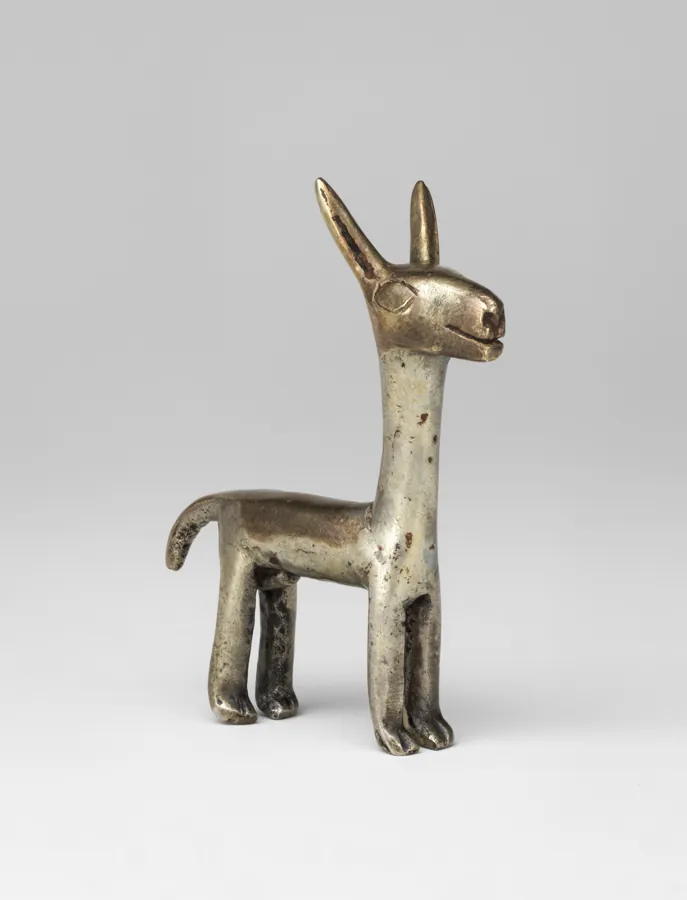
The Inca camelid illustrated here has a solid head and hollow body, identified through the Met’s technical examination. Its construction is part of a deliberate making process. Hollow work can be intricate and historically important; a large internal void is not a reason to dismiss it as an imitation.
Wood, stone, enamel, glass, gilding and internal supports can all belong to the intended design. The problem arises when a description treats a composite object as a known quantity of silver without evidence. Separate an object’s aesthetic and historical significance from any calculation of its recoverable metal.
For a mounted animal, ask whether the quoted weight includes the plinth and fittings. If the maker supplies a silver-only weight, retain the exact wording and source. If no reliable separation is available, write “gross weight including base; silver weight unknown.” Do not invent a typical filling percentage or remove the base just to improve a spreadsheet.
Our weighted and composite silver guide develops the care questions. The original Kirk Stieff horse record shows why a mounted figure deserves photographs of both sculpture and support.
Inspect the vulnerable points
Start with the silhouette. Antlers, fingers, ears, weapons, reins and thin legs may project beyond the main body. Compare them with trustworthy photographs of the exact model when available, while allowing for documented variants. A bent projection or missing part can be easy to overlook in a flattering front view.
Next inspect the junctions: figure to base, head to body, accessory to hand. Ask whether parts are removable by design and whether any mechanism operates. Do not force a stuck attachment, wind an unfamiliar mechanism or straighten a part for a photograph. A specialist can assess a concern without turning uncertainty into irreversible damage.
Marks deserve their own sharp images in even light. Transcribe what is visible before interpreting it. A retailer’s name, designer’s signature, assay mark and edition number may all serve different purposes. A certificate should correspond to the object and model, but paper alone cannot establish metal content or originality.
For expensive or disputed work, an appropriate specialist may combine documentation, visual examination and testing. Surface testing has limits, especially on plated or layered objects. A home scratch, acid or abrasive test is not a sensible first step on a collectible sculpture.
Care begins before polishing
Place a figure on a stable surface where it is unlikely to be knocked, caught by fabric or exposed to damp. Support its weight at strong points rather than lifting by a head, tail or projecting limb. Keep detachable parts documented and secure. Packaging must protect the shape without pressing on fragile details.
The Canadian Conservation Institute cautions that repeated polishing removes metal. Gilding, deliberate darkened surfaces, soldered parts and mixed materials need particular care. Immersion is unsuitable for some hollow or composite pieces, and residues can remain in inaccessible spaces.
Do not assume every dark recess needs to become bright. It may be an intended finish, accumulated tarnish or another surface change that requires identification first. On significant historic work, unstable surfaces or an uncertain finish, ask a qualified conservator before attempting treatment. There is no single dip, paste or cleaning recipe appropriate to everything in this hub.
Good condition records make future decisions easier. Take dated photographs before and after any professional work, retain the treatment report and distinguish new intervention from what was present when acquired.
Keep the value calculation honest
A sculpture’s price can reflect design, workmanship, maker, condition, rarity, provenance, licensing and demand as well as metal. A premium over a calculated silver amount is not automatically unreasonable, but neither does a low edition size prove a resale market.
For comparison, match the exact model, size, finish, edition and accompanying pieces. Asking prices are not completed transactions. When sold examples exist, check whether their totals include fees, shipping or other costs before treating them as equivalent.
Metal arithmetic is only useful when its inputs are sound. Separate gross weight, documented metal weight, fineness and the dated silver price. A theoretical metal value is not a guaranteed offer: testing, recovery costs and the buyer’s terms can affect what someone will pay. If construction is unknown, keep the metal estimate unknown.
Finish with a description another collector could audit: what you saw, what the maker or museum states, what paperwork supports, and what remains unverified. That distinction is more valuable than an impressively precise number based on a guess.
Sources & further reading
Object identifications and image rights were checked against the named institutions. Maker descriptions are attributed to the maker; they are not independent appraisals. Sources checked 11 November 2026.
- V&A: metalworking techniques
- Canadian Conservation Institute: care of silver
- Collect Silver: markings and hallmarks
- Collect Silver: weighted and composite silver
Illustrated museum objects
Museum inclusion does not imply endorsement.