
Small figures, long histories
Silver sculpture has no single starting point and no single purpose. A figure might be an offering, a sacred presence, an object of courtly display or a private possession. These uses can overlap, but they should not be flattened into a story in which everything eventually becomes a modern collectible.
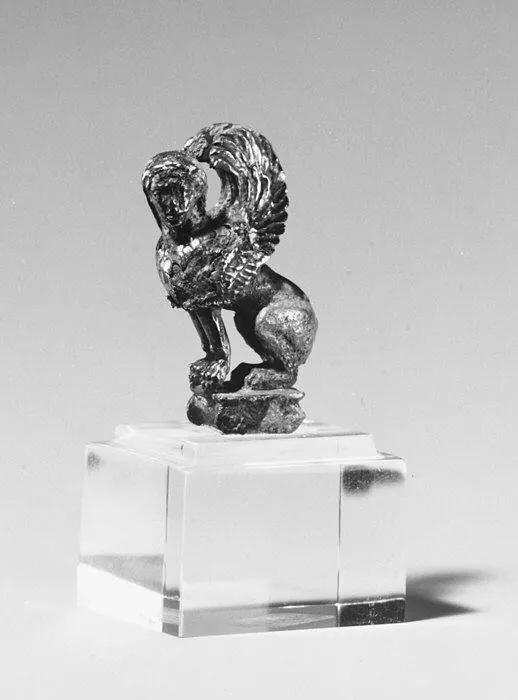
Two ancient objects set very different scales. The Met’s Egyptian Statuette of a Royal (?) Woman, dated 610–595 BCE, carries the cartouches of Necho II. The question mark matters: her identity is uncertain. A Greek sphinx from the fifth century BCE is only 3.2 cm high. Its silver and gilding give a tiny creature a remarkable presence.
The museum mount beneath the sphinx is visible in the photograph. It is not part of the ancient animal. That simple distinction is useful throughout this subject: display fittings, later repairs and original metalwork do not necessarily share a date, material or purpose.
Sacred bodies: Europe and Asia
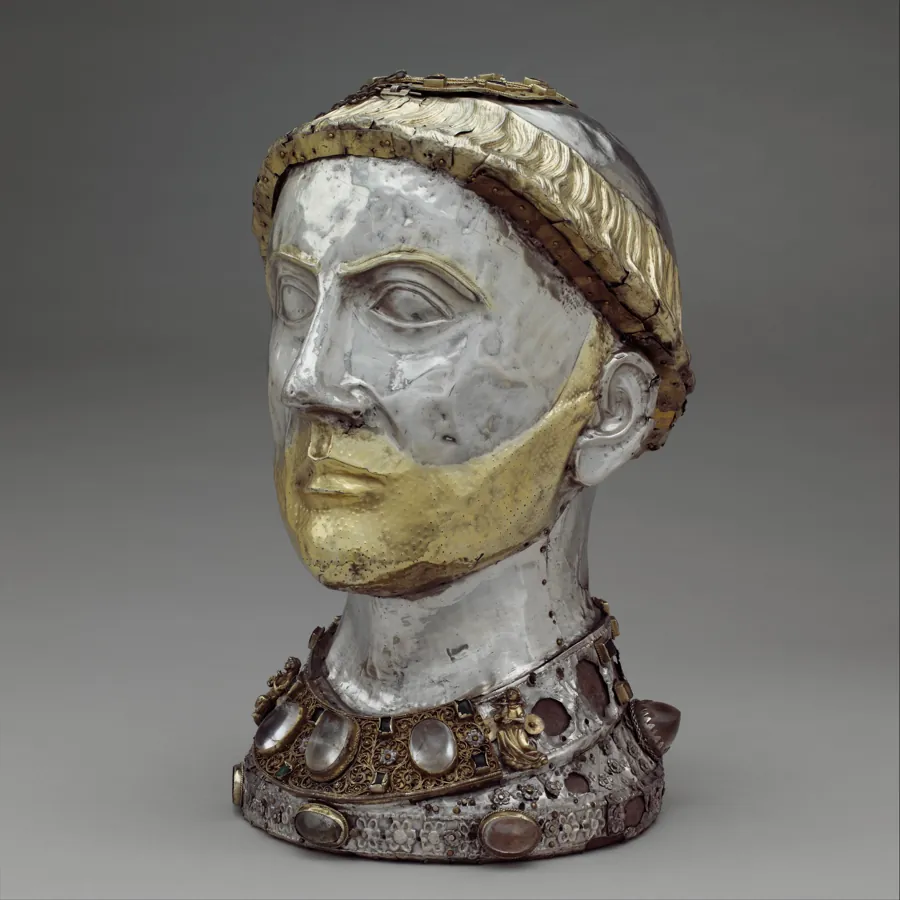
The French reliquary bust of Saint Yrieix, about 1220–40, is a face made luminous through silver, gilding, rock crystal, gems and glass. Silver sheets originally enclosed a carved wooden core. It is a substantial work of silver sculpture without being a body of silver all the way through.
A reliquary gives physical form to devotion and the protection of sacred remains. Its meaning cannot be understood from metal weight alone. Look at the arrangement of the face and ornaments, then read the museum’s account of its original setting and subsequent changes. The grill is later than the main medieval work.
Across a different religious and artistic tradition, the Cleveland Museum of Art’s Bodhisattva Maitreya: The Future Buddha dates to the 1100s in eastern India, Bengal, during the Pala period. Silver is inlaid with turquoise, copper, brass and gold, and the lotus is gilt bronze. The museum proposes that the figure later traveled to Tibet; it does not present that journey as certain.
These objects belong to distinct traditions. Comparing them can illuminate material choices and the relationship between figure and setting, without treating their religious meanings as interchangeable.
The fourteenth and fifteenth centuries
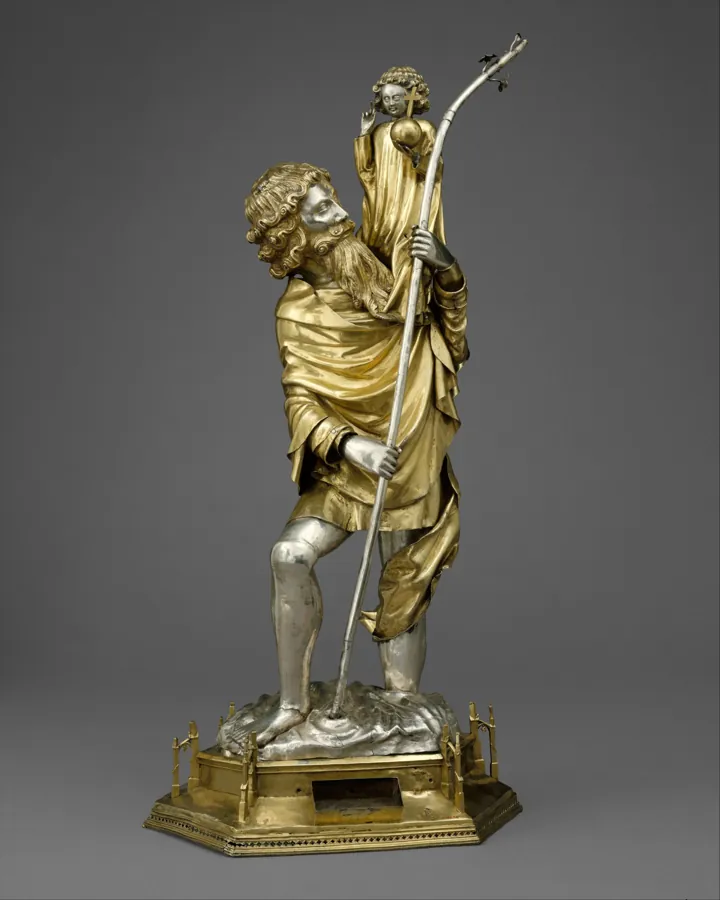
Saint Christopher appears in silver carrying the Christ Child in a French reliquary statuette dated about 1375–1425. Hallmarks connect it with a Toulouse goldsmith. A crystal-covered box in the base once held a relic, now lost. Drapery, gesture and the placement of the small child turn precious metal into a readable narrative.
This is a useful answer to the idea that silver sculpture is mainly a modern novelty. Medieval makers were already coordinating figure, support, surface and function. Yet the object’s survival should not be mistaken for a complete account of what a city or century produced. The museum record describes this particular survivor.
When reading an attribution, distinguish a named artist from a place identified through marks. “Made in Toulouse” and “made by a specific Toulouse goldsmith” are not equivalent claims. A date range spanning 1375–1425 should remain a range, rather than becoming an attractive but unsupported year such as 1400.
Andean miniatures: different ways to make a figure
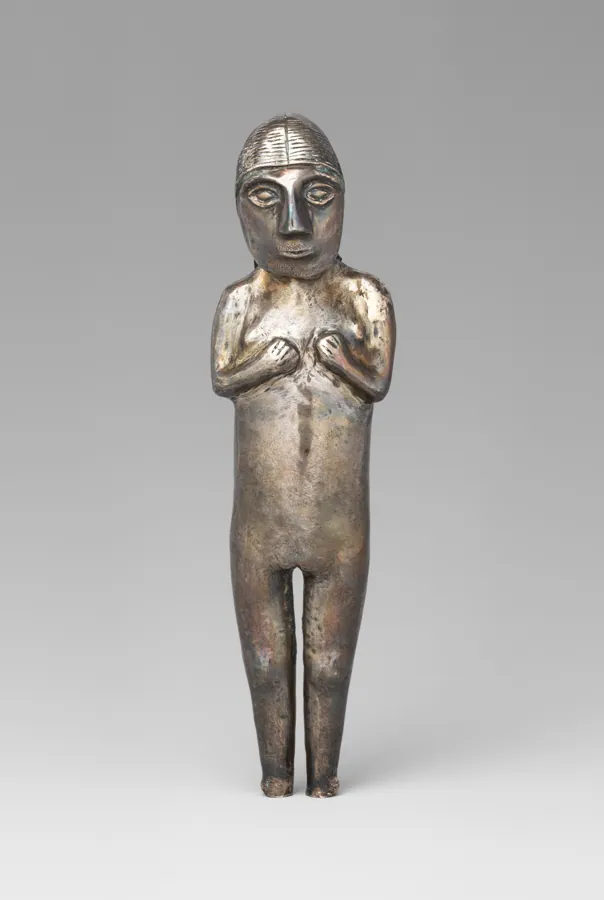
Inca metalworkers created human and animal figures whose small scale did not mean small significance. The Met’s female figurine, dated 1400–1533, was made hollow from five sheet-silver components, including two feet now missing. The museum associates figures of this kind with offerings; the circumstances of this individual object are not a fully documented ritual biography.
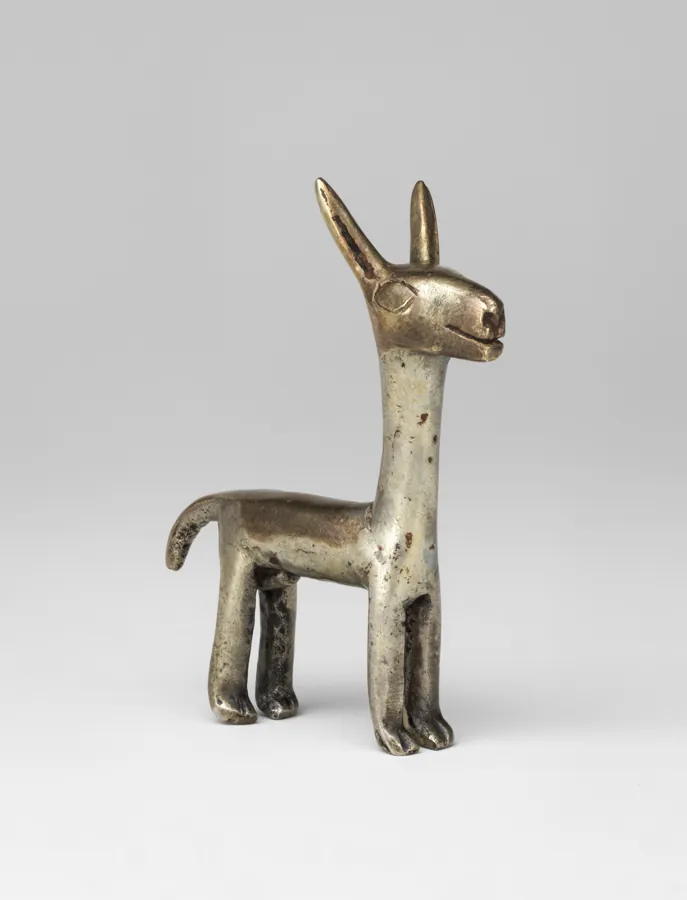
The miniature camelid below, dated 1400–1535, presents a different construction. Technical examination identifies lost-wax casting in two stages, with a solid head and hollow body. Its material is a silver, gold and copper alloy. It should not be described as pure silver, sterling or another example of hammered sheet.
The two figures are especially rewarding to compare because their outward category, “silver miniature,” conceals important differences. A collector’s description becomes more useful when it separates subject, cultural attribution, date, material and construction instead of squeezing all of them into one reassuring label.
The sixteenth century: engineering the table
Some of the most ambitious European silver objects sit between sculpture and tableware. The Schlüsselfelder ship, made in Nuremberg in 1503 or shortly before, combines raised and cast silver, extensive gilding, enamel and painted details. Its removable deck reveals a vessel. The Germanisches Nationalmuseum attributes it to an unknown maker, not to Albrecht Dürer.
The ship’s figures and rigging invite close inspection, but the removable components also show why completeness matters. A later replacement or missing fitting can affect the object’s meaning and operation, not simply its silhouette.
Wenzel Jamnitzer’s 1549 centrepiece takes another direction: an elaborate sculptural arrangement around Mother Earth, populated by cast natural forms. The Rijksmuseum’s technical study examines its components, fastening system and conservation history. The work is nearly a metre high, but its achievement lies as much in the relationships among many delicate parts as in its size.
A functional vessel does not stop being sculptural because it can hold wine or adorn a table. Equally, calling it a statue can hide the very use that explains its shape. Keep both aspects in the description.
A stag that moved across the table
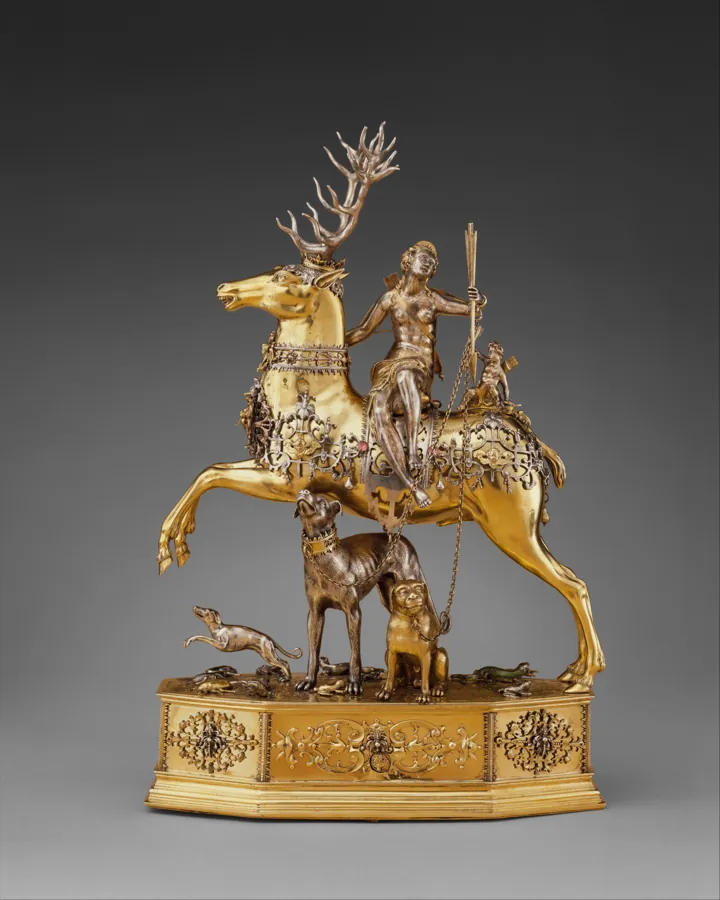
Diana and the Stag, by Joachim Friess of Augsburg, dates to about 1620. The Met identifies partially gilded silver, enamel and jewels in the case, with iron and wood in the movement. The stag’s hollow body could hold wine, its head could be removed, and the mechanism made the object a moving table entertainment.
It belongs just beyond the sixteenth century, not inside it. Its gleaming surface is also not evidence that the movement or every internal component is silver. The distinction between case, contents and mechanism is part of the attraction: this is a collaboration of sculpture, vessel and mechanical ingenuity.
In the photograph, follow the stag’s antlers, Diana’s upright figure and the rolling base. These protruding and moving elements demand a different handling plan from a compact, single-piece figure. History and practical collecting meet in the object’s structure.
Japan: animals built to move
The moving stag invites another question: how can metal suggest a living creature? In Japan, jizai okimono, or articulated ornamental figures, explored movement through jointed bodies and limbs. This is a distinct metalworking tradition, with its own history and materials.
The Tokyo National Museum’s account identifies a dragon by Myochin Muneaki dated 1713 as an early dated example. It suggests that Myochin armor-makers brought their forging and hammer-working skills to ornamental animals during the peaceful middle Edo period. By the Meiji period (1868–1912), these movable figures were being exported, with Takase Kozan’s studio among the principal producers.
A specific silver example is the Asian Art Museum’s Articulated praying mantis, by Takase Kozan (1869–1934), object 1990.67. The museum records its material as silver and its marking as “Kozan.” Those life dates identify the artist; they do not establish a precise year for this insect.
The wider tradition includes iron, copper and mixed alloys as well as silver. Shibuichi contains copper and silver; shakudō contains copper and gold. An articulated animal therefore needs an object-specific material description. Its name and moving joints alone cannot tell you its silver content. For a collector, the joints also make condition a matter of connections and completeness, not just the surface of the metal. The inspection guide explains why unfamiliar moving parts should not be forced.
A dragon, a jewel and an imagined sea
Movement can also be imagined within a stationary work. The Cleveland Museum of Art’s Tide-Changing Jewel with Dragon, from Japan in the early 1900s, brings silver, shakudō and crystal into one composition. Its museum record, 1947.682, gives a height of 35.6 cm with the stand and does not name an artist.
The museum connects this okimono, a small sculptural object, with legends of jewels that control the tides and dragons associated with water. It also interprets the work as appealing to the interest in gems and minerals among some Americans and Europeans of the period. These are the museum’s readings of the object, rather than a documented account of one buyer’s intentions.
Read the materials together: the crystal is part of the work, while the copper-and-gold alloy contributes something different from the silver. Keeping the stand in the measurement helps preserve the scale of the complete composition. The record supplies neither a silver-only weight nor a numerical fineness, so neither belongs in a collector’s description borrowed from it.
Placed beside the articulated mantis, the dragon opens two ways into Japanese metal sculpture: a creature whose parts move, and a still composition whose subject evokes moving water. They also connect this history to the animal cabinet, where pose, materials and the relationship between figure and support reward the same close looking.
Later traditions, living makers
Later silver figures range from domestic miniatures and elaborate presentation pieces to monumental exhibition projects. Montana’s silver Justice at the 1893 Chicago world’s fair is one example of scale serving a public message. Its historical reports deserve care, so it appears in our separate record-size study rather than an unqualified ranking.
Today, the field includes animal sculpture, studio work, licensed characters and small editions. This is not a direct, unbroken descent from a medieval reliquary to a modern film character. It is a set of ways people continue to use a reflective, workable and culturally resonant metal.
Use the museum examples as starting points, not a complete world census. This selection reaches ancient Egypt and Greece, medieval Europe and eastern India, the Inca Andes, and Japanese metalwork. Other regional traditions require their own objects, sources and voices. A future addition should expand that evidence rather than claim a culture is represented by a generic photograph.
For a piece you can inspect today, move from this history to the materials and construction guide. For current makers and editions, follow the modern collecting guide.
Sources & further reading
Object identifications and image rights were checked against the named institutions. Maker descriptions are attributed to the maker; they are not independent appraisals. Sources checked 11 November 2026.
- The Met: Egyptian royal (?) woman, 30.8.93
- Cleveland: Maitreya, 1982.48
- Germanisches Nationalmuseum: Schlüsselfelder ship, HG2146
- Rijksmuseum Bulletin: Jamnitzer’s centrepiece technical study
- Tokyo National Museum: jizai okimono and their history
- Asian Art Museum: Takase Kozan’s silver articulated praying mantis, 1990.67
- Cleveland: Tide-Changing Jewel with Dragon, 1947.682
Illustrated museum objects
- Silver statuette of a sphinx with gilding (1995.539.5)
- Reliquary Bust of Saint Yrieix (17.190.352a, b)
- Reliquary Statuette of Saint Christopher (17.190.361)
- Female Figurine (1979.206.336)
- Diana and the Stag (17.190.746)
- Miniature camelid effigy (1974.271.36)
Museum inclusion does not imply endorsement.