

Haida silver · Haida Gwaii
An individual artist, a living context
Charles Edenshaw, also known as Da.a xiigang (c. 1839–1920), was a Haida artist from Haida Gwaii. Born at Skidegate and later based at Old Masset, he worked across several materials. Silver belongs within that wider career, alongside wood, argillite and collaborations with the weaver Qwii.aang, Isabella Edenshaw.
His silver rewards close looking: a curved bracelet carries an intricate composition around the wrist. The museum examples below span approximately 1880 to 1910, documenting decades of attributed practice rather than a short-lived experiment.
The Council of the Haida Nation’s December 2013 Haida Laas reports on the retrospective through Haida participants, including James Hart and Lalaxaaygans, Terri-Lynn Williams-Davidson. Its account connects discussion of objects and attribution with Haida histories and laws. Read that community account alongside the museum catalogues.
MOA’s archival biography explains that works are usually attributed through style and provenance, rather than signatures. A familiar shape or image alone cannot establish authorship. The individual maker, the specific object and the evidence for its history each deserve a separate record.
From the museum collection
Silver bracelets and their histories
One photograph and three linked comparisons examine composition, materials, attribution and later intervention. Approximate dates remain approximate.
The McMichael bracelet: follow the curved surface
McMichael Canadian Art Collection’s partner record dates this silver Bracelet to c. 1910 and gives dimensions of 6.4 × 6.7 cm. The photograph shows broad curved forms set against finely textured areas, contained between narrow upper and lower borders.
The Vancouver Art Gallery identifies the McMichael object as Sea Bear Bracelet, accession 1981.108.1, and dates it to the late nineteenth century. These published dates differ. Keep both source descriptions visible rather than silently turning either into a precise year.
Look first at the changing width of the engraved forms and the contrast between smooth and textured silver. A single front view cannot show the entire composition, the closure’s condition or later repairs. Follow the collection record before making comparisons with an object in hand.
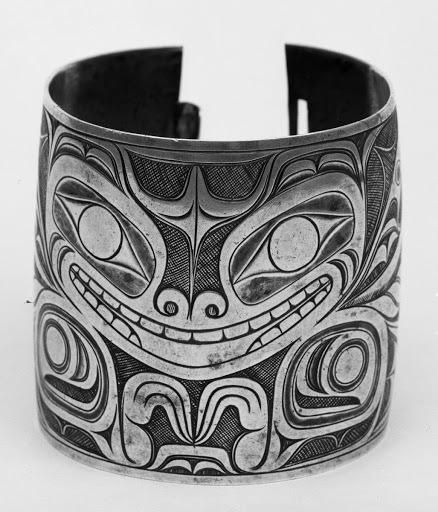
Charles Edenshaw, Bracelet, c. 1910 in the McMichael partner record.
McMichael Canadian Art Collection.
View the collection photographSeattle: record the material exactly
Seattle Art Museum credits Edenshaw as maker of Daalaa stlagaa (bracelet), ca. 1890, object 91.1.130. The gift of John H. Hauberg measures 3 × 6.4 cm. Its medium is catalogued as “Silver coin.”
That description is useful evidence about this object. It does not specify a sterling fineness or identify a particular coin issue. Preserve the museum’s wording rather than supplying an unsupported assay or turning it into a rule for every Haida bracelet.
The linked record gives another view of Edenshaw’s work at a different scale. Compare the recorded dimensions before judging proportions from photographs. Museum images are research references, not evidence that a superficially similar bracelet has the same maker.
MOA: an attribution with a documented basis
MOA’s xiigaa xahl k’iidayaa (Bracelet), object 3260/57, is dated c. 1890 and catalogued in silver. The record identifies Edenshaw through compositional style and describes a double hook-slot closure. It records the bracelet’s arrival with the Elspeth McConnell Collection in 2017.
MOA also gives a specific identification of the imagery in its full record. Keep that interpretation attached to this object and its source. A collector should not transfer it to another bracelet merely because some engraved forms appear similar.
For an attributed work, retain the source, date and reasoning behind the attribution. Ask what provenance survives and whether the closure, edges or engraving have been altered. A written trail makes the comparison more useful than an unsupported famous name.
An early bracelet and Bill Reid’s later work
Gerald McMaster’s Art Canada Institute study illustrates an Edenshaw silver bracelet dated c. 1880 at MOA. Its caption records that Bill Reid restored and re-engraved it around 1980 while he owned it. The surviving surface therefore includes a later artist’s intervention.
Alongside it is Reid’s separate xiigya (Bracelet), c. 1956, made after Edenshaw. Keep the older, subsequently reworked object distinct from Reid’s later study. “By,” “restored by” and “made after” describe different relationships between an object and an artist.
This comparison makes restoration history part of attribution. When a seller supplies an early date, ask what that date describes and what changed afterward. Do not treat a later intervention as invisible, or a clearly credited study as an undisclosed imitation.
Names & chapters
How the story developed.
- c. 1880
An early silver bracelet
The bracelet illustrated by Art Canada Institute is later restored and re-engraved by Bill Reid, c. 1980.
- c. 1890
Two separately catalogued objects
Seattle and MOA each hold a bracelet assigned to this approximate period.
- c. 1910
The McMichael partner record
This is the date supplied on Google Arts & Culture; the Vancouver exhibition uses a different approximate date.
- 2013–14
A retrospective with Haida advisors
The Vancouver exhibition is curated by Robin K. Wright and Daina Augaitis with Haida advisors James Hart and Robert Davidson.
Follow an interest
What to explore.
A historical profile of one Haida artist, not a survey of all Indigenous silver traditions or a current sales listing. Cultural interpretations remain with the identified sources. No object has been examined or authenticated, and no signature, hallmark or crest has been reconstructed.
Check the details
Before you buy.
Follow the object’s full history, including what remains uncertain.
Open the references
Research this name.
- Community publication
Read the Haida Nation’s account
Graham Richard’s “7idansuu,” Haida Laas, December 2013, p. 4.
- Museum exhibition
Explore the Vancouver retrospective
See the exhibition’s scope, advisors and McMichael object caption.
- Collection partner record
Study the McMichael bracelet
Check the photograph, dimensions, approximate date and object-specific rights statement.
- Museum collection
Read the Seattle bracelet record
Check accession 91.1.130, maker credit, dimensions and material.
- Museum collection
Explore MOA’s bracelet 3260/57
Read the attribution discussion, closure description and collection history.
- Curatorial scholarship
Compare Edenshaw and Reid
Read the separate captions for a restored bracelet and a later study.
- Museum archive
Read MOA’s archival biography
Follow the artist’s practice and the role of provenance in attribution.
- Public history
Read the historical biography
Follow the artist’s places, materials and collaboration with Isabella Edenshaw.
- Collecting guide
Explore bracelet construction
Compare forms and fastenings without assigning an artist from shape alone.
- Collecting guide
Keep useful collection records
Bring provenance, condition and research into one object file.
- Collecting guide
Plan safe jewelry care
Preserve surfaces and seek advice before treatment.
Sources & further reading
- Read the Haida Nation’s account Council of the Haida Nation · Community reporting on Haida participants, attribution and cultural context
- Explore the Vancouver retrospective Vancouver Art Gallery · Exhibition context, Haida advisors and qualified object date
- Study the McMichael bracelet McMichael Canadian Art Collection via Google Arts & Culture · Museum-supplied object record and photograph rights
- Read the Seattle bracelet record Seattle Art Museum · Object record and material wording
- Explore MOA’s bracelet 3260/57 UBC Museum of Anthropology · Object-specific attribution, materials, physical description and provenance
- Compare Edenshaw and Reid Art Canada Institute; Gerald McMaster · Iljuwas Bill Reid: Life & Work, Style & Technique
- Read MOA’s archival biography UBC Museum of Anthropology Archives · Biographical and attribution overview
- Read the historical biography Parks Canada · Da.a xiigang (Charles Edenshaw), c. 1839–1920
Sources checked November 11, 2026. Dates, material descriptions and later interventions retain their qualifications. Photograph: McMichael Canadian Art Collection.