A bracelet has to accommodate a moving wrist, a passing hand and the small knocks of everyday wear. Start with how it opens. That simple question leads to better measurements, more useful condition photographs and a clearer understanding of the maker’s choices.
Four forms, four different fitting questions
A closed bangle must pass over the hand. A hinged bangle opens around the wrist. An open cuff leaves a gap between its ends. A flexible bracelet follows the wrist through linked or hinged parts. Sellers sometimes use these names loosely, so ask for photographs of the opening and underside rather than relying on the listing title.
A broad hollow bangle can feel lighter than a narrow solid one. Neither construction is inherently a quality grade: look at how well its shape, surface and fastening work together. A hollow form calls for attention to dents and seams; an articulated band calls for attention to the moving connections.
Closed bangle: record the inside dimensions and check whether the opening clears your hand comfortably.
Hinged bangle: record the closed inside width and depth, along with band width.
Open cuff: record the interior curve, opening and band width. Ask whether its shape is intended for a particular wrist.
Flexible bracelet: record length, width and clasp overlap. Thick links can change the usable fit.
When structure becomes ornament
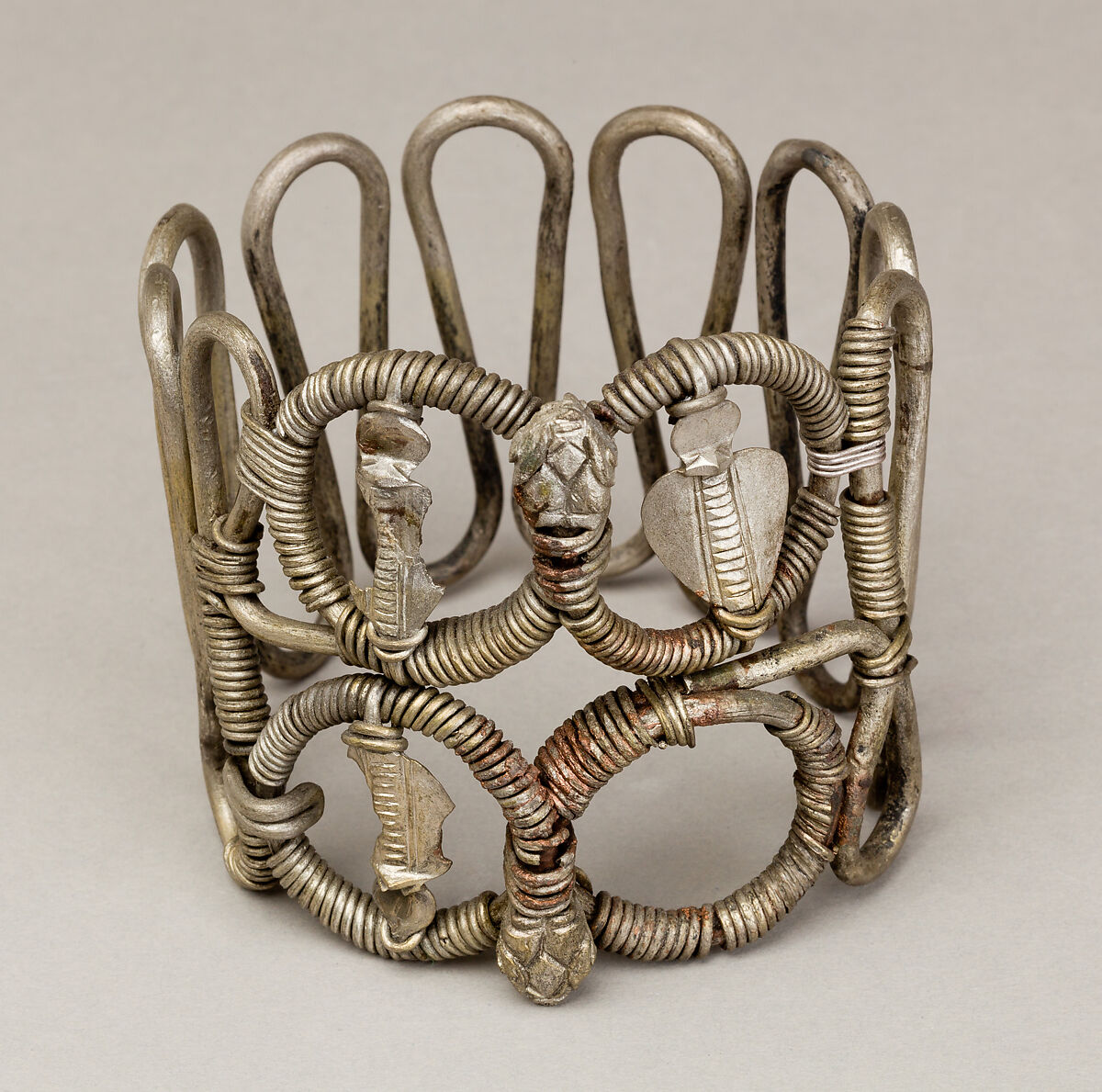
The Met’s bracelet or armlet with uraei, 26.7.1454, is dated 30 BCE–364 CE. Two substantial silver wires are held together by a thinner wire whose loops also supply decoration. Four upright cobra ornaments were originally attached; one is missing. The construction offers a wonderfully clear exercise in looking: follow the main wires first, then the binding, then the applied creatures.
The museum says this design could be made without heat or soldering. That is a statement about the construction’s possibilities, not proof of every step used to make this particular object. Keep the same distinction when inspecting later jewelry: a visible seam or a wrapped joint invites a question, but does not establish the entire manufacturing process.
Bracelet or armlet with uraei, Roman-period Egypt, 30 BCE–364 CE. Silver. The Metropolitan Museum of Art, 26.7.1454. Public Domain. Museum record · Open Access
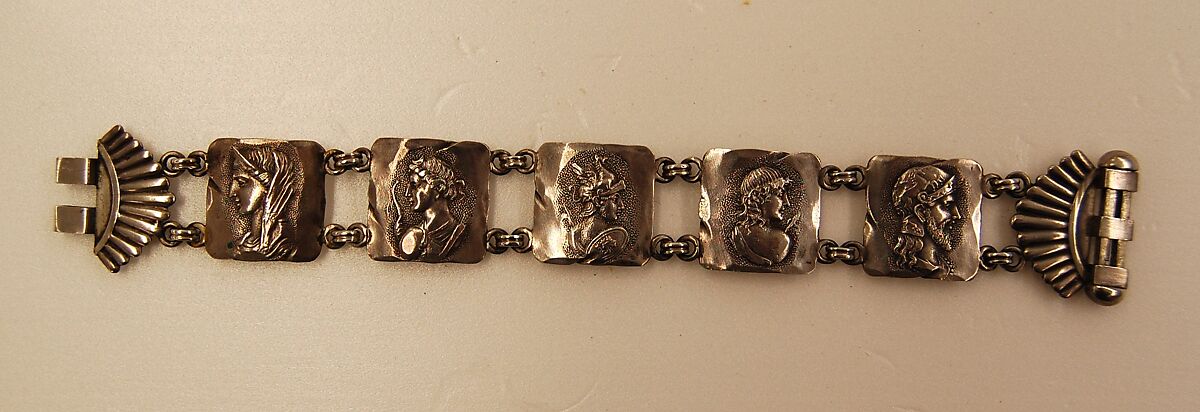
George W. Shiebler & Co.’s silver bracelet, about 1880, brings a different construction into focus. Its five square panels carry classical profiles, with two rows of oval double links joining the panels. Fan-shaped ends meet at a double tongue clasp. The Met records it as 2009.111.
Notice how the broad panels depend on much smaller connecting parts. On a bracelet you are considering, inspect those connections from both sides. Are corresponding links similar in thickness? Does one panel hang at a different angle? Is there a conspicuously altered connection? These observations can guide a repair inquiry without turning every irregularity into evidence of damage. Handmade work and earlier repairs both deserve careful description.
Bracelet, George W. Shiebler & Co., about 1880. Silver. The Metropolitan Museum of Art, 2009.111. Public Domain. Museum record · Open Access
Do not repeatedly spread and squeeze a cuff to get it on and off. Bending can damage the band, soldered decoration or stone settings. There is no universal safe gap or adjustment allowance. If a cuff does not fit comfortably in its intended shape, have a qualified jeweler assess whether adjustment is appropriate before buying it for regular wear.
With a hinged piece, look for alignment where the halves meet and visible wear around the hinge. With a clasp, ask for a demonstration of its normal operation. Do not pull hard, twist hinges sideways or keep forcing a reluctant catch. A safety chain is an additional feature, not evidence that the main fastening is sound.
When buying remotely, compare measurements with a bracelet that already fits you and uses similar construction. Ask how the seller measured the object; an outside diameter is not an inside diameter, and an end-to-end measurement may include overlapping clasp parts.
Keep condition and value in separate columns
Photograph the inside, ends, clasp, hinge, marks and any suspect areas before cleaning or repair. Record dents, missing parts and visible joins in plain language. Have doubtful mechanisms or settings assessed before wear, especially when losing one component would spoil the whole design.
The Canadian Conservation Institute warns that tarnish removal also removes some underlying silver and that gilding needs particular care. Resist polishing a worn bracelet simply to make it look more uniform. Existing finishes and construction should determine treatment.
Keep three kinds of value distinct: estimated silver content, collectible value supported by maker, design and condition, and the personal value of wearing or remembering the piece. Total weight may include stones or other materials. None of these figures is a promise of resale proceeds.