Silver earrings, cufflinks and personal dress silver
Some silver follows the body; some holds clothing together or carries useful objects. Earrings, cufflinks, buckles and chatelaines belong in the same collecting conversation because appearance depends on function. Turn them over, identify the attachment and imagine the garment before deciding what you have.
Earrings: examine the pair as well as each piece
Silver earrings have a long and varied history. The Met’s Cypriot earring with a nail-head pendant, dated to the sixth century BCE, suspends its pendant from a connecting ring. A nineteenth-century earring attributed to present-day Uzbekistan combines silver with coral, glass, turquoise and pearls. These records offer specific comparisons without turning one regional example into a universal tradition.
For a pair you might buy, compare dimensions, decoration, fittings and wear on both pieces. Some designs deliberately mirror one another; others repeat the same orientation. A difference is a question to investigate, not automatic proof that the pair was assembled later. Check that corresponding drops and connecting rings survive.
Request each earring’s weight rather than only the combined weight. Ask for the total drop and attachment position. A photograph cannot establish how an ornament will hang, and silver content alone does not establish comfort or suitability for a particular wearer.
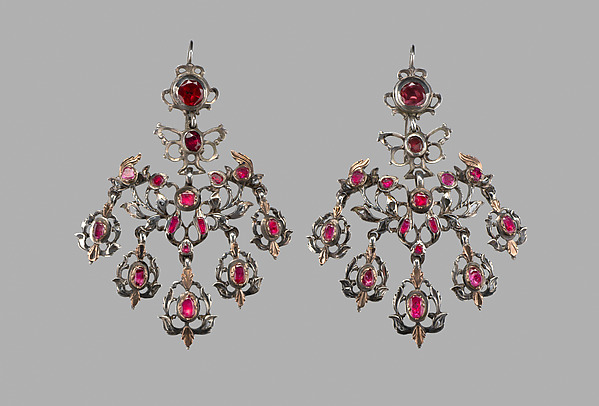
Italian silver, silver-gilt and ruby earrings, 18th century. The Metropolitan Museum of Art, Gift of Marguerite McBey, 1980, 1980.343.6, .7. Public domain; The Met Open Access, CC0. Museum record · CC0 license
Fittings reveal use and alteration, not an automatic date
Describe the mechanism plainly: an open ear wire, a hinged closing wire, a post with a separate back, a screw fitting or a clip. Photograph it open and closed when normal operation permits. Identify whether a screw tightens a clamp or secures a back onto a post; the word “screw-back” alone can leave that unclear.
Do not assign a decade from a fitting in isolation. Compare it with a documented example of the same model and examine how it joins the decorative body. Replacement fittings or a conversion may leave redundant attachment points, local surface differences or altered soldered areas. These observations justify questions, not a diagnosis from one photograph.
Record any confirmed conversion and retain the repair paperwork. Ask a qualified jeweler to assess doubtful catches, bent posts or worn wires before use. Do not force a stiff mechanism or assume that a new back proves the rest of the earring is sound.
Cufflinks and dress studs: match the mechanism to the shirt
Separate the decorated face from the connecting mechanism. Chain links allow two ends to move independently; fixed bridges have no pivoting back; swivel bars turn for insertion; detachable designs have components that separate. Seller terminology varies, so a reverse photograph and a demonstration of normal operation are more useful than the name alone.
Inspect both cufflinks for worn connections, bent bridges and mismatched backs. Check that a swivel remains in its intended position without forcing it. Fixed construction removes one moving joint, but it does not make an object immune to bending or wear. Dress studs need similar scrutiny, including the rear fastener and the clearance available for the shirt fabric.
Tiffany’s official listing identifies Elsa Peretti’s Bean cufflinks as sterling silver and credits Peretti’s design. Preserve that distinction between designer and house in your notes. For any dress set, inventory the actual cufflinks and studs supplied. A fitted box is useful context, but does not alone prove that every component originally belonged together.
Watch chains and chatelaines: follow every connection
With a watch chain, trace the route from the garment attachment to the watch fastening. Record chains, clips, bars and suspended fobs individually. Photograph each marked component: a mark on one fitting does not establish the history of the entire assembly. Compare wear at connections with the condition of the larger links.
A chatelaine combines an attachment with suspended chains or accessories. London Museum’s example, dated about 1780, has a silver hook plate set with iron pyrites and three suspension chains ending in swivel hooks. The Met records a silver chatelaine by Tiffany & Co. dated about 1888. There is no mandatory number of chains or tools.
Inventory surviving parts before deciding what is missing. Compare decoration, attachments and marks, then seek documentary support for an “original ensemble.” An assembled group can still be engaging when described honestly. Avoid inferring the owner’s occupation from a generic label without supporting provenance.
Buckles and head ornaments: inspect the hidden support
A buckle needs its reverse. Establish whether it retains a tongue, hook, loop or interlocking second half, and ask how the strap attaches. Measure the usable opening rather than just the ornamental face. A broad decorative buckle may accommodate a much narrower strap. Record replacements and seek advice before bending a hook or altering an attachment.
Head ornaments likewise depend on their supports. The Met catalogues a silver hair ornament, 24.171.3, to China’s Song dynasty, 960–1279. Its documented context is a starting point for comparison, not a date to transfer to another object with a similar outline.
With a hairpin, comb, circlet or tiara, examine teeth, pins, hinges and attachment loops as carefully as the decoration. Determine how the piece was supported before trying to adapt it to a hairstyle. Missing fittings may affect both its interpretation and its usability.
Anklets, toe rings and arm ornaments need their own context
Use regional names and cultural explanations only when the evidence supports them. The Met’s nineteenth-century silver anklet, 91.1.1124, is attributed to India, specifically Mumbai or Rajasthan. That record does not supply a general rule about every wearer’s status or every similarly shaped ornament.
For an anklet, establish whether it opens and measure its interior. With toe rings, record the intended opening without repeatedly spreading it. Broad arm ornaments sold as “gauntlets” also need measurements: record their length, interior shape and opening rather than assuming a standard fit or historical function. Seek a specialist comparison before wearing or modifying an unfamiliar form.
Make condition and completeness part of the purchase
Before buying, request front, reverse, profile and mark photographs, measurements, individual component weights where practical, and disclosure of repairs or replacements. Separate confirmed facts from the seller’s attribution. For an expensive or uncertain piece, an independent assessment is more useful than adding up the apparent silver weight.
Cleaning should follow identification. The Canadian Conservation Institute warns that polishing removes silver and advises against polishing intentional patination. Mixed materials and delicate fittings need particular care; do not immerse an unfamiliar ornament simply because its main body is described as silver.
Store pairs and detachable parts together but protect them from knocking against one another. Keep photographs and a component inventory with the receipt. A well-documented, usable piece can be a satisfying purchase without being complete, untouched or expected to rise in value.
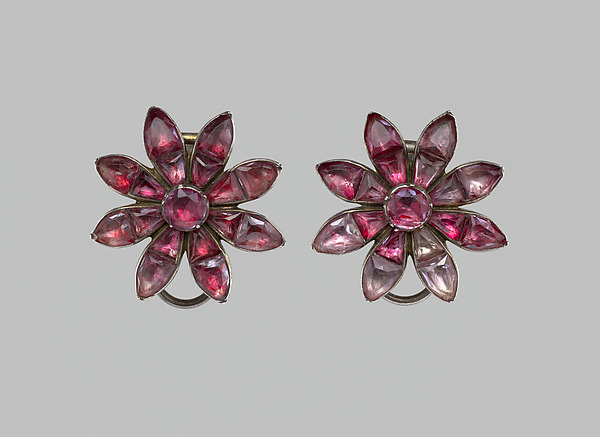
European silver and pink-foiled-stone earrings, 18th century. The Metropolitan Museum of Art, Gift of Marguerite McBey, 1980, 1980.343.34, .35. Public domain; The Met Open Access, CC0. Museum record · CC0 license