A brooch gives you two designs to study: the composition facing the room and the fastening against the cloth. Turn it over carefully. The reverse often supplies the most useful questions about construction, condition and changes during the object’s life.
Start with the shape and the fastening
Brooch is a broad term for an ornament secured to clothing. Fibula is commonly used for ancient and early medieval brooches, but the name does not describe one universal mechanism. Describe the visible structure before assuming how it works: an arched body, a flat disk, an open ring, a separate pin, a spring or a hinge.
A penannular form has an incomplete ring; an annular form has a closed ring. A modern decorative pin may have an entirely different fastening behind a sculptural face. These terms help organize looking, not establish a date or cultural attribution by themselves. Ask whether the pin and body belong together, and whether missing hardware affects interpretation.
Make a simple sketch of the front and back if the construction is difficult to photograph. Label only what you can identify, leaving uncertain parts as questions. That record is more useful than a confident period label copied from an unreferenced listing.
An early medieval object in close view
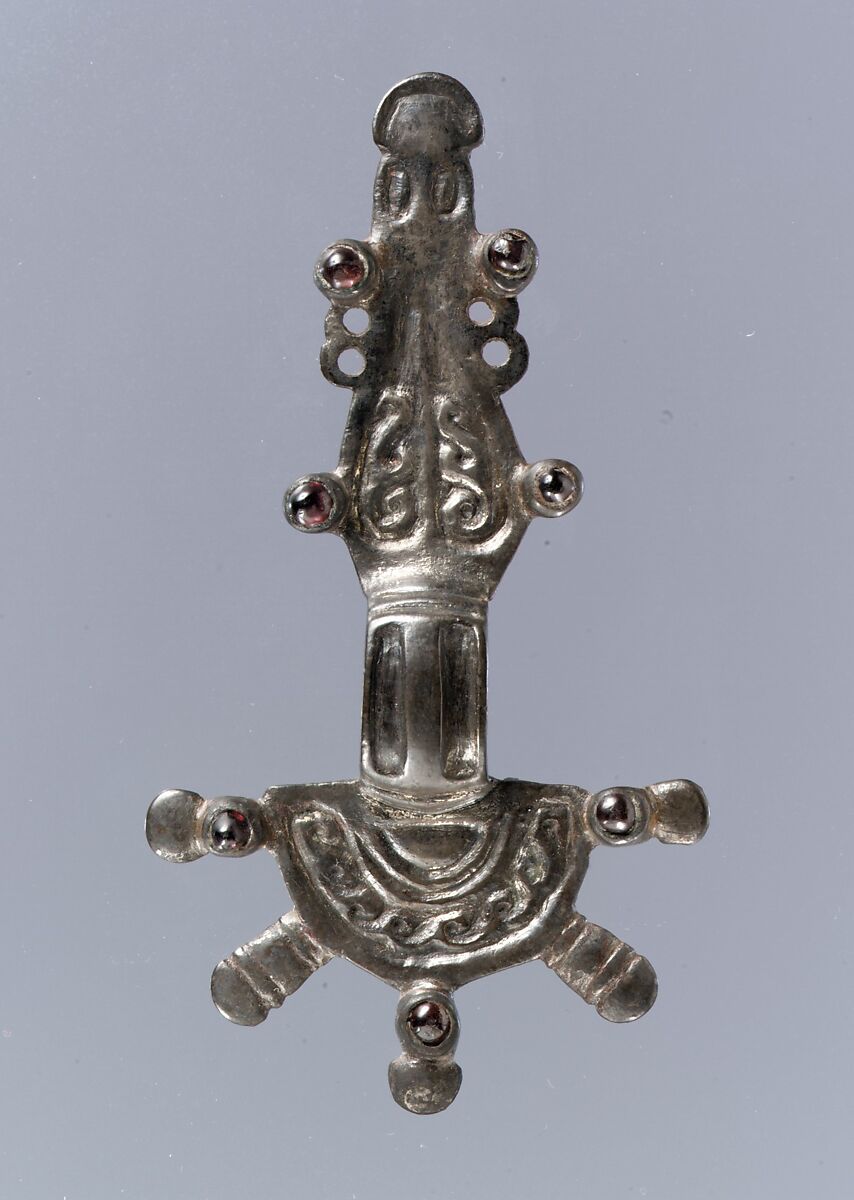
The Met’s Ostrogothic bow brooch, 17.192.150, is cataloged to the first half of the sixth century and made in Italy. Its recorded materials are gilded silver, garnets and cabochons. Those details matter: a gold-colored surface does not necessarily mean a solid-gold body, and the material description should follow the museum’s wording rather than an inference from color.
Study the relationship between the arched middle and the broader ends. The object asks to be seen in profile as well as face-on. For a contemporary or vintage brooch, the same habit reveals projection, edges and the space available behind the ornament. A striking front photograph cannot show how an object will sit on fabric.
A museum comparison provides a documented reference, not authentication for a similar-looking purchase. Ancient-looking motifs have been revisited by later makers. Provenance, materials and construction still need to be considered together.
Bow brooch, Ostrogothic, first half of the sixth century. Gilded silver, garnets, and cabochons. The Metropolitan Museum of Art, 17.192.150. Public Domain. Museum record · Open Access
Read the reverse without turning it into a dating chart
An open hook catch, sliding safety catch or rotating safety catch is worth recording. So are hinge shape, pin length and the way each fitting meets the backplate. Hardware can support a proposed date, but it cannot settle one alone. Older mechanisms continued in use, and damaged fittings could be replaced.
Look for an unused fixing point, a change in finish near a catch, a fitting that covers a mark, or a pin that no longer aligns naturally. These are reasons to investigate an alteration. They do not prove a particular repair date or solder composition. A tidy repair may be difficult to see; an uneven original joint may be easy to misread.
Compare the complete object with documented examples by the proposed maker. Record a seller’s attribution separately from a confirmed catalog match. If the back cannot be seen in the listing, request a clear photograph before paying a premium for age or authorship.
Match the brooch to the cloth
Weight alone does not tell you whether a brooch will sit well. Its footprint, center of balance, pin position and the garment’s structure all matter. A projecting ornament can tilt; a heavy one can pull a light fabric. Try a sound piece on suitable clothing when possible, without forcing the pin through resistant material.
Check the pin tip, hinge, catch and attachment points under good light. A bent pin, loose fitting or unreliable closure deserves a jeweler’s assessment before wear. Do not straighten an antique pin with household pliers or bend a catch to create more tension. Archaeological or fragile historic pieces may be better kept for study and display.
Before any repair, ask what will be changed and whether original fittings can be retained. Photograph the existing arrangement and keep the repair record. A functional improvement can alter evidence that a later collector will want to understand.
Preserve what makes the object interesting
Treat darkened recesses, gilding, enamel and applied stones as part of the examination before choosing a cleaning method. The Canadian Conservation Institute cautions that polishing can damage gilding. Do not try to make every part of a mixed-material brooch equally bright. Seek qualified conservation advice for uncertain or fragile surfaces.
Keep three kinds of value apart: silver content, collectible interest in design and documented history, and personal pleasure in the object. A brooch with an old repair may remain compelling, but the repair should be disclosed and reflected in comparisons. Metal weight does not measure the success of the design.
Store the piece so its pin and projecting decoration do not catch neighboring objects. Keep front, back and side photographs alongside dimensions, marks, purchase details and any treatment history. The reverse deserves a place in the collection record, not just a quick glance at the stall.