
A small object, a whole workshop.
Turn a Mexican silver bracelet over and the marks invite you in: a name, a number, perhaps an eagle small enough to disappear beneath a fingertip. Turn it back again and a different story begins. A broad silver panel catches the light. A stone sits deep in a darkened frame. One link folds into the next, making a substantial piece feel unexpectedly alive.
The pleasure of this field lies in learning to see both sides. Stamps can help you research a piece, while the design, construction, condition and ownership history ask questions of their own. No single mark settles them all.
Twentieth-century Mexican silver brought designers, silversmiths, stone cutters and enamelworkers into close collaboration. Taxco became a particularly important center, but the story also reaches Mexico City. This guide follows documented objects through that wider world, then brings the lessons back to the piece you might actually buy.
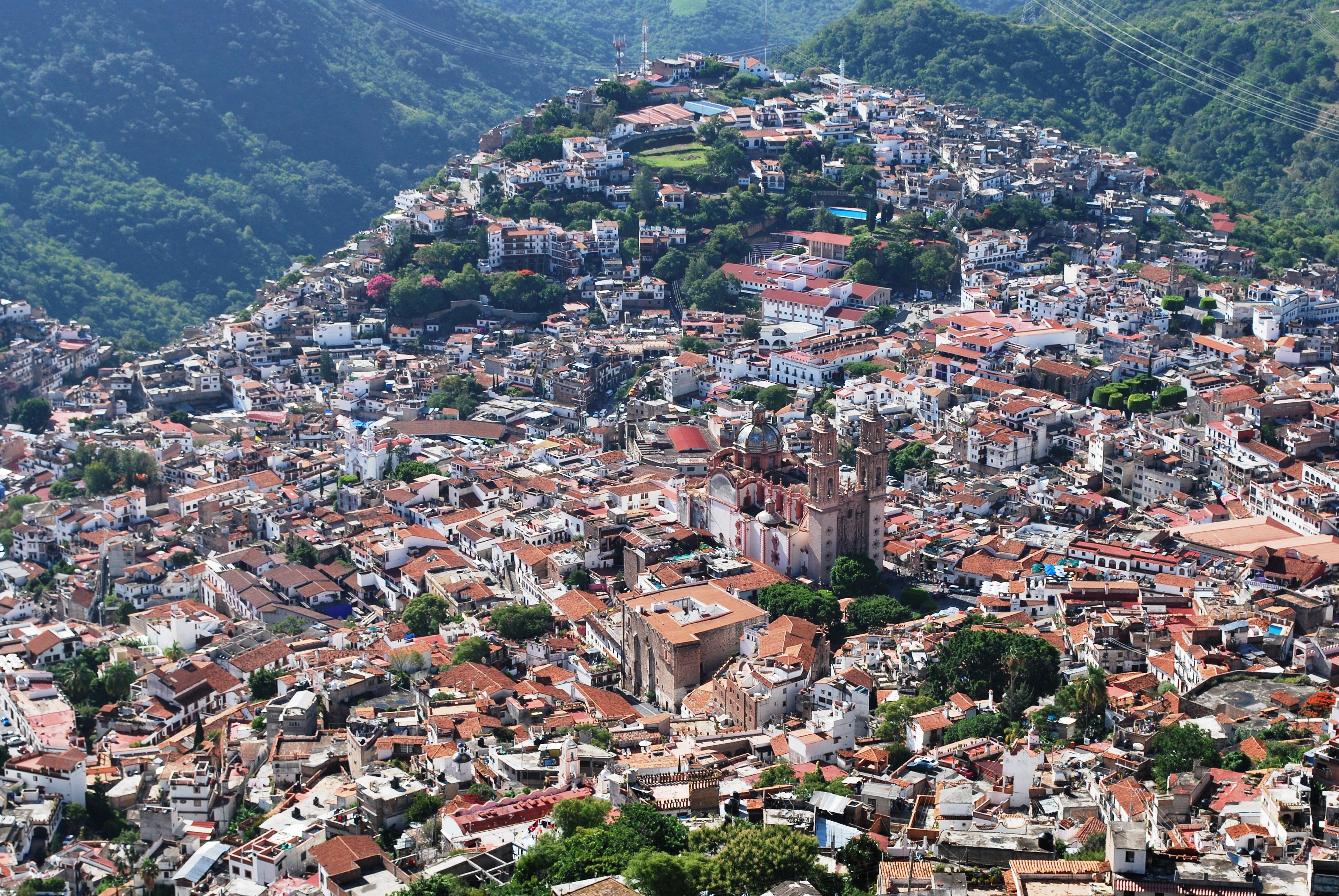

Why the story reaches beyond Taxco.
Taxco is a place before it is a collecting label. Its hillside streets and tightly clustered roofs give the silver workshops a setting that a cropped auction photograph cannot convey. Yet using “Taxco” for every Mexican silver jewel can conceal important differences in where and how the work was made.
Frederick Walter Davis was producing and selling jewelry through his Mexico City business in the late 1920s. LACMA’s account follows him from the Sonora News Company store to a showroom at Sanborns. His silver-and-obsidian Mask Brooch, dated about 1940, belongs to that capital-city history rather than to a generic Taxco category.
Matilde Poulat, whose work is associated with the name MATL, provides another route into Mexican silver. Trained as a painter, she turned to silver design in the 1930s. Her framed obsidian-mask bracelet at LACMA shows how a carved stone could become the center of an elaborate silver composition. A later auction record for a MATL necklace transcribes HECHO EN MEXICO D.F., keeping the place of production visible in the object’s own markings.
For a collector, geography is a useful question rather than a ranking. A Mexico City mark does not make a piece less interesting. Record what the object actually says, then investigate the workshop behind it.
The names, and the people behind them.
William Spratling is a familiar entrance to the subject. LACMA distinguishes his first workshop in 1931 from the opening of the larger Taller de Las Delicias in 1935. Those dates describe stages of a developing business. They also help explain why a tidy list of founders and years can miss the workshop’s changing life.
Héctor Aguilar and Lois Smith Cartwright established Taller Borda in 1939. Margot van Voorhies Carr designed for Los Castillo before creating work under her own name. Antonio Pineda trained in Spratling’s workshop and developed a language of bold, wearable forms. Their careers connect, but their designs reward separate attention.
A famous name on the reverse does not mean one person made every part. The Fowler Museum’s Pineda research credits skilled workshop silversmiths including Bruno Pineda, Rafael Ruiz, José María Pineda and Filiberto Gómez. LACMA’s Cascabeles Necklace offers an even more tangible measure of collaboration: six craftsmen working over several days.
That changes the way a piece can be appreciated. A clasp is not just an interruption before the decoration begins. It can be the place where a workshop solved its hardest problem: how to make a dramatic object close securely, move comfortably and survive repeated wear.
Eight museum objects that teach you how to look.
These are documented reference objects, not authentication templates. Use the linked museum records in the sources below to study each object’s photographs and catalog entry. Similar appearance alone does not establish the maker or date of something offered for sale.
Spratling’s Tree of Life Brooch: follow a design to its source.
LACMA dates this silver-and-copper brooch to about 1938–1944. Its curatorial account traces the flowering tree to page 29 of the Codex Fejérváry-Mayer. That specific connection is more illuminating than a seller’s broad description of a piece as “Aztec style.”
Notice what happens when a graphic source becomes something worn: the tree acquires depth, the two metals separate parts of the design, and the brooch must work as a compact object. The record establishes the materials and design source. It does not provide a universal reverse-side test for identifying every Spratling brooch.
Aguilar’s Cascabeles Necklace: imagine the time at the bench.
The circa-1940 necklace brings together repeated cross-like forms and hanging bells. LACMA relates its imagery to the Nahua gold glyph and ceremonial bells, and records the work of six craftsmen over several days.
When you study a linked necklace, follow each connection around the whole piece. Does the rhythm continue through the fastening? Are any links stretched or replaced? Movement and careful finishing matter to condition and wearability, but they cannot establish attribution on their own.
Aguilar’s Feathers Necklace: look at depth as well as weight.
Dated 1943–1948 and catalogued as silver and obsidian, Feathers offers a different experience of substantial silver. LACMA describes the role of heavy-gauge material in giving the forms definition. The dark stones and strongly modeled silver make each other more visible.
Weight is useful to record, especially when comparing the same design, but it is only one part of the object. A thick piece can have worn connections, a replacement clasp or damaged stones. Inspect the vulnerable parts as closely as the impressive ones.
Margot’s Fish and Waves Necklace: follow the designer.
LACMA’s silver Fish and Waves Necklace is dated about 1940 and credited to Margot van Voorhies Carr, designed for Los Castillo. Its curatorial discussion connects the imagery with Japanese ceramics and textiles.
This is a useful reminder that a workshop name and a designer’s name answer different questions. A collector tracing Margot’s work needs to look at her Los Castillo period as well as pieces carrying the later Margot de Taxco name.
Margot’s Fish and Waves Bracelet: watch color change a motif.
In the circa-1955 bracelet, fish and waves return in silver with green and blue enamel. LACMA describes champlevé as a distinctive feature of Margot’s work and notes the women who executed the enamelwork.
The comparison is a way to see a recurring idea develop, rather than a reason to assume that every fish design came from the same period or workshop. Color is also a material responsibility: a bracelet that combines metal and fired glass must be handled differently from plain silver.
Margot’s snake set: the joints belong to the design.
LACMA’s circa-1955 set includes a necklace, bracelet, belt and extension. The necklace has 26 parts, with rivets serving both structural and decorative purposes. The engineering helps the snake take the shape of something that can be worn.
Look at the edges of individual segments, the rivets and the enamel beside them. An attractive frontal photograph can hide wear in exactly those places. Ask for close views and a condition report before judging a complicated articulated piece.
Davis’s Mask Brooch: distinguish an ancient reference from an ancient object.
Davis’s circa-1940 brooch combines silver with an obsidian mask. LACMA situates these designs within the modern use of Mesoamerican imagery and connects them with Poulat’s work.
A carved mask in a twentieth-century jewel should not be called an archaeological artifact simply because it refers to an older visual tradition. Material, design inspiration and the date of manufacture are separate facts to document.
MATL’s Framed Mask Cuff: let the frame hold your attention.
Poulat’s circa-1940 silver-and-obsidian bracelet makes the surrounding silver part of the stone’s presence. LACMA relates it to earlier designs by Davis while placing it within Poulat’s own career.
The frame gives a collector plenty to study: how the stone is held, how the cuff meets the wrist, and where surfaces may have been altered or repaired. Enjoy the richness of the design without assuming that every stone or fitting is original.
Bring the museum lessons back to the listing.
A good seller’s description should help you understand the whole piece. If the photographs only show the polished front and one cropped stamp, there is more to ask. Start with evidence that can be supplied without scratching, bending or chemically testing the object.
- Request front, reverse, side and clasp photographs, plus close-ups of every readable mark. Keep the marked component visible in at least one wider photograph.
- Ask which parts are original, which have been repaired or replaced, and what supports the maker and date. Separate a documented history from a seller’s attribution.
- Record dimensions and total weight. For a cuff, ask for interior width and height plus the opening gap. For a collar, request the inside dimensions rather than length alone.
- Inspect hinges, connections, stone edges, enamel cells and the fastening. Do not force a stiff clasp or bend a rigid cuff to prove it fits.
- Ask about condition, returns and any independent examination before paying a substantial attribution premium. A photograph or a familiar stamp cannot replace specialist inspection.
- For coral, ivory, tortoiseshell, feathers or other potentially regulated materials, check the exact material and applicable shipping/import rules before bidding.
A sale result tells a story, not a price rule.
Four lots in one Bonhams Los Angeles sale, held October 13–20, 2026, show how widely outcomes can differ within Mexican silver. The figures below are the auction house’s reported sold prices including buyer’s premium. They are historical records, not current asking prices, appraisals or promises about resale.
| Lot | What sold | Reported result including premium |
|---|---|---|
| 2029 | Antonio Pineda, large silver and amethyst necklace, circa 1950 | US$12,350 |
| 2055 | Antonio Pineda, silver necklace and bracelet, two-piece lot | US$1,235 |
| 2105 | Matilde Poulat, silver and gemset necklace | US$9,750 |
| 2134 | Héctor Aguilar, two silver bracelets and a necklace, three-piece lot | US$546 |
The catalog describes a total weight of 229.1 g for the amethyst necklace in lot 2029 and 324.30 g for the two-piece Pineda lot 2055. The heavier lot sold for less. That comparison shows why a simple price-per-gram formula cannot capture collectible jewelry; it does not isolate which design, condition, provenance or bidding factor caused either result.
Lot 2134 includes reported repairs or alterations and broken links. Dividing its price by three would not tell you the value of each object. Multi-piece lots need to be understood as lots, with their own mix of strengths and problems.
Keep the money categories separate: a dealer’s asking price, an auction hammer price, the result including premium, your total after tax and shipping, and the amount a seller ultimately receives. Fees and conditions vary by sale. For metal-content calculations, the total weight of a stone-set or mixed-metal piece is not the weight of its silver.
Start with one piece you want to understand.
A thoughtful collection can begin with a modest brooch, a pair of earrings or an unsigned bracelet. Choose something whose design makes you curious, whose condition you understand and whose price makes sense without an optimistic attribution.
Study one workshop or one construction technique for a while. Compare documented examples. Save photographs of the reverse as carefully as photographs of the front. Over time, differences in scale, fastening, finish and proportion become easier to notice.
Keep a small object record: description, dimensions, weight, exact mark transcriptions, photographs, purchase date and price, seller, receipts, condition and any repair history. Label uncertain attributions as uncertain. A record that distinguishes what you observed from what someone told you will remain useful long after the listing disappears.
For a museum visit, follow the existing Taxco museum entry and check current official visitor information before travelling. The object and its place can teach different parts of the same story.
Sources & further reading
Reviewed November 10, 2026. Museum records, historical auction results, conservation guidance and specialist collector references have different purposes. None authenticates an object you own, and linked institutions do not endorse this guide. Museum object photographs remain on their source sites.
- LACMA: Mask Brooch, M.2015.190.12.2
Circa 1940, silver and obsidian; Davis’s Mexico City business and relation to Poulat’s designs.
- LACMA: Framed Mask Cuff Bracelet, M.2013.4.22
Circa 1940, silver and obsidian; Poulat’s background in painting and silver design.
- Bonhams: Matilde Poulat, silver and gemset necklace, lot 2105
13–20 October 2026; sold for US$9,750 including premium. The catalog records HECHO EN MEXICO D.F., coral, turquoise and amethyst.
- LACMA: Tree of Life Brooch, M.2013.4.9
Object date, silver and copper, codex reference, and workshop history.
- LACMA: Cascabeles Necklace, M.2013.4.17
Circa 1940; collaborative production and interpretation of the bell forms.
- LACMA: Fish and Waves Necklace, M.2013.6.1
Date Made: circa 1940. Margot van Voorhies Carr, designed for Los Castillo; Japanese design influences.
- Fowler Museum at UCLA: Silver Seduction: The Art of Mexican Modernist Antonio Pineda
An archived exhibition, August 24, 2008–March 15, 2009, not a current event listing.
- Fowler Museum at UCLA: Silver Seduction exhibition release
Workshop collaboration, articulation, hollow forms and wearable construction.
- LACMA: Feathers Necklace, M.2013.4.18
1943–1948, silver and obsidian; heavy-gauge construction discussed by the museum.
- LACMA: Fish and Waves Bracelet, M.2013.6.4
Circa 1955; silver and enamel, champlevé technique, and women enamelworkers.
- LACMA: Snake Necklace, Bracelet, and Belt, M.2014.246a–d
Circa 1955; the necklace has 26 parts. No design number is inferred from this record.
- Bonhams: Antonio Pineda, large silver and amethyst necklace, lot 2029
13–20 October 2026, Los Angeles; sold for US$12,350 including premium. Historical result, not a current offer.
- Bonhams: Antonio Pineda, silver necklace and bracelet, lot 2055
13–20 October 2026; sold for US$1,235 including premium. The necklace is described as marked 970; bracelet as STERLING.
- Bonhams: Héctor Aguilar, two silver bracelets and a necklace, lot 2134
13–20 October 2026; sold for US$546 including premium. Lot includes damage/alteration and records 940 on the bracelets.