
Taxco · Design and collaboration
Silver made through a workshop.
William Spratling (1900–1967) offers a way into Mexican silver that begins with design and workshop practice rather than metal weight alone. An American trained in architecture, he became closely associated with Taxco, where his designs brought historical sources into conversation with twentieth-century silverwork. His name belongs in the story of a community of skilled makers, not simply on a list of famous signatures.
Mexico’s Instituto Nacional de Antropología e Historia records that Spratling settled in Taxco in 1929 and established his first workshop in 1931 with silversmiths from Iguala. LACMA dates the opening of Taller de Las Delicias to 1935 and describes collaboration with experienced silversmiths and local apprentices. The first workshop and the later Las Delicias opening mark different stages of the business. A designer’s name on a catalogue record does not mean that one person performed every stage of making.
From the museum collection
A bracelet worth looking at closely.
A documented object is a starting point for comparison, not a template that authenticates every similar piece.
Panels, rings and recorded marks
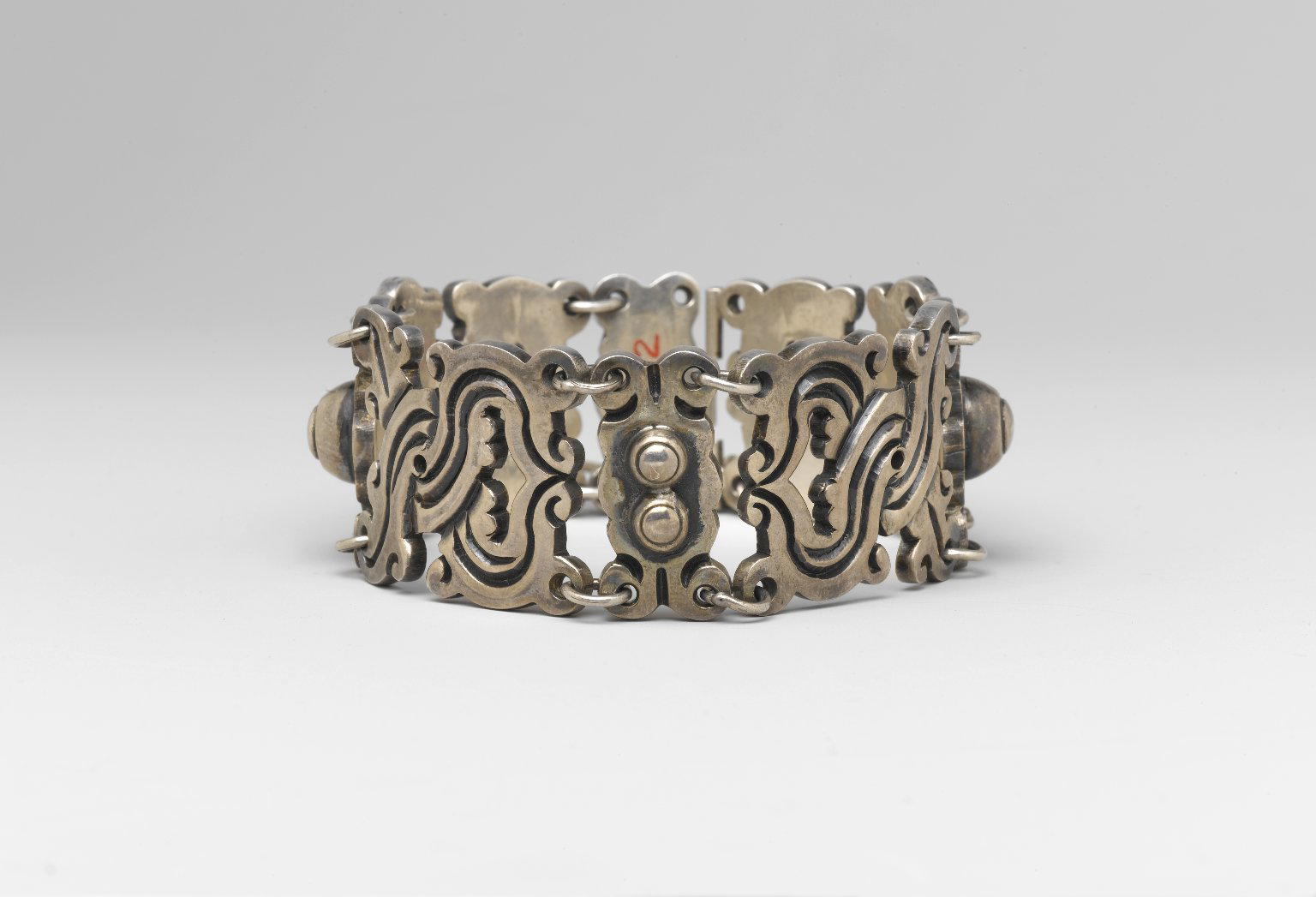
The Brooklyn Museum’s bracelet, accession 2006.7.2, is dated about 1935–1940 and catalogued as silver. Its photograph makes the construction legible: broad decorated panels are connected by small rings, with dark recesses setting off the brighter surfaces. The museum records the inscriptions “[M]ADE IN/TAXCO” and “980” on the reverse of a short link. These are observations about this particular object, not a universal marking formula for everything associated with Spratling.
Beyond a single decorative formula
Spratling’s work drew on Mesoamerican art as well as Art Deco and modernism. LACMA’s silver bowl, dated 1940–1944, provides a concrete example. Its curatorial account explains the raising of sheet metal around a form and connects the three-part support and shell-shaped feet with earlier objects. Rather than treating “Mexican style” as a single decorative formula, look for the specific decisions that shape each vessel or piece of jewelry.
Follow an interest
What to explore.
Historical workshop and museum research, with present-day production kept distinct.
Check the details
Before you buy.
For an attributed piece, start with its construction and documentation. These questions help distinguish age, condition and attribution.
Open the references
Research this name.
- Collect Silver reference
Follow the Taxco museum trail
INAH describes archaeological holdings and a silver gallery at Museo Guillermo Spratling. Use the museum as a route into the wider setting and check official information before planning a visit.
- Collect Silver reference
Check silver authenticity
Practical questions about the piece, its marks and the evidence behind an attribution.
- Collect Silver reference
Separate sterling from fine silver
Keep fineness terminology distinct from age, authorship and collector value.
Sources & further reading
- Bowl (Cuenco), 1940–1944, M.2015.190.4 Los Angeles County Museum of Art · Museum object record and curatorial history · Checked Nov 7, 2026
- Museo Guillermo Spratling Instituto Nacional de Antropología e Historia · Official museum history · Checked Nov 7, 2026
- Bracelet, ca. 1935–1940, 2006.7.2 Brooklyn Museum · Museum object record and image rights · Checked Nov 7, 2026
- History and present-day workshop Spratling Silver Inc. · Current operator’s own account; not independent verification · Checked Nov 7, 2026
Museum and institutional records support the historical account. Present-day manufacturing statements are attributed to the current operator. Collecting advice is editorial guidance.