
A price on a screen is not a bid for your piece
A silver bar, a vintage spoon and a wearable chain can contain the same metal without appealing to the same buyer. The original December 2025 article asked an important question: why might a higher silver price fail to turn every silver object into an easy sale?
The durable answer starts with three separate figures: the quoted price of silver, the estimated metal content of the object, and the amount a particular buyer will actually pay. Then there is a fourth figure that matters most to a seller: what remains after the costs of completing the sale.
Start with the kind of silver you have
Bullion is commonly described by weight and fineness. A collectible coin can also have value connected to rarity, condition and collector interest. The U.S. Mint distinguishes these markets: metal content is central to bullion, while collectible coins may trade for more than that content alone.
Jewelry and tableware need their own questions. The FTC describes sterling as 92.5 percent silver and silver plate as a layer of silver over base metal. A piece described as coin silver uses a different standard. A familiar-looking stamp is a starting point for identification, not a reason to skip checking the object, maker and seller’s description.
Keep a possible collectible separate from an obvious scrap lot until its identity is understood. A pattern, maker or unusual form may matter to a buyer who wants the object intact. Calling everything “melt” can hide the very features another collector is looking for.
Gross weight is not necessarily silver weight
Composite objects require care. A candlestick may be weighted; a knife may combine a silver handle with a steel blade; jewelry may include stones or other components. The Goldsmiths’ Company Assay Office’s UK guidance explicitly describes marks for base-metal parts and non-metallic filling. A precious-metal mark does not turn those components into silver.
The simple metal-value calculation works only after the weight and fineness of the relevant metal are established. Imagine a lot consisting entirely of 10 troy ounces of sterling alloy, with no stones, filling or other non-alloy parts. Multiplying 10 by 0.925 gives 9.25 fine troy ounces of silver.
At a hypothetical USD $40 per fine troy ounce, that silver content has a theoretical value of $370. This is an arithmetic example, not a current quotation, an appraisal, or a promise of recovery. Applying the same calculation to the gross weight of a filled object would overstate its silver content.
Understand the spread before comparing offers
A dealer’s selling price and buying price can differ. The CFTC describes this bid/ask spread and advises buyers to understand the costs involved. The price at which a shop offers a coin is therefore not automatically the price it will pay to buy that coin back.
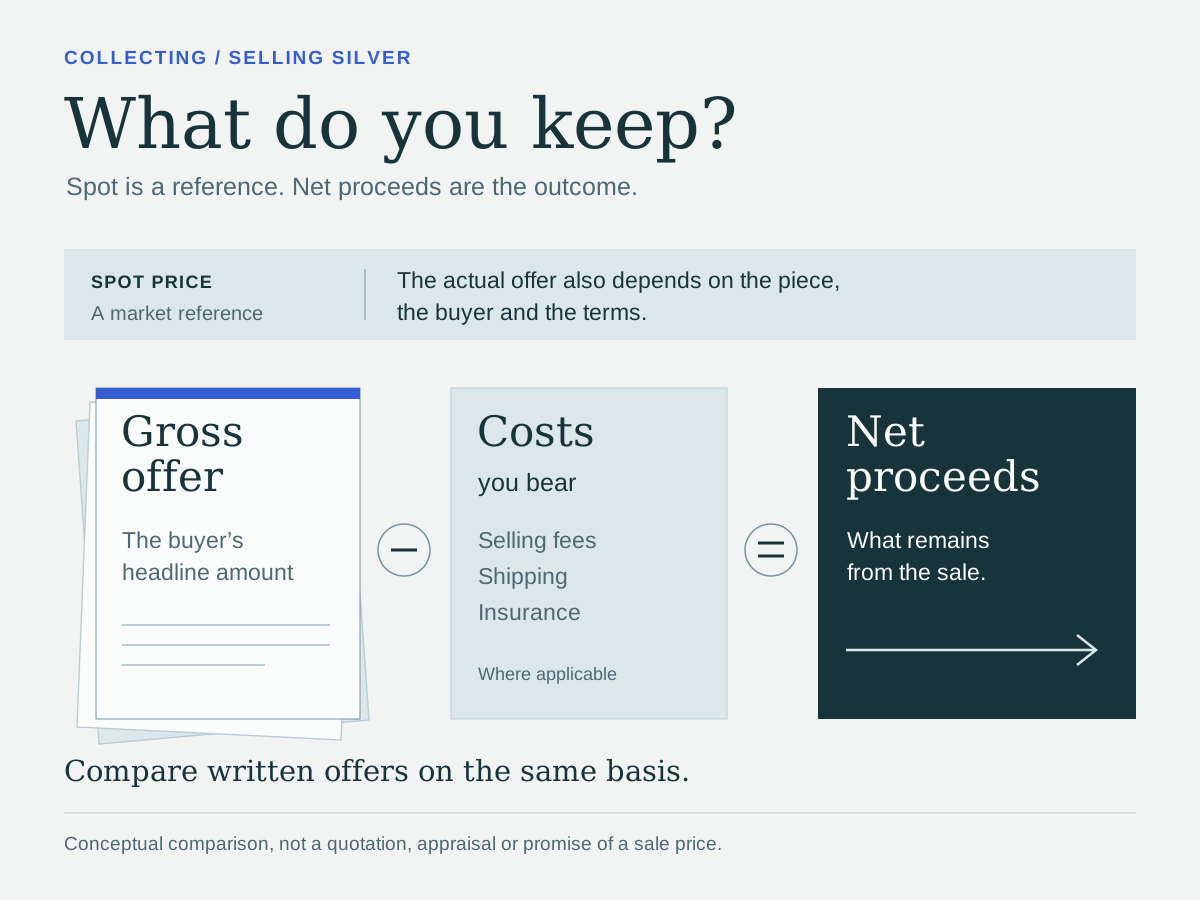
Ask for the actual purchase offer for your specific item, not just a percentage displayed on a sign. Establish whether an offer is firm or conditional on verification, when the metal price is fixed, and which deductions apply. Compare offers made on the same basis and at reasonably similar times.
A collector-to-collector sale may produce a different gross price, but it also requires finding a buyer and completing the transaction. Dealer convenience, platform access, shipping arrangements and time all belong in the comparison. A larger headline number can still leave less money in hand.
Use sold evidence, not optimistic asking prices
An active listing tells you what someone hopes to receive. A relevant completed sale is more useful evidence, provided the object and circumstances are comparable. Match the maker, pattern or issue, material, condition, size and included accessories as closely as possible. A mixed lot or damaged example can distort a simple price comparison.
eBay’s Product research tool provides historical sold data and includes the actual accepted price when an item sold through Best Offer. Its documentation also warns that results depend on the search parameters. That makes careful filtering part of the research, not a minor detail.
This guide does not report a sampled result from eBay, Etsy or Mercari. No claim about which platform is currently “hot,” which category sells fastest, or how often pieces sell above metal value can be drawn from the existence of a research tool alone. Look for several relevant sales, note their dates, and keep shipping costs visible.
Refining terms can change the route to cash
A refiner buys material to process; a collector may buy an object to keep. Their offers answer different questions. Mixed material, required testing, minimum quantities and settlement arrangements can make a refining quotation less straightforward than multiplying gross weight by spot.
One dated example shows why terms need checking. In its April 9, 2026 update, United Precious Metal Refining described backlogs and said it was limiting new business while continuing to process material for existing active customers. Its notice asks customers to obtain current terms before sending metal. This is one company’s account at that time, not a finding that every refiner has stopped buying or that those exact conditions persist today.
Before sending a lot, ask what material is accepted, how fineness will be assessed, what fees or minimums apply, when the price is fixed and when payment is expected. Keep the written answer with the description and photographs of the material.
Protect the object and compare what you keep
Do not polish a coin simply to improve a sale photograph. The U.S. Mint warns that polishing or cleaning can reduce a coin’s value. Likewise, avoid treating an unfamiliar antique as scrap before checking whether its intact form matters. Destructive testing and dismantling can remove options that cannot be restored.
For each possible sale, write down the gross offer and subtract the costs you would actually bear, such as selling fees, shipping and insurance. Confirm payment timing, return terms and any conditions that could change the offer. No single platform fee or dealer discount applies to every transaction.
A useful selling file is small: clear photographs, marks and measurements, provenance or receipts where available, relevant sold comparisons, and written offers. The aim is to know what you are selling and how each route works. Spot price belongs in that file, but it does not replace the rest of the story.
About this edition
Original source and editorial notes
Adapted from original material by Rich Silver. Original publication: Silver’s Breakout Is Rewriting the Aftermarket ↗ (2025-12-19).
Reviewed 2026-11-05. Adapted from the article published December 19, 2025. Recasts its useful aftermarket distinctions as an evergreen guide. Removes unsupported last-90-days platform observations, specific price and lease-rate claims, buyer stereotypes, and forecasts. No marketplace transaction sample was collected for this edition. United PMR is a dated April 2026 example from one refiner, not proof of current industry-wide conditions. Dollar figures are explicitly hypothetical, in USD. The guide does not appraise a particular object or provide individualized tax, legal or investment advice.
Sources & further reading
- CFTC and FINRA: 10 Things to Ask Before Buying Physical Gold, Silver, or Other Metals ↗
- CFTC: Social Media Precious Metals Scams, discussion of spot, bid/ask spreads and fees ↗
- FTC: Buying Platinum, Gold, and Silver Jewelry, November 2024 ↗
- The Goldsmiths’ Company Assay Office: Mixed Metals, filled and base-metal components ↗
- U.S. Mint: Collectible Coins ↗
- U.S. Mint: Caring for Your Coin Collection ↗
- eBay: Product research, sold-price data and search limitations ↗
- United Precious Metal Refining: Refining Update, April 9, 2026 ↗