
Start with the form
A stud sits close to the ear; a hoop makes a complete or partial loop; a drop hangs below its attachment. The outline tells you where to begin, but does not establish the metal, date or maker. A pair can combine forms: a fixed upper element may carry an articulated drop.
Compare the fronts, profiles and backs together. Measure length and width of each earring, and ask for weight per ear rather than only the combined weight. Similar-looking partners can differ in fittings, decoration or repairs.
Follow the fastening
A post passes through a piercing and needs a compatible retaining back. A hook or wire also passes through a piercing; its exact closure varies. Clips and screw-adjusted fittings hold the ear without a post. Ask for clear open and closed views and confirm whether both retainers are included.
Examine the connection between fitting and ornament for wear, movement and visible repairs. A post, clip or screw fitting may have been replaced or converted; its presence alone cannot date the whole earring. Do not force a stiff mechanism. A jeweler can assess a doubtful fitting before wear.
Read a drop as an assembly
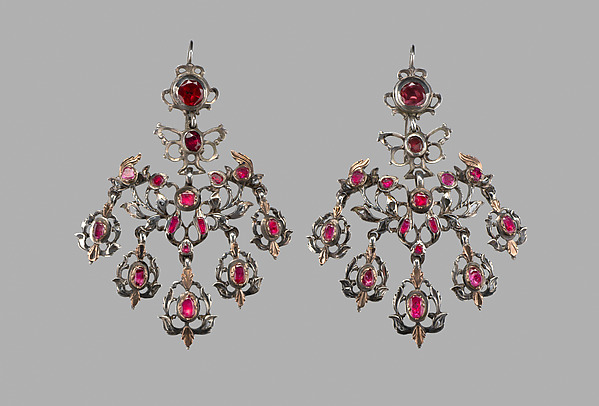
The Met identifies this Italian eighteenth-century pair as part of a set, made of silver, silver gilt and rubies. Each is recorded as 7 cm long. Follow the repeated scrolls and suspended elements as well as the attachment: a drop depends on small connections to move and remain together.
For another pair, compare corresponding elements, connecting rings and settings from both sides. A difference is an observation to investigate, not automatic proof of a replacement. The museum record documents these earrings; visual similarity alone cannot establish the maker or date of another pair.
Look beyond the silver
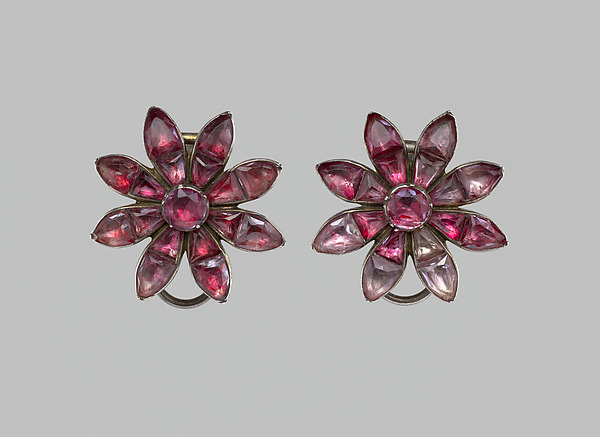
The Met describes this eighteenth-century European pair as silver and pink-foiled stone. Its wording does not identify the stones as rubies. The flower-like arrangement makes the settings part of the design, while the catalog reminds us that the complete object includes materials besides metal.
Ask for close views of the settings, backs and any discoloration, missing stones or loose components. Do not immerse mixed-material earrings or apply a metal cleaner without understanding their construction. Foil, gilding, stones and adhesives can require different treatment; seek a conservator or qualified jeweler when uncertain.
Keep the pair and its story together
Photograph each earring front and back with a scale. Record dimensions, individual weight where available, marks as seen, fitting type, condition and the source of any attribution. Note missing or replaced parts separately from a seller’s description. Store the pair so that hard stones and metal do not scratch one another.
A documented designer, maker, workshop and retailer may have different roles. A regional style or a matching initial alone does not establish authorship. Follow a documented comparison and retain uncertainty; the Georg Jensen and William Spratling profiles offer different routes into jewelry-making histories.