
Before decoding a mark
Turn the object over, but do not leave the rest of it behind. A tight photograph of two initials removes the scale, material and construction that may help explain them. Begin with a full view, then a close-up of every mark, including faint characters, scratched numbers and inscriptions.
Photograph under soft, angled light and keep an untouched original. Do not polish away a difficult surface to improve the picture. A second lighting direction can reveal a shallow punch more safely than abrasion. Record what you can actually read; a question mark is more useful than an invented letter.
The Hung Chong & Co. profile puts that distinction into practice with a documented box bearing separate retailer and workshop marks.
Different marks, different roles
Roman-letter trading names or initials can identify the retail business associated with a piece. Chinese-character marks can provide another route into workshop identity. Neither should be discarded merely because the other is easier to read. Researcher Adrien von Ferscht emphasizes the distinction between retail silversmiths and the workshops supplying them.
- Trading name
- The commercial identity associated with sale or supply.
- Workshop attribution
- The documented production link, when evidence supports it.
- Purity indication
- A fineness claim, not an independent test of the present object.
- Inscription
- A recipient, occasion or owner, not necessarily a manufacturing date.
Some historical identities remain unresolved. Transliteration can vary, and initials may be shared. Do not attach a modern spelling, exact operating dates or a personal biography to an ambiguous stamp simply because a similar example appears online.
A working example: record before attribution
Imagine a bowl whose underside shows two Roman letters, a number and a partly worn character. A useful first entry is not a confident maker biography. It is a record of those three observations, with a photograph showing their position relative to the foot. Write the letters as seen, preserve the number, and leave the unclear character unresolved. If the inscription is on a removable stand, record the stand separately.
Next, compare examples that show both the stamp and the complete object. A dealer description with no underside photograph may be useful as a lead, but it cannot confirm that the mark looks like yours. A museum or auction record with clear photography, dimensions and a qualified attribution gives more to compare. Keep “attributed to,” “probably” and “retailed by” in your notes: removing those words changes the claim.
When two sources disagree, look for the evidence behind the difference. One may describe an earlier interpretation, another a newly identified workshop mark. Or both may repeat the same unsupported caption. Ten copies of a claim are not ten independent confirmations. Saving the record’s title, source and object number makes that distinction easier to revisit.
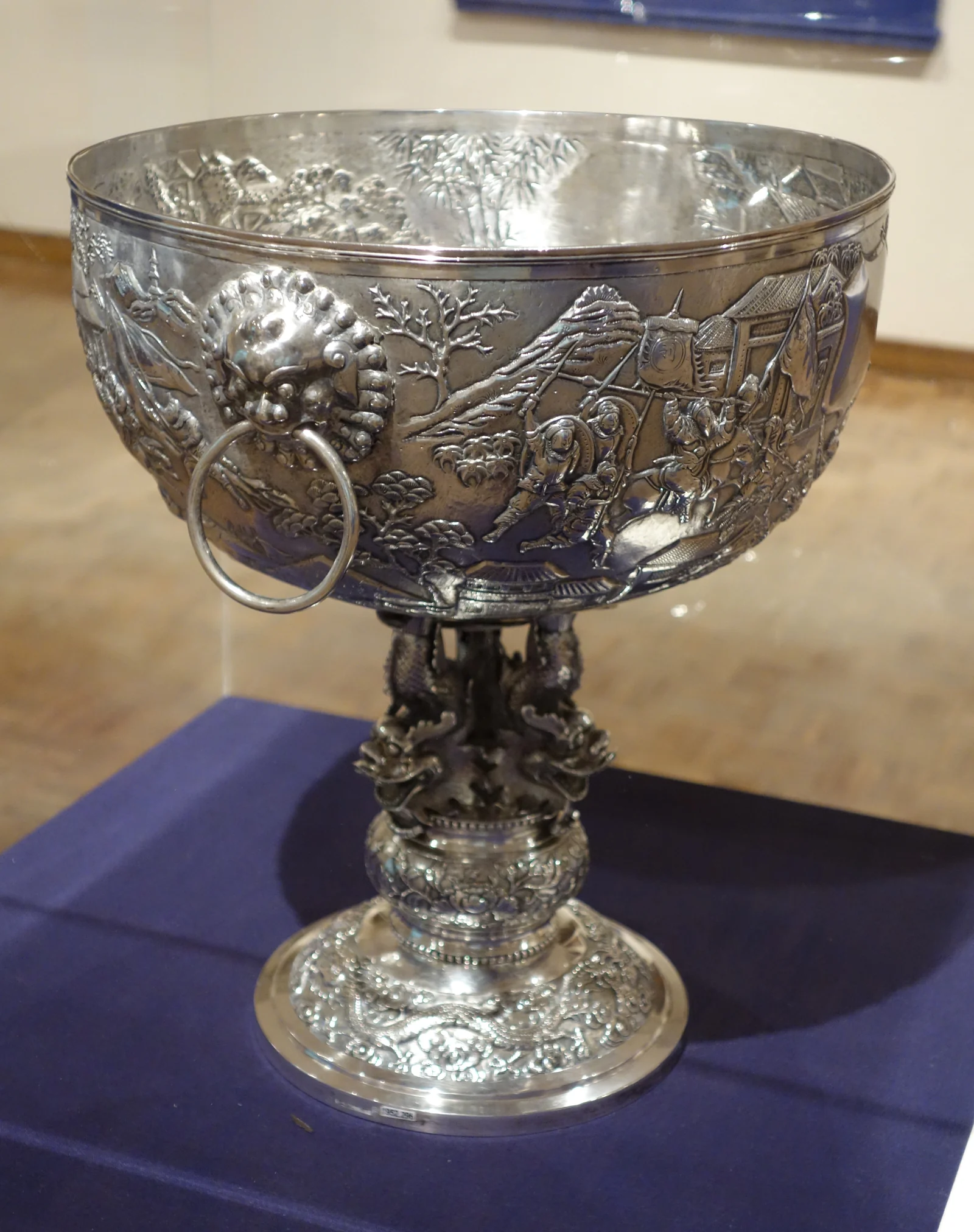
Two names, one object: a tazza
A late nineteenth-century tazza catalogued by Christie’s offers a concrete way to understand the distinction. The auction house attributes the workshop to Bao Sheng and identifies Wang Hing as retailer. Its footed dish has a dragon-shaped stem, with panels of decoration around the bowl. The record locates the marks on the base rim.
The two names do not compete for one empty “maker” field. They describe different relationships to the same object. Retaining both makes the record more informative and provides two routes for future comparison: other work attributed to the workshop and other objects sold through the retailer.
The source itself needs careful reading. Christie’s related guide qualifies the workshop attribution as “probably Bao Sheng,” while the lot title is more definite. We retain the cautious attribution instead of turning a difference in catalogue wording into certainty. This is a practical example of why a database should preserve evidence and qualification, not just a name.
English-style punches are not English assay
Some earlier export pieces carry punches imitating the appearance of British hallmarks. These are commonly described as pseudo-hallmarks. The resemblance is part of their history, not proof that the silver passed through a British assay office.
Avoid reading a familiar-looking letter as a British date letter without first establishing the actual marking system. Compare the complete sequence, its shapes and its relationship to the object. The broader silver marks guide explains why origin and context come before a decoding chart.
Wang Hing and the Tiffany story
Wang Hing offers a useful lesson in separating a trading relationship from a repeated claim. Adrien von Ferscht reports that an examination of Tiffany’s 1858–1906 ledgers found no documentary evidence of direct supply by Wang Hing. That does not erase known objects bearing Tiffany special-order inscriptions; it limits what those objects establish.
A proposed intermediary is a research hypothesis, not a proven chain of supply. For your own object, record the exact marks and inscription first. Do not turn the general Tiffany story into provenance for a piece without evidence specific to that piece.
Build a useful record
Keep a small dossier: whole-object photographs, every stamp, dimensions, weight with units, construction notes, the seller’s description and any previous documentation. Separate the inscription’s date from the date you assign to manufacture. Preserve disagreement between sources rather than silently selecting the most impressive attribution.
Use our authenticity guide for testing limits. A photograph of a convincing mark is not a certificate of alloy, age or authorship. Conversely, wear or an incomplete mark does not automatically disqualify an old object.
What a mark cannot answer alone
A stamp may help name a business without identifying a designer. It may indicate intended purity without accounting for solder, repairs or a later component. It may be genuine while the lid has been replaced. None of these possibilities makes marks unimportant; it explains why they work best alongside the physical object.
Condition also affects legibility. A worn punch is not automatically suspicious, and an unusually crisp punch is not automatically reassuring. The question is whether the marks, wear, construction and documentary history make sense together. For high-value or contested pieces, a specialist’s examination can address questions that internet comparison cannot.
Treat an unidentified mark as a research opportunity rather than an empty space that must be filled before you can enjoy the object. A careful description can remain useful for years. A guessed attribution tends to spread, detach from its uncertainty, and become harder to correct.
Visit the Wang Hing & Co. profile for a view inside the historical showroom and museum objects that separate retailer, workshop and owner.