
Chinese export silver
The showroom behind the stamp
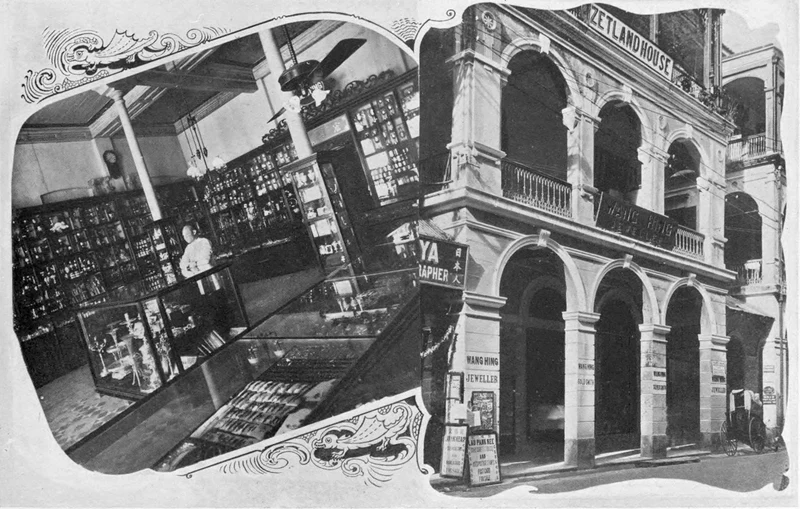
The photograph opens a door. Behind the Wang Hing sign are glass counters, tall cabinets and rows of objects waiting to be chosen. A trade name that now appears in auction catalogues once belonged to a place where customers browsed, commissioned gifts and compared workmanship. This view of the premises was published in 1908.
That year’s Twentieth Century Impressions placed the firm among the silver and jewellery shops of Queen’s Road Central, Hong Kong. It reported a founding date of 1854 and described cups and trophies supplied for local races and societies. The account is enthusiastic commercial publicity, but its concrete details help recover the business behind the initials.
Wang Hing should not be treated as one individual silversmith. Surviving records distinguish its retail identity from particular workshops. Christie’s catalogues a late-nineteenth-century tazza as marked Bao Sheng, Canton, and retailed by Wang Hing & Co. The Jewish Museum separately records Wang Hing as maker or distributor and Rao J. as workshop on an Esther-scroll case.
From the museum collection
A showroom’s reach, one object at a time
The objects lead in several directions: ceremony, domestic display, miniature collecting and international retail.
Silver for a ceremony
The Jewish Museum’s Esther Scroll in Case, accession 2021-60a-b, joins gilt and enamelled silver with a parchment scroll. The museum dates it to the late nineteenth century and places its manufacture in Hong Kong. Its attribution preserves two names: Wang Hing and Co., and the workshop of Rao J.
That pairing matters. A catalogue entry can record the business through which an object passed without erasing the workshop associated with its making. It also widens the picture of Chinese export silver beyond the familiar tea set. Here the silver protects and presents a text used in Jewish religious life.
From a table centrepiece to a tiny chair
Peter Kaellgren’s study of the Royal Ontario Museum collection describes a Wang Hing centrepiece, accession 993.53.301, with a pierced dish raised on bamboo-like supports and cranes below. Its height, 31 centimetres, gives the table a vertical focal point. The same study records a much smaller encounter with furniture: a five-centimetre silver chair, accession 991.30.4, dated about 1900–1930s.
The chair has a bat on its upper rail. It entered the museum after being acquired at London’s Portobello Market. Its scale invites close looking rather than a grand display: legs, back and ornament must still read as furniture when reduced to an object small enough to hold in a palm.
These records demonstrate range, not proof that the same artisan made both pieces. Keep the museum’s attribution and accession number attached to each example; a shared commercial name does not settle the identity of every craftsperson.
What the Tiffany connection actually tells us
The High Museum of Art catalogues a silver-and-gilt sugar bowl, accession 1986.188.3, about 1880, with Wang Hing as designer and maker and Tiffany & Co. as retailer. That is a specific museum attribution worth recording. It is not, by itself, a contract or a complete history of the supply chain.
Researcher Adrien von Ferscht reports that an investigation with Tiffany’s archive found no documentary evidence of direct supply by Wang Hing in ledgers covering 1858–1906. He also acknowledges surviving pieces bearing Tiffany special-order inscriptions. Those two observations can coexist: an object may have reached a retailer without proving a direct business relationship between the two firms.
The useful distinction is between an attributed object, a marked special order and a documented trading arrangement. We do not turn the museum’s sugar bowl into evidence for a decades-long direct supply agreement, or turn the reported absence of a ledger account into a claim that no Wang Hing silver ever reached Tiffany.
Read the object before completing the story
The Bao Sheng tazza in Christie’s catalogue combines a shallow bowl with a dragon-form stem. Its chased panels include cranes, prunus and figures in landscapes. The catalogue explicitly separates the workshop mark from the retailer. That offers a better model for a collection record than a single catch-all maker field.
Photograph the complete stamp group, not only WH. Record each character as seen, retain an uncertain reading, and distinguish a seller’s description from an attribution supported by a published comparison. Note repaired joins, missing fittings and later inscriptions separately. Those details can matter more than a sweeping claim about a famous name.
Follow an interest
What to explore.
A historical profile built from period and object records, not a complete mark register.
Check the details
Before you buy.
Begin with the object, then follow its names.
Open the references
Research this name.
- Related Collect Silver guide
Chinese export silver
Follow the trade, objects and people behind the marks.
- Related Collect Silver guide
Retailers, workshops and marks
Learn to separate business identities and workshop attributions.
- Related Collect Silver guide
Table, tea and presentation silver
Explore silver used at the table and given in celebration.
- Related Collect Silver guide
Hung Chong & Co.
Compare another export firm through documented objects.
Sources & further reading
- Wang Hing, Oriental Mercantile Community Twentieth Century Impressions, 1908 · Contemporary commercial account; promotional language treated critically
- Esther Scroll in Case, 2021-60a-b The Jewish Museum · Museum object record
- An Appreciation of Chinese Silver, figures 22–25 Peter Kaellgren, Silver Society of Canada Journal 2023 · Curatorial study of Royal Ontario Museum objects
- Chinese export silver tazza, lot 55 Christie’s · Object catalogue; conflicting weight figures not repeated
- Sugar Bowl (from Tea Set), 1986.188.3 High Museum of Art · Museum attribution to maker and retailer
- The Wang Hing/Tiffany & Co Misunderstanding Adrien von Ferscht · Researcher’s report of archival investigation; not independently inspected ledgers
- Wang Hing premises, published 1908 Wikimedia Commons / Twentieth Century Impressions · Individual image record, PD-US
Period publications, museum records and an archival-research report support this profile.