
Canton · Shanghai
Behind the name, many hands
A bowl is a meeting place. It brings people around a table, but it also brings together the work of a designer, a metalworker, a retailer and sometimes an engraver. Hung Chong & Co. is a useful name to follow because its silver opens all of those questions without reducing them to one celebrated pair of hands.
Christie’s records the firm at Club Street on Honan Island, Canton, and at 11-B Nanking Road in Shanghai, in the late nineteenth and early twentieth centuries. Canton is the historical English name for Guangzhou. These addresses place the business within two trading cities, rather than identifying the person who chased a particular surface.
The distinction is visible on surviving objects. S & J Stodel describes a chrysanthemum-decorated box, dated about 1910, with Hung Chong’s retailer mark alongside the workshop mark 華, transcribed as Hua. That is evidence of two roles on that box, not a reason to assign every Hung Chong piece to Hua.
Exact start and end dates vary between published accounts. A broad late-nineteenth- and early-twentieth-century setting is more dependable here than a single lifespan attached to every object. An approximate catalogue date belongs to the piece being described; it is not automatically a company founding date.
From the museum collection
More than a name on the base
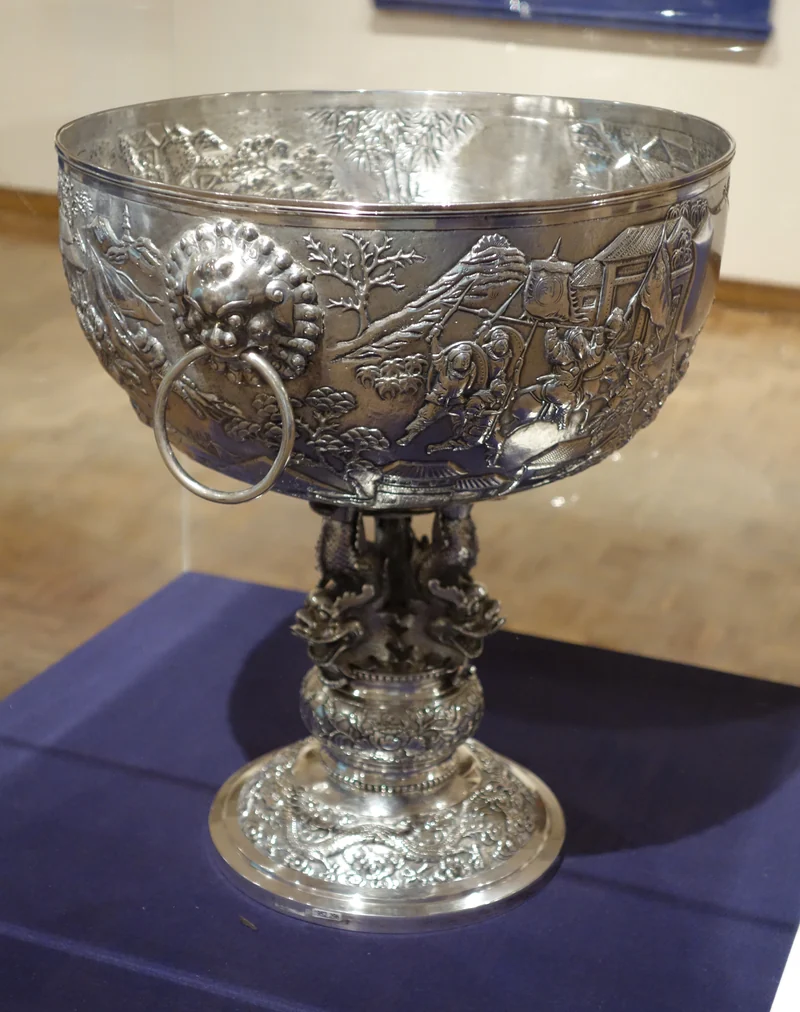
Start with the bowl pictured above, then compare the different kinds of evidence preserved by two other objects.
A landscape wrapped around a bowl
The photographed Huntington Museum of Art punch bowl is identified in its photograph record as Hung Chong & Co., Shanghai, about 1875. The individual artisan is not named. Its broad vessel sits above a tall, ornamented pedestal; a ring hangs from a projecting mask at the side.
Look past that handle and the surface becomes a miniature landscape. Buildings, trees and figures share the curved wall. The relief catches light differently as it rises and falls, while the comparatively quiet rim lets the eye rest. You can follow the composition without first knowing the identity of every figure.
This is a vessel that also works as sculpture. The stand changes its presence on a table, lifting the scene towards the viewer. A straight-on photograph tells only part of that story: the curve conceals the next part of the scene. When documenting a comparable bowl, take overlapping views around it, then photograph the underside separately.
The openwork centrepiece
A different Christie’s record describes a rectangular centrepiece marked Hung Chong & Co. with two Chinese characters. Its pierced sides combine dragons, courtyard figures, chrysanthemums and birds among bamboo; dragon handles and bamboo-shaped legs carry the ornament beyond the panels.
Here the empty spaces matter as much as the silver. Openwork lets a background show through and turns an otherwise solid wall into something lighter. Compare the edges of the openings, the joins at the legs and the attachment of each handle. Those details reveal how the design holds together, not merely what motifs decorate it.
Neither an English trade name nor a familiar dragon motif is a complete attribution. A clear record preserves all the marks, including characters that have not yet been read, alongside photographs of the whole object. A transcription can improve later; an omitted mark cannot help the next researcher.
Two marks, two parts of the story
The box recorded by S & J Stodel makes the distinction especially tangible: Hung Chong is identified as retailer and Hua as maker. Its chrysanthemum decoration is different from the landscape bowl and the openwork centrepiece. A shared retail identity need not mean a single workshop, pattern or decorative style.
For a collection record, give the retailer and the attributed workshop separate fields. Keep the source of that reading beside it. If a seller supplies only the initials HC, request a sharp photograph of the complete stamp group before turning those initials into a firm identification.
Then return to the object. Does the lid sit properly? Are the corners sound? Have repairs interrupted a chased line? These are questions about this particular piece, not a verdict on a name. The most satisfying collection brings those close observations together with the larger history of the trade.
Follow an interest
What to explore.
A historical firm profile built around object records, not a complete register of workshops or marks.
Check the details
Before you buy.
Begin with a complete view, then follow the details.
Open the references
Research this name.
- Related Collect Silver guide
Chinese export silver
Follow the objects, ports and people behind this collecting field.
- Related Collect Silver guide
Retailers, workshops and marks
Separate the business name from the workshop attribution.
- Related Collect Silver guide
Table, tea and presentation silver
Explore vessels, gifts and the stories preserved by inscriptions.
- Related Collect Silver guide
The Silver Table
Place these objects within the wider history of serving and hospitality.
Sources & further reading
- Export silver centrepiece, lot 1133752 Christie’s · Auction object record and catalogue essay
- Large Antique Chinese Silver Box S & J Stodel / BADA · Dealer object record; retailer and workshop separately identified
- Hung Chong punch bowl, Huntington Museum of Art Daderot / Wikimedia Commons · Photograph record and individual rights statement
Object records and the individual photograph record support this profile.