

Birmingham · Design and manufacture
Fresh thinking for the table
A row of upright rods, a flat base and a handle: Hukin & Heath’s tableware can make an everyday task look unexpectedly fresh. The firm offers a rewarding route into design history through objects small enough to turn over and study.
Established in Birmingham in 1855, the silversmithing and electroplating firm appointed Christopher Dresser as art adviser around 1878. The Met records that his designs stayed in production through the end of the century. Dresser supplied designs; Hukin & Heath manufactured the wares.
The Musée d’Orsay records a London showroom opening in 1879 and a second factory around 1880–81. It distinguishes marks for silver from those for silver plate. This profile concentrates on documented plated objects, keeping that material description visible rather than treating every silver-colored surface as sterling.
The objects below connect a rack dated 1878 with a separate traveling service dated 1885. That seven-year span gives the workshop a firm place in this directory, alongside the broader manufacturing history. Compare the forms, but keep each museum’s accession and material record attached to its own object.
From the museum collection
Useful objects, revealing undersides
Start with the shape, then turn to the evidence. Four studies bring the design, the manufacturer and the surviving marks into the same view.
The 1878 rack: a small exercise in structure
The Met’s Toast rack, accession 2015.449, is silver-plated metal, designed by Christopher Dresser and manufactured by Hukin & Heath. It measures 13.5 × 11.1 × 8.3 cm.
Follow the vertical rods and the open spaces between them. The carrying handle rises above the dividers; the plain base makes the assembly easy to see. This is a useful way to look at tableware: ask how it holds, separates and carries before naming a style.
A later rack in the Met, dated 1881, uses exposed rivets and simple repeated elements. The museum connects that construction to Dresser’s interest in functional, readily manufactured design. It is a separate object, accession 1985.311.
For a comparable piece, request front, side and underside views. Check whether rods lean consistently or show isolated distortion, and note repairs at the joints. Do not straighten old components merely to make the outline look more regular.
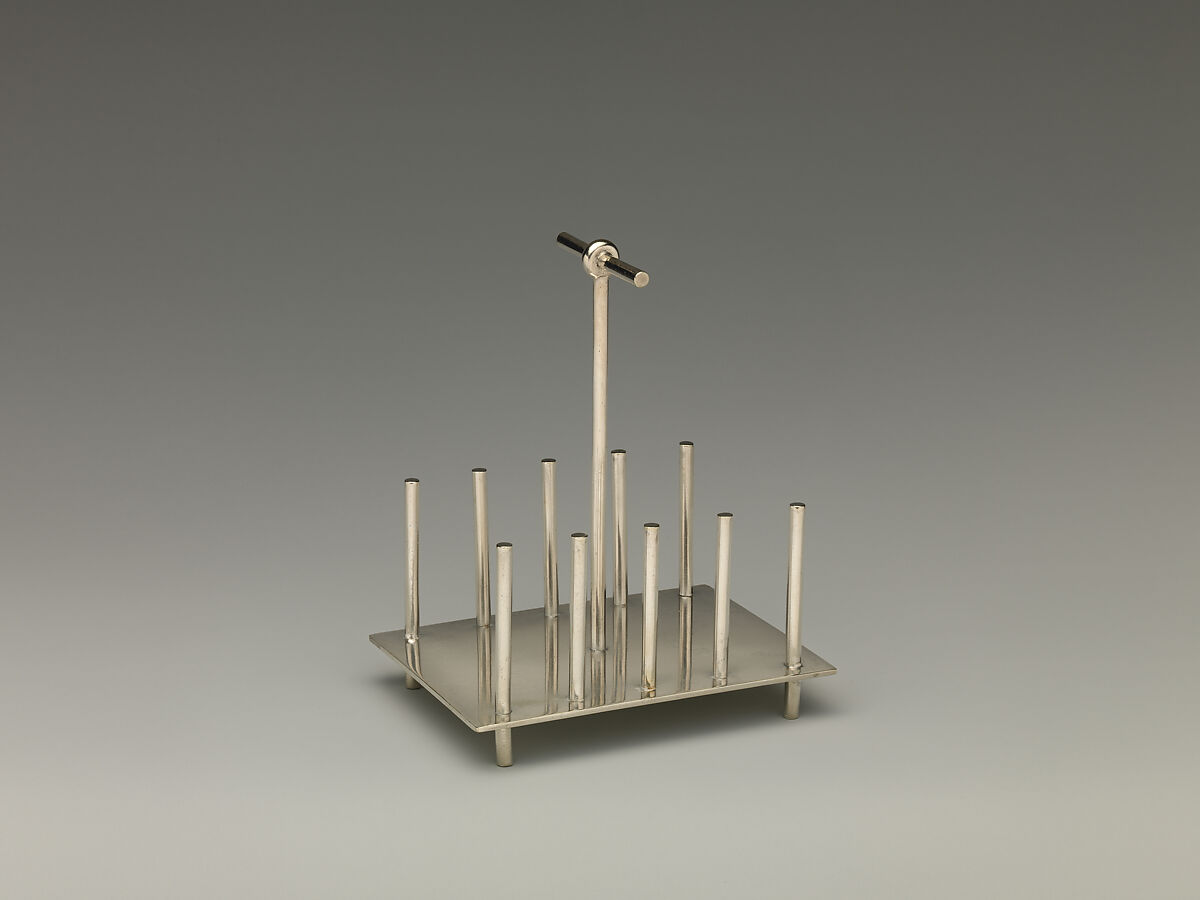
Hukin & Heath, Toast rack, designed by Christopher Dresser, 1878.
The Metropolitan Museum of Art. Purchase, Austin B. Chinn Gift, in honor of Larry and Ann Burns, 2015. Museum record · CC0
View the museum photographOne underside, several kinds of evidence
The museum records H & H with an eagle, the designer stamp “DESIGNED BY / DR C. DRESSER,” a registration diamond, stamped 1987 and scratched 13824. The photograph lets you inspect those elements together rather than compare a redrawn emblem in isolation.
There is a small discrepancy worth preserving: the museum’s registry transcription calls the month character 8 and identifies October, while the photograph appears to show B. The page retains the museum’s 1878 object date without silently correcting or independently decoding that character.
The manufacturer, designer, registration and scratched notation answer different questions. The number 1987 is recorded as a stamp, not presented as the year this rack was made. Keep the whole arrangement, its location and any uncertain strokes in your own notes.
A matching mark is one part of an attribution. Look for agreement among construction, proportions, material, surface and provenance. This original photograph is a comparison reference, not an authentication certificate for another rack.
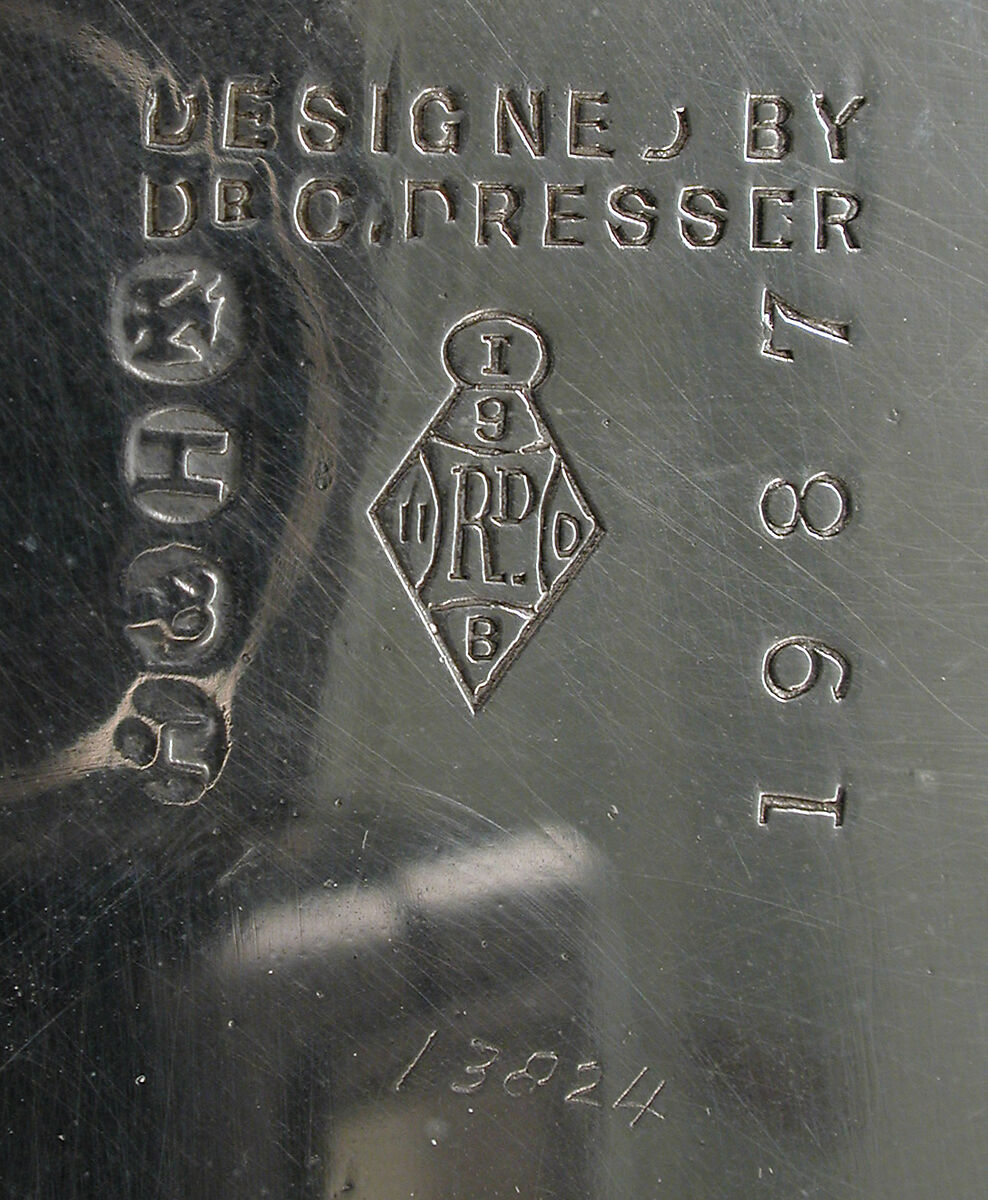
Marks on the Met’s 1878 rack, accession 2015.449.
The Metropolitan Museum of Art. Purchase, Austin B. Chinn Gift, in honor of Larry and Ann Burns, 2015. Museum record · CC0
View the museum photographA traveling tea set: collect the relationships
The Met dates this Traveling tea set to ca. 1879, accession 2000.594.1a, b–.8. It combines gilt and silver-plated brass with split bamboo; its case includes leather-covered wood and textile linings. Smaller pieces fit inside the kettle and teapot.
The mark inventory is component-specific. The kettle underside includes H & H, an eagle and 2110; the teapot includes H & H, an eagle and 2109. Several parts carry Rd No 18367. The museum notes no marks on the spirit-lamp or tea-caddy covers.
At Boijmans, the distinct service V 276 a-e (KN&V), dated 1885, is silver-plated metal and wood. Its small components pack into the teapot, then a leather cover. That record credits Dresser as designer and Hukin & Heath as executor.
The pleasure is in the fit between pieces. Before buying a traveling set, list every component and ask for assembled and unpacked photographs. Similar-looking covers may have different jobs. An unmarked cover is not automatically a replacement, but completeness still needs evidence.
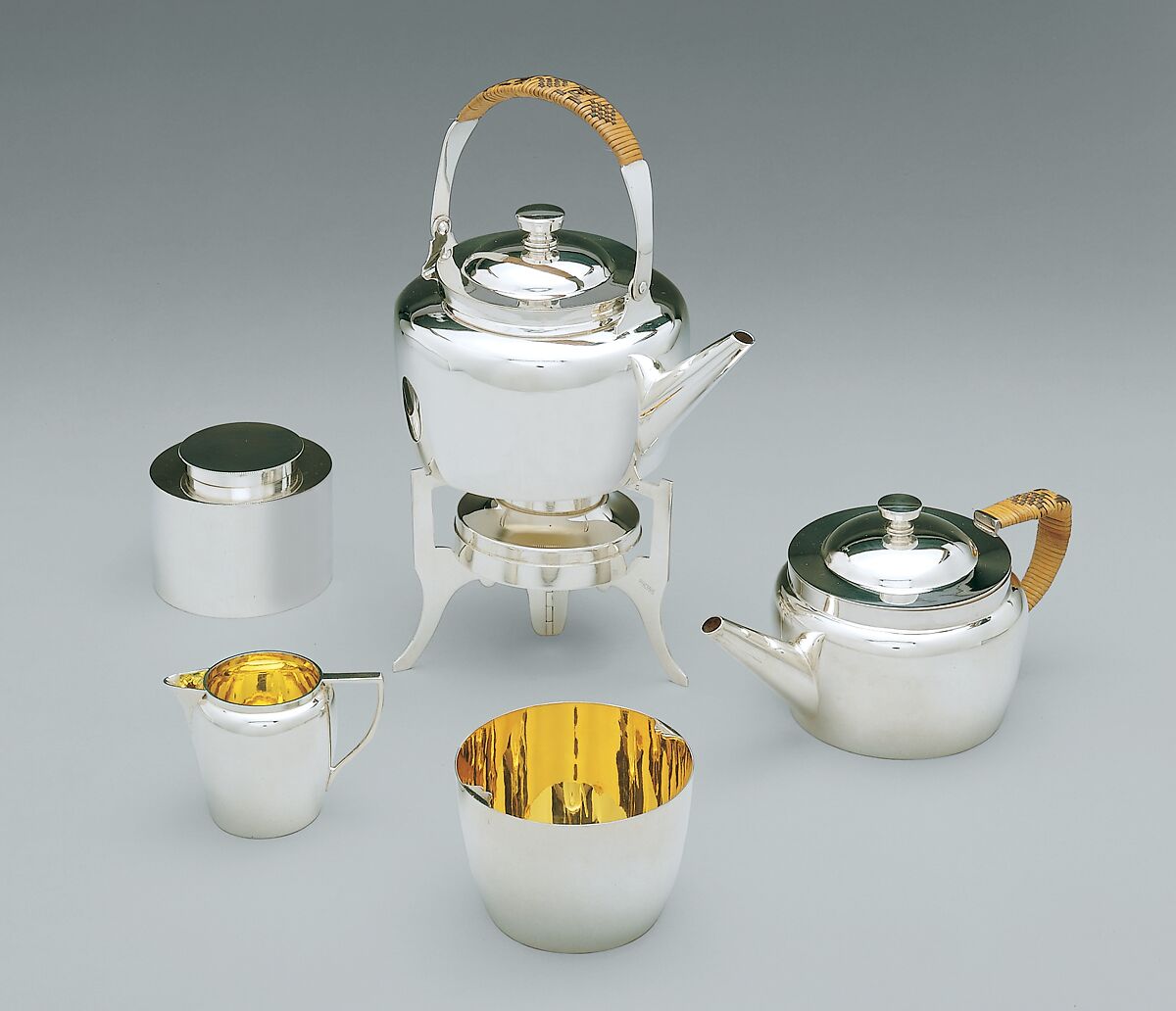
Hukin & Heath, Traveling tea set, designed by Christopher Dresser, ca. 1879.
The Metropolitan Museum of Art. Anonymous Gift, in memory of Walter E. Stait, 2000. Museum record · CC0
View the museum photographAn indistinct mark and a qualified design attribution
For the Met’s 1879 rack, accession 2021.153.4, the museum describes indistinct H & H letters and a stylized dove on the underside, with 1965 stamped separately. Its curatorial note says the rack has not been traced to a particular Dresser design, despite the designer credit in the catalogue.
The close-up remains indistinct. It has not been sharpened into a new outline or replaced with a clean invented stamp. Notice also that this record calls the bird a dove, while the 1878 rack’s record calls it an eagle. A generic bird device is the safer description across the two.
Keep the qualification when writing your own description. A secure workshop identification and a proposed designer can coexist. Preserve phrases such as “attributed to” and explain which source supplies them, rather than promoting resemblance into certainty.
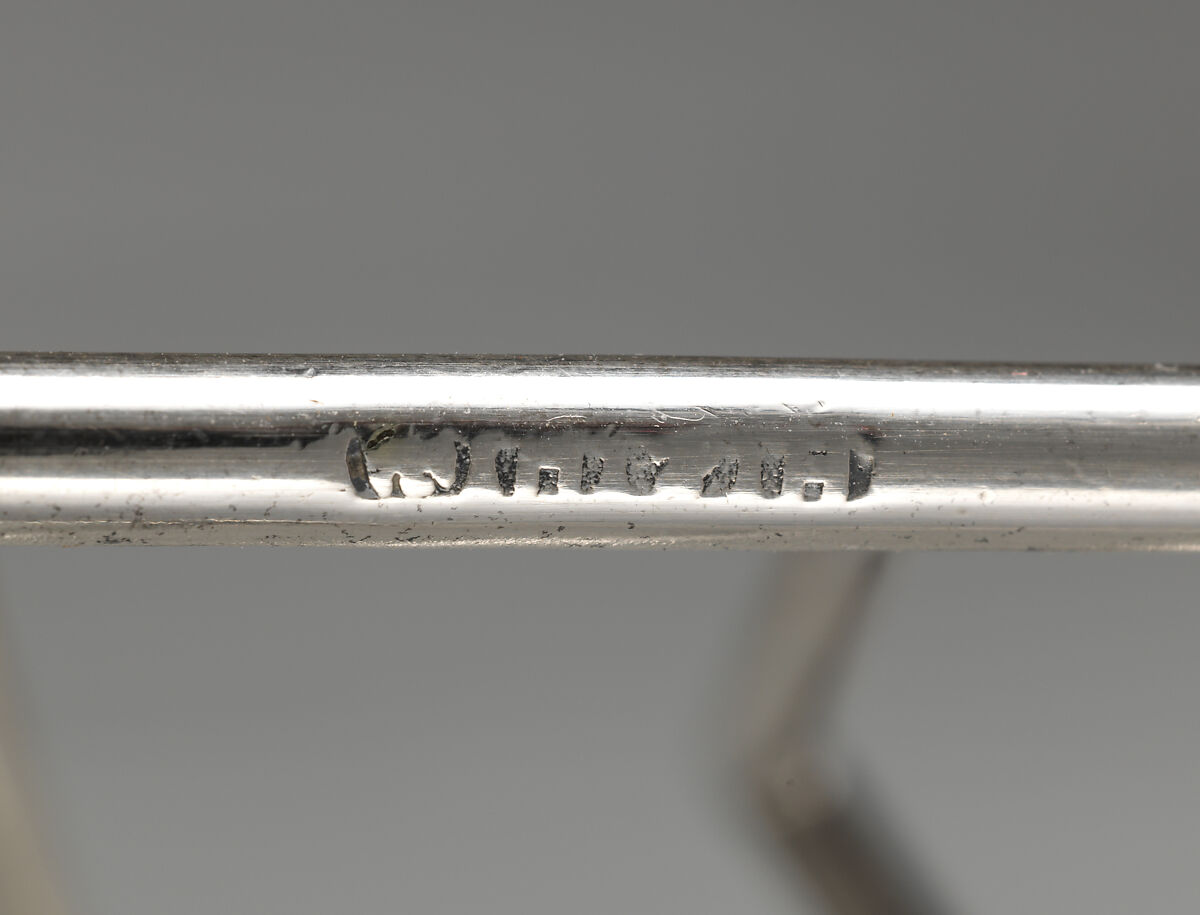
Indistinct maker mark on the Met’s 1879 rack, accession 2021.153.4.
The Metropolitan Museum of Art. Gift of Lawrence A. and Janet Y. Larose, 2021. Museum record · CC0
View the museum photographNames & chapters
How the story developed.
- 1855
A Birmingham manufacturer
The firm begins its documented history.
- 1878
Design and production meet
Dresser begins advising the firm around this time; the Met dates its rack to 1878.
- 1879
A London showroom
Orsay records the Charterhouse Street opening.
- 1885
A later traveling service
Boijmans dates its separate silver-plated set to this year.
- 1952–1953
Two published endpoints
Orsay records 1952 liquidation; the Met’s firm dates end in 1953.
Follow an interest
What to explore.
A historical maker profile centered on museum-documented silver-plated tableware. It is not a current shop, complete product catalogue, universal hallmark chronology or appraisal service.
Check the details
Before you buy.
Enjoy the design, then check the material, the components and the evidence.
Open the references
Research this name.
- Museum collection and workshop history
The firm and its 1881 toast rack
Follow the partnership between a manufacturer and a designer.
- Museum maker authority
Hukin & Heath in the Orsay authority record
Compare the workshop locations, business dates and material-specific marks.
- Museum object, inscription record and photographs
The 1878 rack and its photographed marks
Read the object and the marks together.
- Museum object and component mark inventory
The Met’s traveling tea set
Explore the nesting design and the marks on separate pieces.
- Museum collection; Dutch-language record
An 1885 traveling tea service
Compare a later, separately catalogued silver-plated service.
- Museum object, qualified attribution and photographs
The 1879 rack and its attribution caveat
Keep the maker identification distinct from design attribution.
- Image-reuse policy
The Met’s Open Access policy
Check the CC0 terms for the museum photographs used here.
- Related Collect Silver guide
Explore the silver table
Place a rack, tea service or serving vessel in its table setting.
- Related Collect Silver guide
Read UK hallmarks carefully
Distinguish a maker’s identification from a complete hallmark sequence.
- Related Collect Silver guide
Document each component
Keep photographs, measurements and provenance together.
- Related Collect Silver guide
Plan silver care
Consider the finish and every other material before treatment.
- Related Collect Silver guide
Compare Christofle
Explore another manufacturing house associated with silver plate.
Sources & further reading
- The firm and its 1881 toast rack The Metropolitan Museum of Art · Museum collection and workshop history
- Hukin & Heath in the Orsay authority record Musée d’Orsay · Museum maker authority
- The 1878 rack and its photographed marks The Metropolitan Museum of Art · Museum object, inscription record and photographs
- The Met’s traveling tea set The Metropolitan Museum of Art · Museum object and component mark inventory
- An 1885 traveling tea service Museum Boijmans Van Beuningen · Museum collection; Dutch-language record
- The 1879 rack and its attribution caveat The Metropolitan Museum of Art · Museum object, qualified attribution and photographs
- The Met’s Open Access policy The Metropolitan Museum of Art · Image-reuse policy
Sources checked November 11, 2026. Object dates, material descriptions and mark readings remain tied to their museum records. Met photographs are reused under CC0.