
A different kind of silver story
The table as a place for design.
A cup can be a vessel, a sculpture and a small demonstration of technology. Christofle’s history brings those possibilities together. Charles Christofle established his namesake business in 1830, initially as a jeweler. In 1842 he acquired patents for silver plating and electrolytic gilding. The story is therefore wider than solid silver: a plated object can be central to the history of the house.
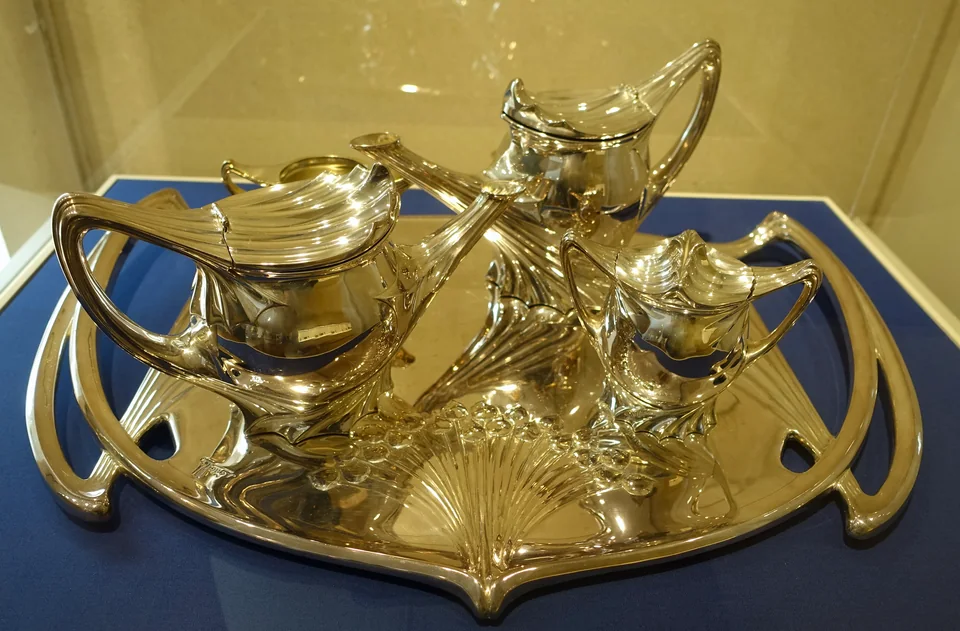
Start by looking at the tea service pictured here. Its spouts seem to continue the movement of the bodies, while the tray gathers the separate pieces into one composition. Designed by Paul Follot for Christofle & Cie around 1903–1904, the service belongs to the Dallas Museum of Art. The museum identifies it as silverplate. Its interest lies in design and manufacture, not in treating its whole weight as precious metal.
That distinction is useful at a dining table as well as in a museum. Christofle’s current collections span different materials, and familiar pattern names can recur across them. Begin an object record with three separate entries: the design, the material and the evidence for its maker and date. A name recognized from a catalog is a lead to follow, not the conclusion.
From the museum collection
Follow the line. Read the material.
A coordinated tea service and a historical reproduction offer two different ways to look closely. These are museum reference objects, not examples of current inventory.
A service that moves as one
In the photograph, long ridges sweep over lids and shoulders. Handles open away from the pots, and the tray repeats their curves at a larger scale. Look at a single piece, then let your eye travel across the whole group. This is a useful exercise when viewing any service: ask what ties its parts together, and which differences are deliberate. A matched appearance alone does not establish that every piece in an offered set began life together.
A nineteenth-century cup with an older model
The covered cup at The Met is cataloged as a nineteenth-century Christofle electrotype after an original of 1574–75. The older cup had been made for Henry III, king of France and Poland. The museum describes this later object’s material as silver gilt on base metal. Those details prevent two tempting mistakes: dating the reproduction to the Renaissance, or describing it as solid silver because of its maker.
Keep the reproduction’s own identity intact: Christofle & Cie, nineteenth century, accession 08.105.2a,b. The ring at the top, decorated rim and spreading foot invite close comparison with a source model, but resemblance does not make the two objects the same age.
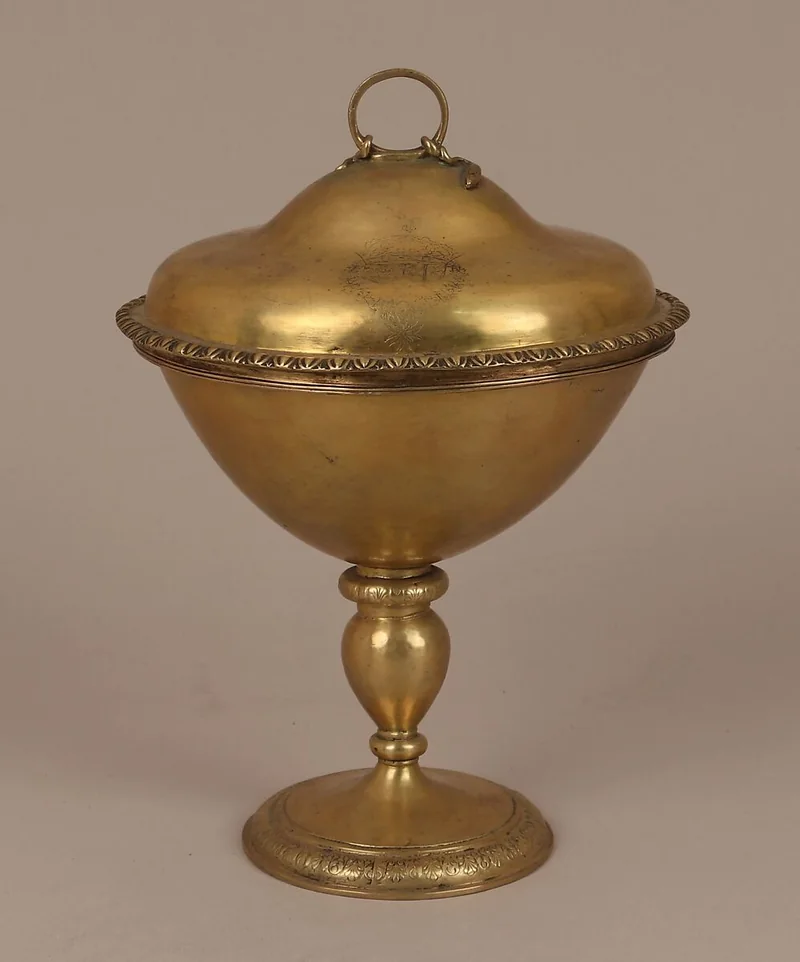
Christofle & Cie, Cup, nineteenth century, after a 1574–75 original. Silver gilt on base metal. The Metropolitan Museum of Art, Rogers Fund, 1908, 08.105.2a,b.
The Metropolitan Museum of Art. Public-domain image. Museum record · CC0
View the full museum photographThe pattern name is not the metal
The current Christofle collection pages list Albi and Marly in both sterling silver and silver-plated versions. Perles also appears in stainless steel. A pattern can tell you about an outline or decoration without specifying the material of the particular fork in front of you. When matching a service, compare the exact utensil, length, finish and material, not just the name on a listing.
Christofle describes the silver used for its plated layer as 99.9% pure. That figure describes the deposited silver, not the composition of the whole object underneath it. Keep silver-plated, sterling and stainless steel as distinct categories in your notes. Do not use the gross weight of a plated piece as its fine-silver weight.
Before making the surface brighter
The Canadian Conservation Institute explains that polishing removes some underlying metal as well as tarnish. Repeated treatment can wear through plating and soften detail. A darker recess may also be part of an intended finish. Photograph the condition first, and seek specialist advice for fragile, valuable or mixed-material objects rather than making aggressive polishing the first step.
Christofle’s care guidance covers several materials and includes exceptions for particular collections. Match instructions to the exact object and finish. Advice for a new utensil should not automatically become a treatment plan for a repaired antique or an unfamiliar historical coating.
Names & chapters
How the story developed.
- 1830
A jeweler’s beginning
Charles Christofle establishes the business that bears his name.
- 1842
A new way to coat metal
The house acquires patents for silver plating and electrolytic gilding.
- 19th century
Looking back through reproduction
The Met’s covered cup reproduces a Renaissance model in silver gilt on base metal.
- c. 1903–1904
A flowing table ensemble
Paul Follot designs the silver-plated service now in the Dallas Museum of Art.
Follow an interest
What to explore.
An introduction to Christofle’s history and material distinctions, illustrated with museum objects. It is not an appraisal, an authentication service or a review of an individual seller.
Check the details
Before you buy.
Begin with the specific object. A familiar brand or pattern name does not settle its material, age or condition.
Open the references
Research this name.
- Collect Silver guide
Look closely at silver flatware
Compare forms, construction, wear and records.
- Collect Silver resource
Keep a useful object record
Save the material, marks and history with the object.
- Collect Silver profile
Compare French and American tableware stories
Continue into another major silver manufacturer.
Sources & further reading
- Charles Christofle, a visionary Christofle · Company account of its founding and electroplating patents
- The Year in Review 2006–2007, printed page 8 Dallas Museum of Art · Museum acquisition record: Paul Follot service, date, manufacturer and silverplate
- Coffee and tea service at the Dallas Museum of Art Daderot / Wikimedia Commons · Original photograph, identification and CC0 dedication
- Cup, nineteenth century, 08.105.2a,b The Metropolitan Museum of Art · Museum object record and public-domain photograph
- Flatware collections Christofle · Current pattern and material examples, checked November 9, 2026
- Silver and metals at Christofle Christofle · Manufacturer’s distinction between silver plating and other materials
- A collection of hallmarks Christofle · Manufacturer’s historical marks reference
- How to make and use a precipitated calcium carbonate silver polish Canadian Conservation Institute · Conservation cautions on metal loss, plating and intended finishes
- Care advice Christofle · Material-specific care guidance and collection exceptions
Museum records establish the historical examples. Christofle supplies the company, collection and marks references; the conservation guidance is independent. Current examples are checked on the date shown, not a promise of stock or price.