
Know the business
The useful overview.
Engelhard belongs in a directory of historical bullion makers, rather than a list of currently verified retail-bar manufacturers. Heraeus traces Charles Engelhard’s US precious-metal refining enterprise to 1902, linking the founder to its own family and commercial history. That origin helps explain why platinum and industrial metallurgy are central to the story, even when a collector first encounters the name on a silver ingot. It should not be mistaken for the production date of any particular bar.[1]
The corporate structure changed repeatedly. A historical company account describes Engelhard Industries combining with Minerals & Chemicals Philipp in 1967, creating Engelhard Minerals & Chemicals Corporation. It then records the 1981 separation of businesses into Engelhard Corporation. These names are research leads for annual reports and old paperwork, not interchangeable descriptions of every object bearing the hallmark. The broader enterprise developed catalysts, pigments and other materials alongside its precious-metals work; a bullion-only history misses that industrial setting.[2]
The London branch adds another layer. LBMA’s history records the Royal Mint Refinery’s sale to Engelhard Industries in 1968 and subsequent relocation to Chessington. The operation later known as Engelhard CLAL stopped gold refining there in 1998, while its laboratory continued serving as an LBMA referee until the 2002 closure. Those are site-specific milestones. They should not be converted into universal end dates for Engelhard silver bars made in other places, or confused with the modern Royal Mint’s consumer products.[3]
For the BASF transaction, two dates describe different stages. BASF’s financial report uses June 6, 2006 as the acquisition date and the start of consolidation. Its June 12 announcement reports successful completion, wholly owned subsidiary status and the end of Engelhard’s New York listing. Keeping both dates avoids a false contradiction between an accounting record and the completion announcement. Neither document is a production ledger for collector bullion.[4][5]
BASF still presents Engelhard in its brand information. That establishes a corporate brand context, not a current retail silver-bar catalog or a promise to authenticate an old bar. A present-day seller offering an Engelhard item may be offering historical stock. Buyers need evidence about the individual object, its claimed age and manufacturing origin, rather than treating the continued appearance of a corporate name online as proof of renewed production. No current retail production program was verified for this profile.[6]
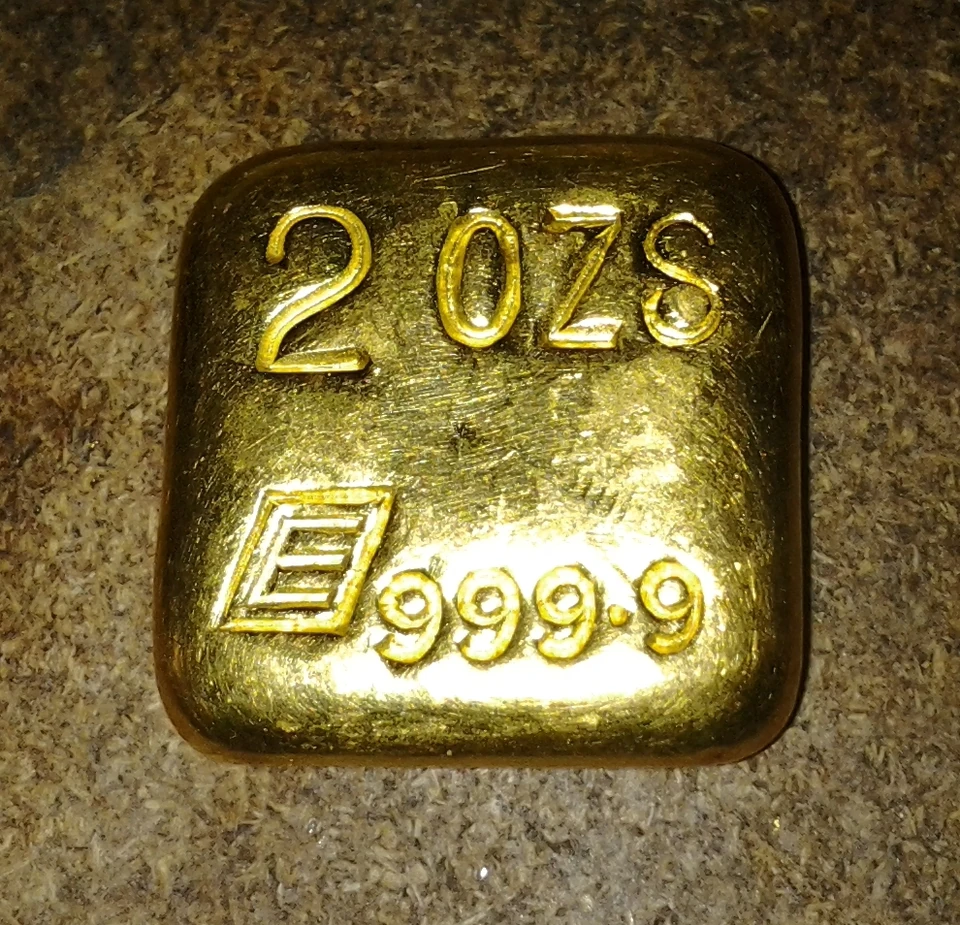
The collecting range includes bars, ingots and rounds. All Engelhard’s specialist reference documents the American Prospector series and distinguishes reverse designs, fractional pieces and special issues. Its warnings about counterfeits make the same pages useful for learning what to investigate, but photographs and familiar design elements cannot certify an offered piece. The appeal can lie in an identifiable design or manufacturing variation as much as in the amount of silver; those are separate reasons for paying a premium.[7]
Scarcity should be described with particular care. All Engelhard explains that its mintage work is reconstructed from recorded specimens and serial numbers, with estimates revised as evidence grows. That is a collector research method, not a recovered factory census. For your own records, preserve clear photographs of every side, the invoice, measured weight and dimensions, and the precise attribution used at purchase. Record unresolved details as unresolved, rather than turning a seller’s confident description into a fact.[8]
Names & chapters
How the story developed.
- 1902
Origins in precious metals
Heraeus dates Charles Engelhard’s refining enterprise to 1902.[1]
- 1967 / 1981
Corporate reorganizations
The historical account identifies the EMCC combination and later Engelhard Corporation separation.[2]
- 1968
London refinery acquired
Engelhard Industries acquired the Royal Mint Refinery.[3]
- 2006-06-06
Acquisition accounting date
BASF began including Engelhard in its consolidated financial statements.[4]
- 2006-06-12
Completion announced
BASF announced completed acquisition and wholly owned subsidiary status.[5]
Follow an interest
What to explore.
These are historical collecting categories, not live inventory or a complete list of factories and product lines.[9]
Check the details
Before you buy.
Read the current item and checkout terms. These notes summarize dated company policies, not a promise about your order. Applicable consumer rights still matter.
Open the references
Research this name.
- Independent collector reference
All Engelhard collector reference
Explore weight classes and specimen comparisons.[9]
Collector research is revisable and is not an assay or a warranty.
- Independent collector reference
Prospector and other rounds
Compare documented designs.[7]
Do not reproduce the specimen database or infer authenticity from a visual match.
- Independent collector methodology
How mintage estimates are made
Understand the evidence behind scarcity claims.[8]
Estimates are not factory-issued totals.
- Primary corporate source
BASF acquisition accounting
Verify the corporate transaction.[4]
Corporate records do not date individual bars.
The evidence trail
Sources & review notes.
- Heraeus history Heraeus · Primary corporate source · Checked Nov 5, 2026
- History of Engelhard Corporation FundingUniverse · Secondary corporate history; historical account · Checked Nov 5, 2026
- The Royal Mint Refinery LBMA · Trade-association historical research · Checked Nov 5, 2026
- BASF Financial Report 2006, note 2 BASF · Primary corporate source · Checked Nov 5, 2026
- BASF Completes Acquisition of Engelhard Corporation BASF via Presseportal · Primary corporate source · Checked Nov 5, 2026
- Engelhard brand BASF · Primary corporate source · Checked Nov 5, 2026
- Engelhard silver rounds All Engelhard · Independent collector reference · Checked Nov 5, 2026
- Mintage Methodology All Engelhard · Independent collector methodology · Checked Nov 5, 2026
- All Engelhard All Engelhard · Independent collector reference · Checked Nov 5, 2026
- 2oz gold Engelhard.JPG Wikimedia Commons / HighInBC · Photograph license record · Checked Nov 5, 2026
Company pages describe company policies and claims. Independent references and Collect Silver’s first-hand reviews are labeled separately. A source link is not an endorsement.