
A London workshop
The people behind the name.
After John Bateman died in 1760, Hester continued the family silver business. Her first mark was registered at Goldsmiths’ Hall on 16 April 1761. The workshop at Bunhill Row brought her trained sons into a family enterprise serving a growing market for domestic silver.
The National Museum of Women in the Arts connects the firm’s success with economical production and fashionable classical design. Its output ranged from spoons and other flatware to coffee pots, tea urns, salts and salvers. Beaded borders and bright-cut engraving are useful features to notice, but a decorative vocabulary alone cannot identify a maker.
From the museum collection
An everyday form, a business history.
Start with a documented utensil, then distinguish the object’s appearance from the evidence behind its attribution.
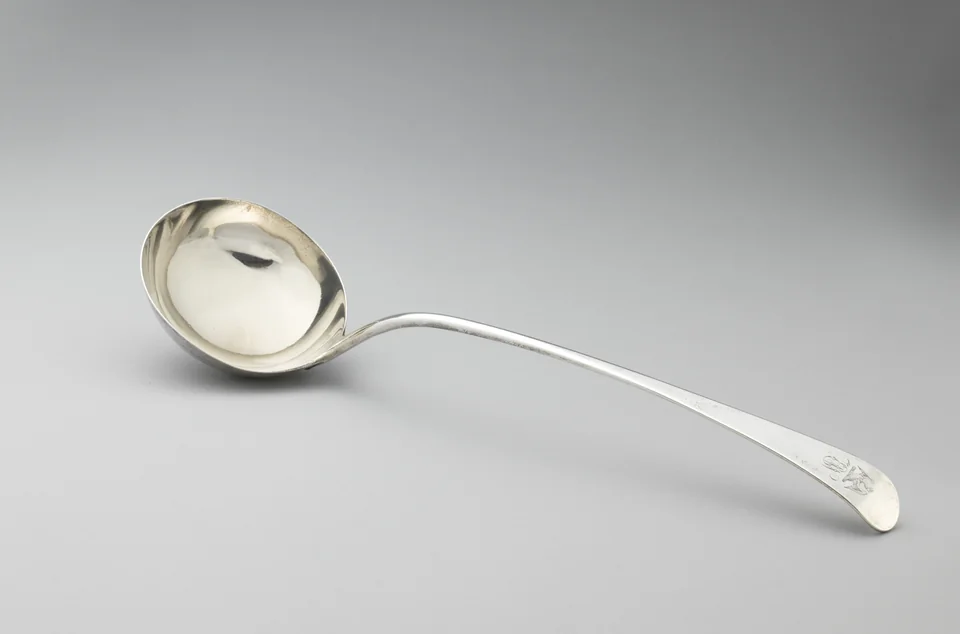
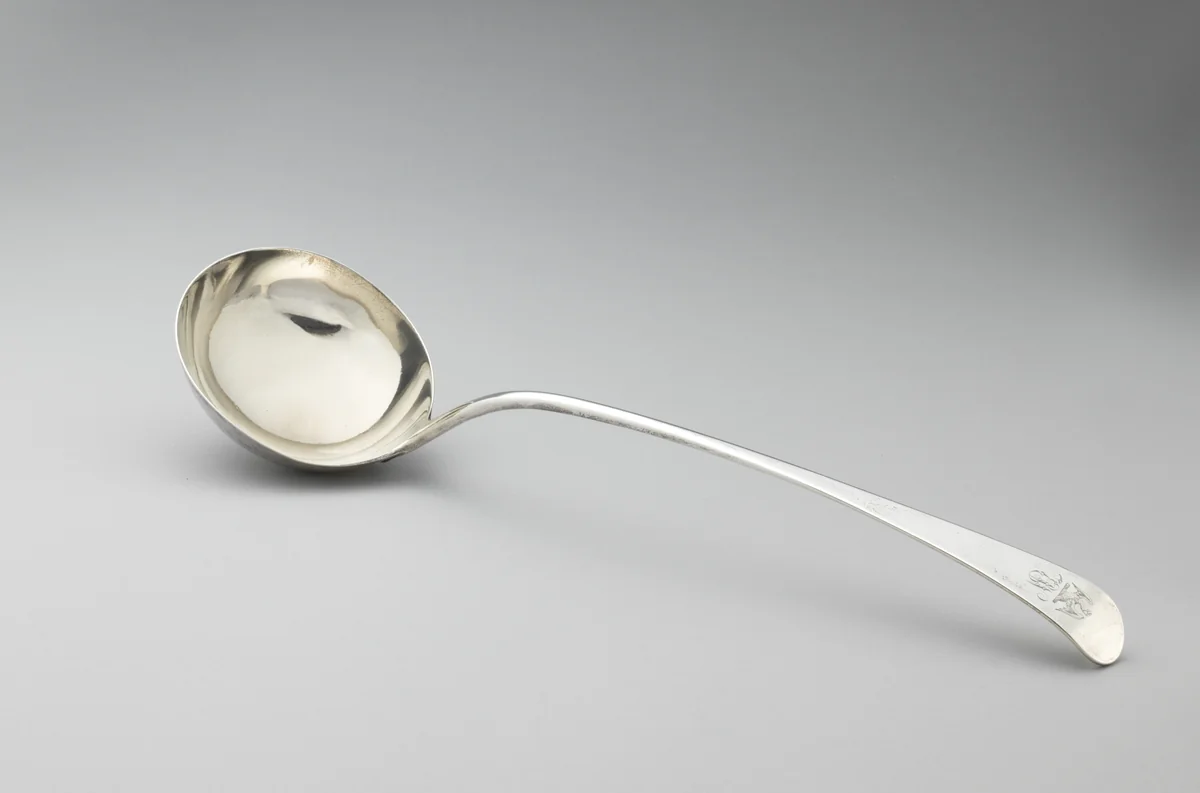
A ladle in the museum
The Met catalogs this silver ladle to Hester Bateman and dates it 1780–81. The rounded bowl, long curved stem and engraved terminal can all be studied in the complete photograph. The museum describes cutlery, especially spoons, as a workshop specialty. Its accession number is 1970.228.
A mark names a responsibility
NGV cautions that surviving evidence does not establish that Hester physically made the objects herself. A registered mark could identify the proprietor responsible to the Assay Office. The same research describes earlier output overstamped by retailers and the purchase of prefabricated sheet-silver components from Boulton & Fothergill from 1774. Assembly, decoration, retailing and responsibility were not necessarily one person’s work.
The family beyond Hester
Hester retired in 1790, but the family business continued into the nineteenth century. Later Bateman work therefore needs its own maker and date, rather than being folded into her personal working period. The National Museum of Women in the Arts records her life as 1708–1794.
Names & chapters
How the story developed.
- 1761
A registered workshop
Hester’s first mark is entered in London.
- 1780–81
A surviving utensil
The Met dates the illustrated ladle to this period.
- 1790
Retirement, not the end of the family trade
Hester retires; the Bateman business continues.
Follow an interest
What to explore.
A historical reference, not a current business review, authentication service or price guide.
Check the details
Before you buy.
These are editorial research questions for a historical object, not current seller policies or an authentication decision.
Open the references
Research this name.
- Collect Silver guide
Explore flatware
Compare utensil forms and the questions to ask about an individual piece.
- Collect Silver tool
Record an object
Keep photographs, measurements and the seller’s attribution together.
Sources & further reading
- Hester Bateman: artist profile National Museum of Women in the Arts · Museum research · Checked Nov 7, 2026
- Hester Bateman: An eighteenth-century entrepreneur National Gallery of Victoria · Museum research · Checked Nov 7, 2026
- Ladle, 1780–81, 1970.228 The Metropolitan Museum of Art · Museum research · Checked Nov 7, 2026
- Open Access at The Met The Metropolitan Museum of Art · Image reuse policy · Checked Nov 7, 2026
Museum research and collection records support this profile. Keep qualified attributions and uncertain provenance qualified. The photograph depicts a museum object, not inventory offered for sale.