
A London workshop
A name across changing businesses.
Storr apprenticed to Andrew Fogelberg and established workshop and sales premises in London’s Air Street in 1796. In 1807 he took charge of Philip Rundell’s Dean Street workshop. Place each object within this changing business history.
The later business also needs its own chronology. The Science Museum Group traces Storr & Co. from 1819 to 1822, Storr & Mortimer from 1822 to 1838, then Mortimer & Hunt and Hunt & Roskell. This is a succession of businesses, not permission to assign every later object to Storr himself. Keep the name actually documented for a piece alongside its date.
From the museum collection
Four objects, four kinds of evidence.
Read the record as closely as the object. These museum examples separate decoration, workshop credit, attributed design and the dates of assembled parts.
The engraved arms
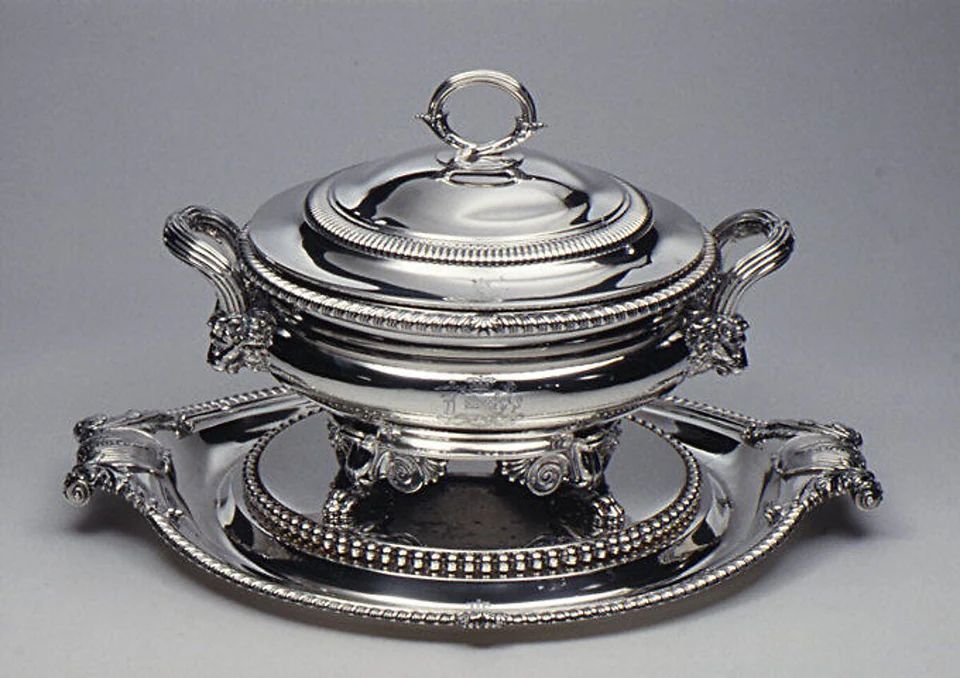
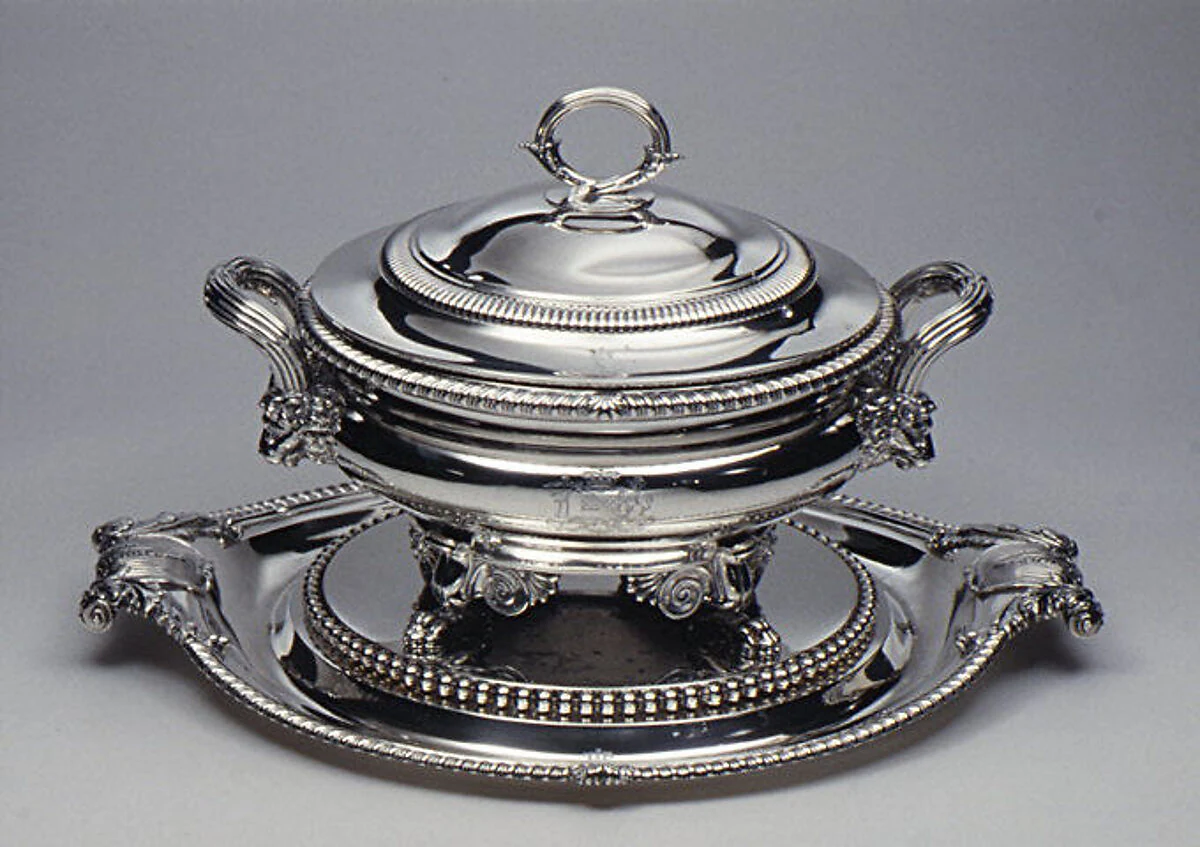
The Met’s 1806–8 soup tureen combines a broad vessel with lion heads beneath its handles and decorated feet. Its engraved arms are those of Robert Walter Stewart, eleventh Baron Blantyre.
Maker and retailer
Cleveland’s Wine Ewer of 1815 makes the commercial relationship explicit: Paul Storr fabricated it, and Rundell, Bridge and Rundell retailed it. The museum records silver gilt, with a vine-leaf border, acanthus beneath the lip and dolphin heads near the hinge. Those details offer a close study of Regency ornament without making every similar vessel a Storr product.
An attributed design
Designer, silversmith and retailer are separate credits on the Art Gallery of South Australia’s Dessert stand, dated 1812–13. Storr made the silver-gilt and glass object; its design is attributed to John Flaxman, and Rundell, Bridge & Rundell was the retailer. Three caryatids support its bowl. The catalog also records marks on several components, including the platforms, acanthus leaves and figures’ drapery. Preserve the qualification “attributed to” when citing its designer.
An earlier bowl, later mounts
An object can contain work from very different periods. The Barber Institute’s bloodstone bowl and setting combines a bowl thought to have been made around 1600, perhaps in Milan, with London mounts dated 1824/5 by Storr. Its listed materials include bloodstone, jasper and silver gilt. Dating the complete object solely from the mounts would erase the earlier bowl and its unidentified maker.
Names & chapters
How the story developed.
- 1796
Air Street premises
Storr establishes workshop and sales premises.
- 1807
Dean Street workshop
He takes charge of Rundell’s workshop.
- 1819–22
Storr & Co.
The Science Museum Group records this trading period.
- 1822–38
Storr & Mortimer
The next partnership in the museum’s business chronology.
Follow an interest
What to explore.
A historical reference built from museum objects and institutional records, rather than a current seller review or appraisal.
Check the details
Before you buy.
For an attributed historical piece, start with the object and its documentation. These are research questions, not current seller policies, a valuation or an authentication decision.
Open the references
Research this name.
- Collect Silver guide
Compare the flatware guide
Keep individual utensil types, construction and material descriptions distinct.
Sources & further reading
- Soup tureen with cover and stand, 1806–8, 39.65.38a–c The Metropolitan Museum of Art · Museum object record and workshop history · Checked Nov 7, 2026
- Wine Ewer, 1815, 1943.181 The Cleveland Museum of Art · Museum object record; maker and retailer · Checked Nov 7, 2026
- Dessert stand, 1812–13, 932A23 Art Gallery of South Australia · Museum object record; qualified design attribution and component marks · Checked Nov 7, 2026
- Bloodstone bowl and setting, 54.5 The Barber Institute of Fine Arts, University of Birmingham · Museum object record; separate dates for bowl and mounts · Checked Nov 7, 2026
- Hunt and Roskell: business succession Science Museum Group · Institutional maker authority record · Checked Nov 7, 2026
- Centerpiece from the Nereid Service, c. 1900, 1943.189 The Cleveland Museum of Art · Museum object record; revised attribution and spurious marks · Checked Nov 7, 2026
- Dessert Stand: conservation treatment Artlab Australia, Government of South Australia · Institutional conservation project · Checked Nov 7, 2026
- Open Access at The Met The Metropolitan Museum of Art · Institutional image and data reuse policy · Checked Nov 7, 2026
Museum records distinguish the maker, designer, retailer and later attribution. Preserve their qualifications when comparing an object. Sources and image rights were checked on the dates shown.