
A London workshop
The people behind the name.
Born in the Netherlands in 1688, Paul de Lamerie died in London in 1751. Saint Louis Art Museum records the start of his apprenticeship in August 1703 and preserves the fuller name Paul Jacques de Lamerie. The Met lists his active period as 1712–1751.
His family belonged to the Huguenot diaspora. The Met describes a substantial workshop and thirteen apprentices trained during his career. Read the celebrated name as a business and a community of skilled workers, not an assurance that every surface was fashioned by one hand.
From the museum collection
Dining, tea and the assembled object.
Four museum records show why function, materials and the history of individual components matter as much as ornament.
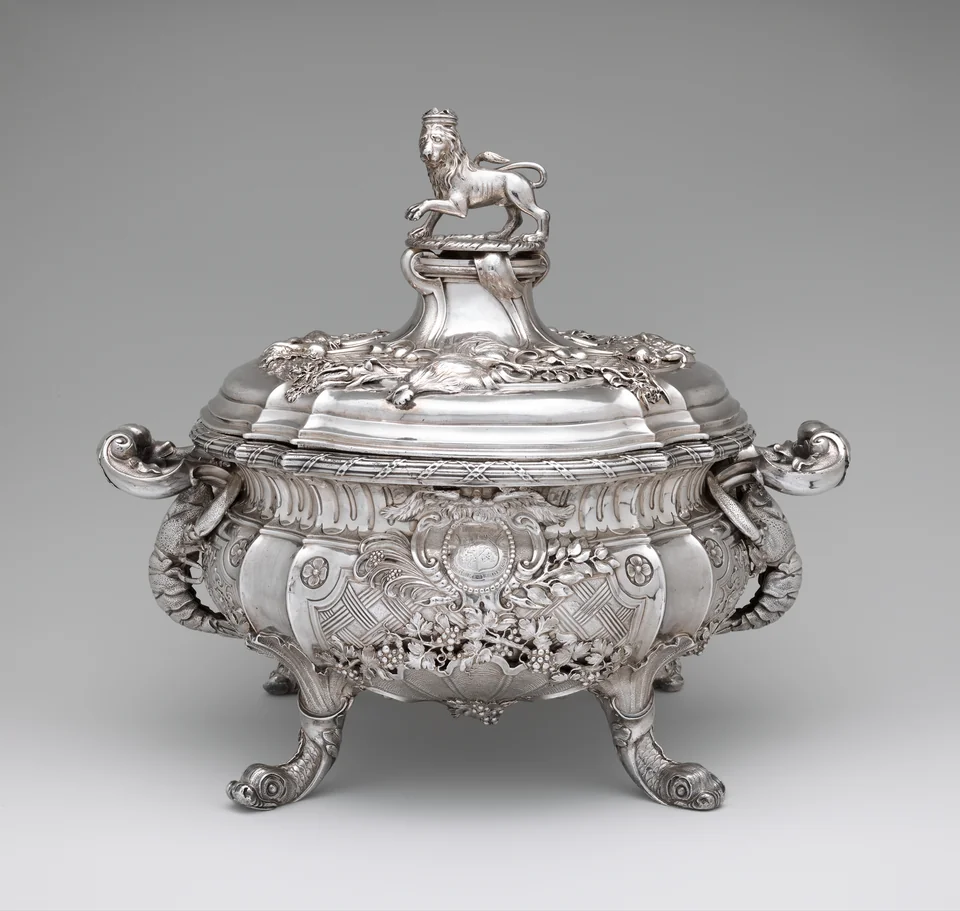
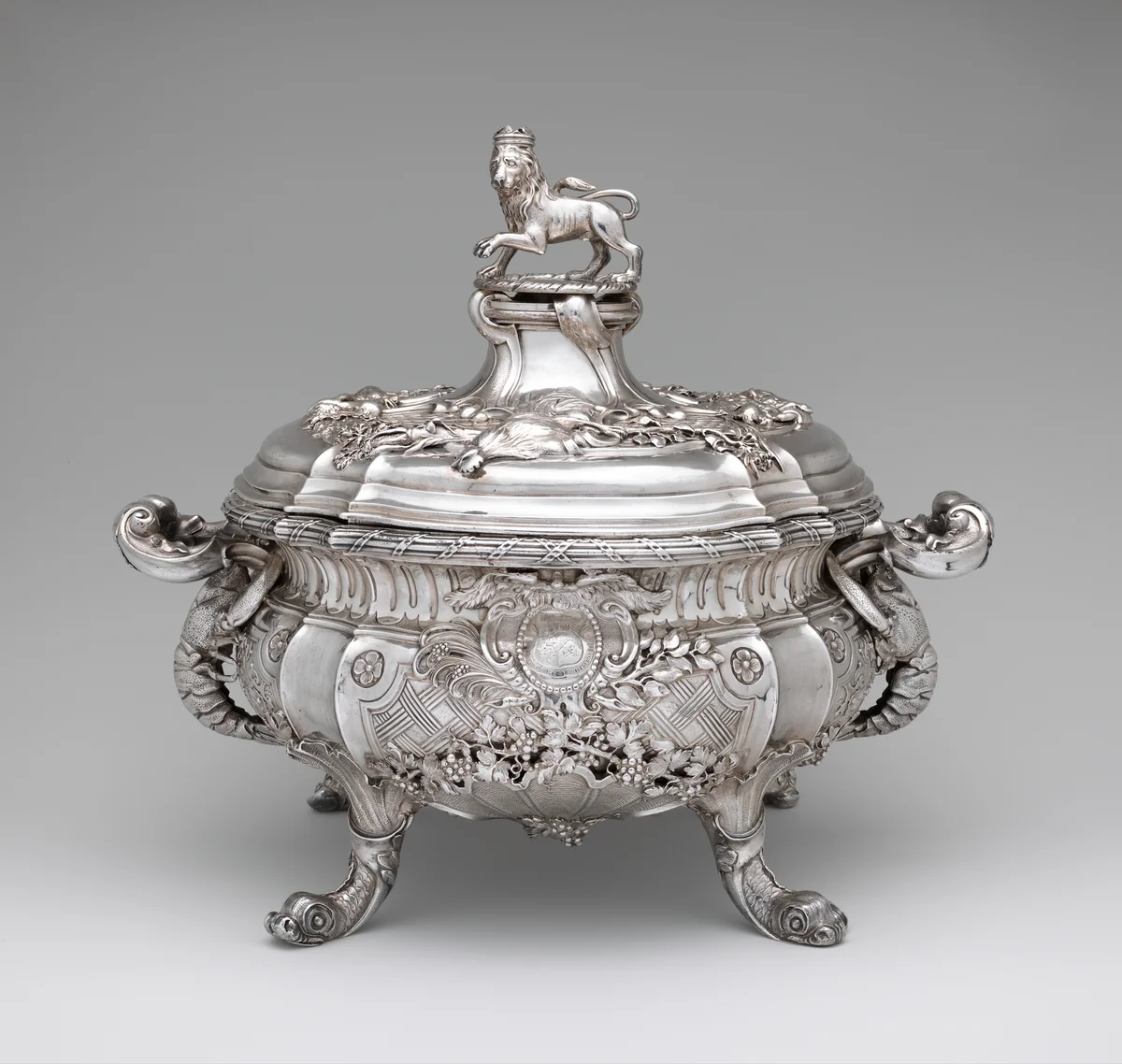
A tureen for a particular dish
The illustrated silver tureen of 1736/37 was intended for oille, a seasoned game stew. The Met connects its design with French silver and cautiously suggests it may have been made for the fourth Earl of Chesterfield. That possible commission is not certain provenance. The crowned lion finial, curling handles and feet reward a whole-object view.
Tea as a display of status
Cleveland’s silver-gilt Tea Caddy of 1741–42 combines sloping shoulders with scrolling decoration. The museum connects such containers with the high social value of tea, and traces this shoulder form to de Lamerie’s designs of the early 1730s. Shape, gilding and ornament work together; a single decorative motif is not an attribution.
Glass belongs in the account
The Met’s cruets of 1749–50 combine glass vessels with silver stands. They held oil and vinegar at the dining table. For a collector, the pairing suggests a practical question: which parts survive, and what evidence establishes that they belong together? A silver attribution does not by itself date every glass component.
Arms, containers and case
A pair of tea caddies and a sugar box of 1738/39 survives at the Met in a fitted rosewood case. The containers bear the arms of Sir James Dashwood and Elizabeth Spencer. The museum considers a wedding commission likely, rather than certain. Keep that distinction when reading heraldry alongside the history of a set.
Names & chapters
How the story developed.
- 1703
Apprenticeship begins
Saint Louis Art Museum records August 1703.
- 1736/37
The illustrated tureen
A documented example of elaborate London table silver.
- 1751
End of a lifetime
De Lamerie dies in London.
Follow an interest
What to explore.
A historical reference, not a current business review, authentication service or price guide.
Check the details
Before you buy.
These are editorial research questions for a historical object, not current seller policies or an authentication decision.
Open the references
Research this name.
- Collect Silver guide
Explore flatware
Compare utensil forms and the questions to ask about an individual piece.
- Collect Silver tool
Record an object
Keep photographs, measurements and the seller’s attribution together.
Sources & further reading
- Paul de Lamerie: maker record Saint Louis Art Museum · Museum research · Checked Nov 7, 2026
- Pair of cruets and cruet stands, 1749–50 The Metropolitan Museum of Art · Museum research · Checked Nov 7, 2026
- Tureen, 1736/37, 49.7.99a–d The Metropolitan Museum of Art · Museum research · Checked Nov 7, 2026
- Tea Caddy, 1741–42, 1943.179 Cleveland Museum of Art · Museum research · Checked Nov 7, 2026
- Pair of tea caddies and a sugar box in a case, 1738/39 The Metropolitan Museum of Art · Museum research · Checked Nov 7, 2026
- Open Access at The Met The Metropolitan Museum of Art · Image reuse policy · Checked Nov 7, 2026
Museum research and collection records support this profile. Keep qualified attributions and uncertain provenance qualified. The photograph depicts a museum object, not inventory offered for sale.