
Begin with an object
A silver bowl can be familiar and surprising at once. Its outline belongs on a dining table; its surface asks you to stop and look. Follow a stem, a dragon, a handle or a tiny stamped character and the object begins to open into several stories: how it was made, who sold it, what its first owner wanted, and how it travelled.
Chinese export silver is a useful collecting category, but not a single style. It encompasses restrained vessels and exuberant relief, large presentation pieces and small personal possessions. The most rewarding starting point is the object itself, not a checklist of dragons and initials. A plain piece deserves attention alongside a spectacular one.
A landscape you can turn
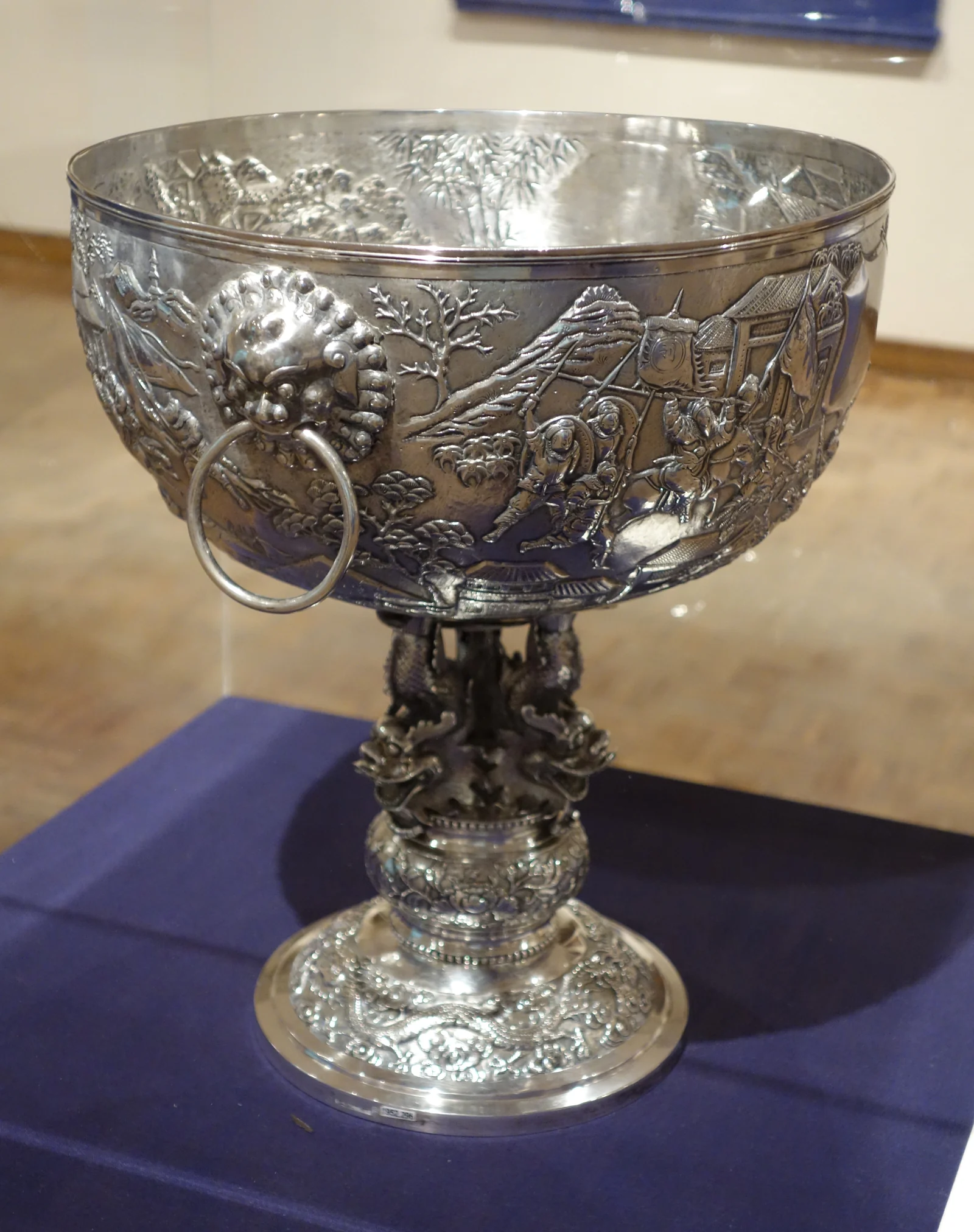
The punch bowl associated with Hung Chong & Co. rewards a slower look. At first, the pedestal makes the bowl appear almost architectural: a broad upper vessel balanced above a narrow, heavily worked support. Then the eye finds the ring handle, suspended from a projecting face. Beyond it are small figures, buildings, trees and a path that seem to continue around the curved wall.
A flat photograph cannot show that entire scene at once. The bowl asks to be viewed from several positions. Its surface is not simply a pattern filling empty space; it creates a sequence of discoveries. The broad polished rim provides a moment of rest above the crowded relief. At the foot, ornament returns, giving the upright shape a visual foundation.
This is where collecting overlaps with sculpture. A vessel can be useful without being visually still. Our silver sculpture guides approach objects through shape and movement; the same attention works here. Notice how the ring, mask and pedestal project beyond the bowl’s outline, while other details remain close to its surface. You do not need to identify every figure to begin seeing how deliberately the object has been organized.
Follow the name behind the bowl in our Hung Chong & Co. profile, where related object records distinguish a retail identity from the workshops behind it.
What “export” means
The term usually describes Chinese silver made for overseas buyers and cross-cultural trade. Its familiar nineteenth-century forms sit within a much longer history of Chinese metalworking. The Peabody Essex Museum records a silver teapot made about 1680 and imported to London in 1682–83, an early documented survivor of that exchange.
Destination, style and maker are separate questions. A Western-shaped vessel does not tell us precisely who bought it, and a Chinese motif does not prove that an object left China. Use the label as a door into research rather than as a complete account of an object’s life. Where a museum documents the intended market, preserve that specific information. Where it does not, leave the journey open.
The trade behind the silver
The objects travelled within a much larger trade. MIT’s history of Canton identifies silver among the principal incoming commodities and tea as a major export. But this was not an economy in which nothing except silver changed hands: textiles, raw cotton, American furs and ginseng also entered the trade. That broader picture is more useful than the familiar shorthand that every exported silver object began as a melted foreign coin.
The history was not simply a peaceful exchange of beautiful things. The nineteenth-century trade also involved opium smuggling and imperial conflict. A richly decorated vessel does not remove that context. Nor does that context erase the skill of the people who made it. Holding both in view helps us appreciate the craft without turning the ports into a romantic backdrop.
For an individual object, bullion history and provenance remain different kinds of evidence. The presence of foreign silver in trade cannot establish the source of the metal in a particular bowl. Follow a documented object’s history as far as it goes, rather than extending the general history of commerce into a story about its specific material.
Choose your way in
Start with the underside if a mark has caught your attention. Start with the table if you are drawn to tea services and presentation vessels. Or follow the seams and surfaces to understand the craft. Each guide connects back here and to the wider Collect Silver collection.
A table across oceans
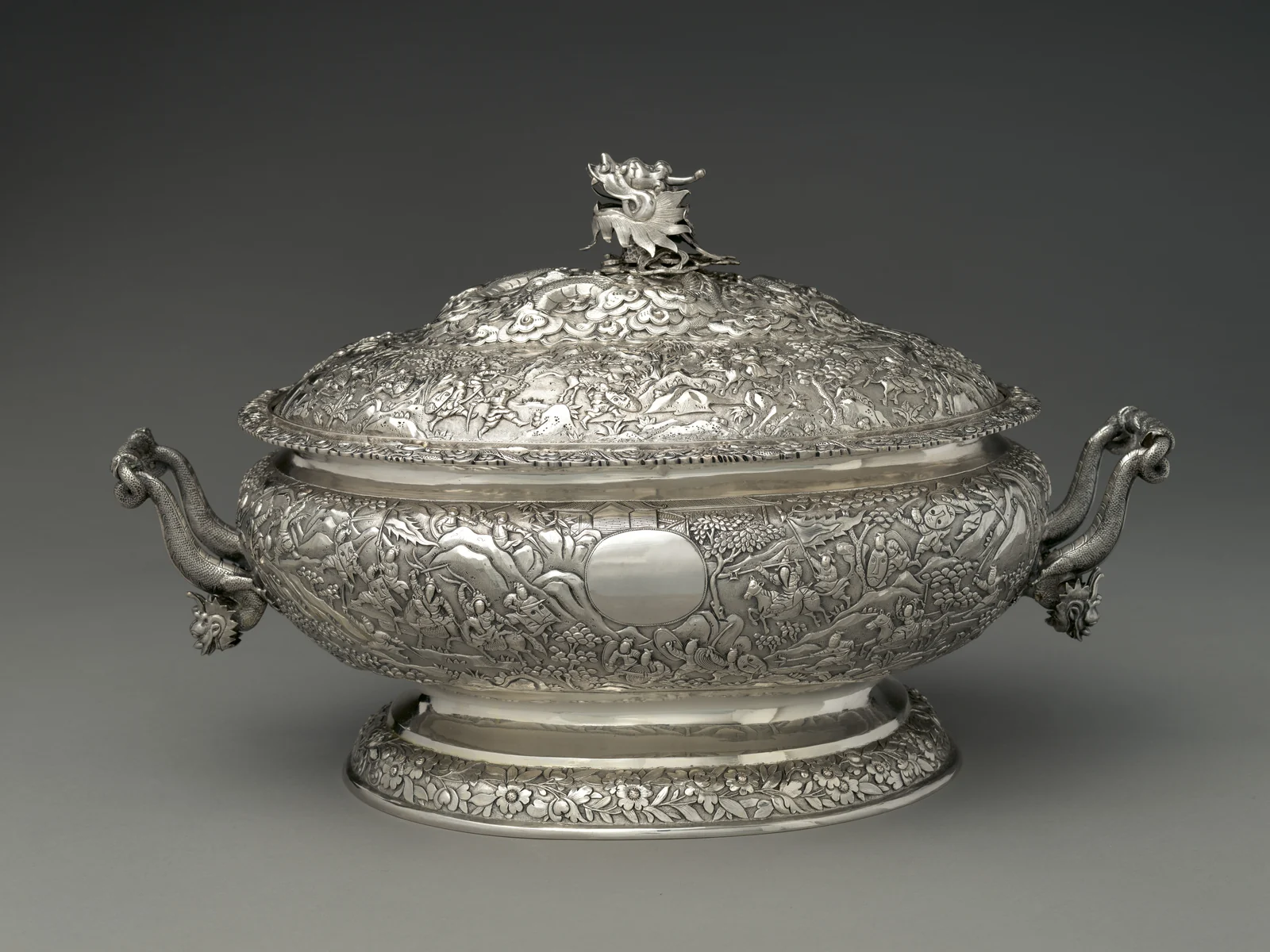
The Met’s silver soup tureen, dated about 1865, is catalogued as Chinese, for the American market. That brief description is unusually helpful: it distinguishes place of making from intended audience. A tureen is also a social object, made to serve, to occupy space and to be seen in company.
Imagine the difference between reading “silver container” and recognizing a piece made for serving soup. Function gives the handles, lid and scale a reason. Comparing it with tea service and the wider Silver Table helps turn an unfamiliar antique into something legible.
Several ways to build a collection
One collector follows a form: tea pots, boxes or presentation cups. Another follows a place or trading name. A third is interested in techniques, comparing pierced work, relief and polished planes across objects that would never have belonged to one service. These approaches can meet in a single piece without requiring a collection to become an encyclopaedia.
An effective collection begins with a question that can become more precise. Instead of “I want something with dragons,” try “How does a dragon become a handle?” Compare the attachment, curve, grip and relationship to the vessel. Instead of seeking an important name alone, ask whether several objects carrying that name share construction details or merely the retail mark. The question makes modest objects interesting and impressive ones easier to evaluate.
The same object may therefore belong in several parts of Collect Silver: a tableware guide, a maker record and a study of metalworking. Those connections should help you move through the subject, not create three competing identities for the piece. Keep one careful object record, then follow its different relationships.
Names, hands and histories
A name on silver can represent a retailer, a workshop or an individual. These roles sometimes overlap, but should not be collapsed automatically. The person who sold an object need not be the person who raised its body or chased its decoration. A careful record gives each documented role its own place.
That is also why an attractive story deserves checking. Inscriptions, old labels and inherited descriptions are valuable leads. They are not interchangeable with evidence of manufacture. Keep photographs and the source of an attribution together, so a future discovery can improve the record without erasing what was originally known.
Visit the Wang Hing & Co. profile for a view inside the historical showroom and museum objects that separate retailer, workshop and owner.