
A vessel with a job
A covered bowl, a tea pot and a trophy can share ornamental ideas while asking very different things of their maker. One must pour, another must hold heat or food, another must carry an inscription and command attention. Function is the thread that connects their proportions and construction.
Begin by asking how a piece would be held, opened, filled and cleaned. Where are the handles? Does the lid locate securely? Is a projecting ornament also a functional grip? These questions make a comparison more revealing than simply counting decorative motifs.
Tea before the matched service
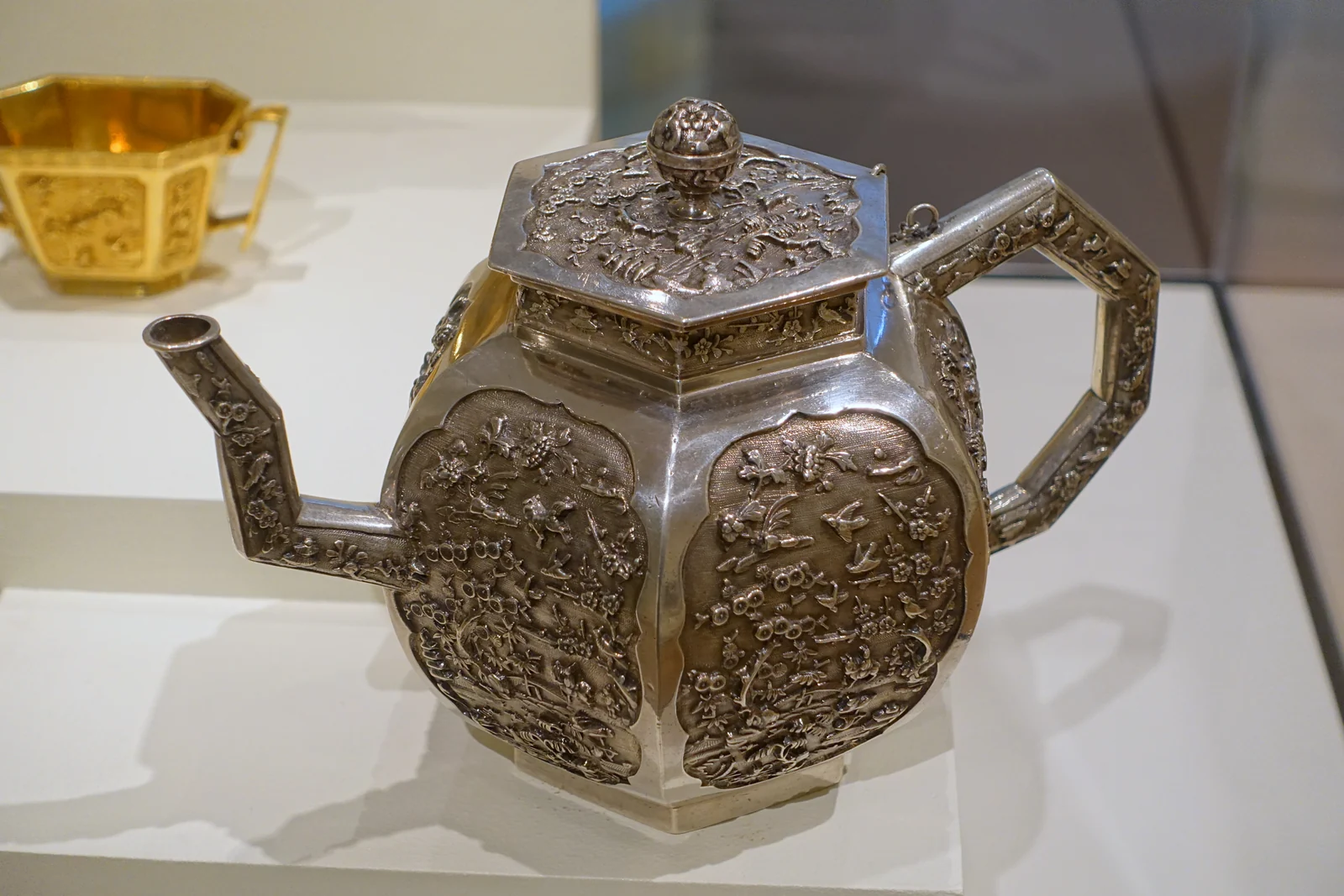
The photographed Chinese teapot, catalogued on its image record as about 1680 and held at the Peabody Essex Museum, helps stretch the visual comparison beyond the late nineteenth-century tea set. Its faceted body, angular handle and straight-sided spout offer a striking contrast to a rounded bowl. Its photograph alone does not establish its original buyer or export journey.
A single pot can be a complete object even when it is not part of a surviving service. For later groups, distinguish a documented original service from pieces assembled because they look compatible. Compare dimensions, handles, decoration and marks, but do not insist that every legitimately related component must be identical. The tea-set components guide offers a wider framework for thinking about completeness.
Serving and display
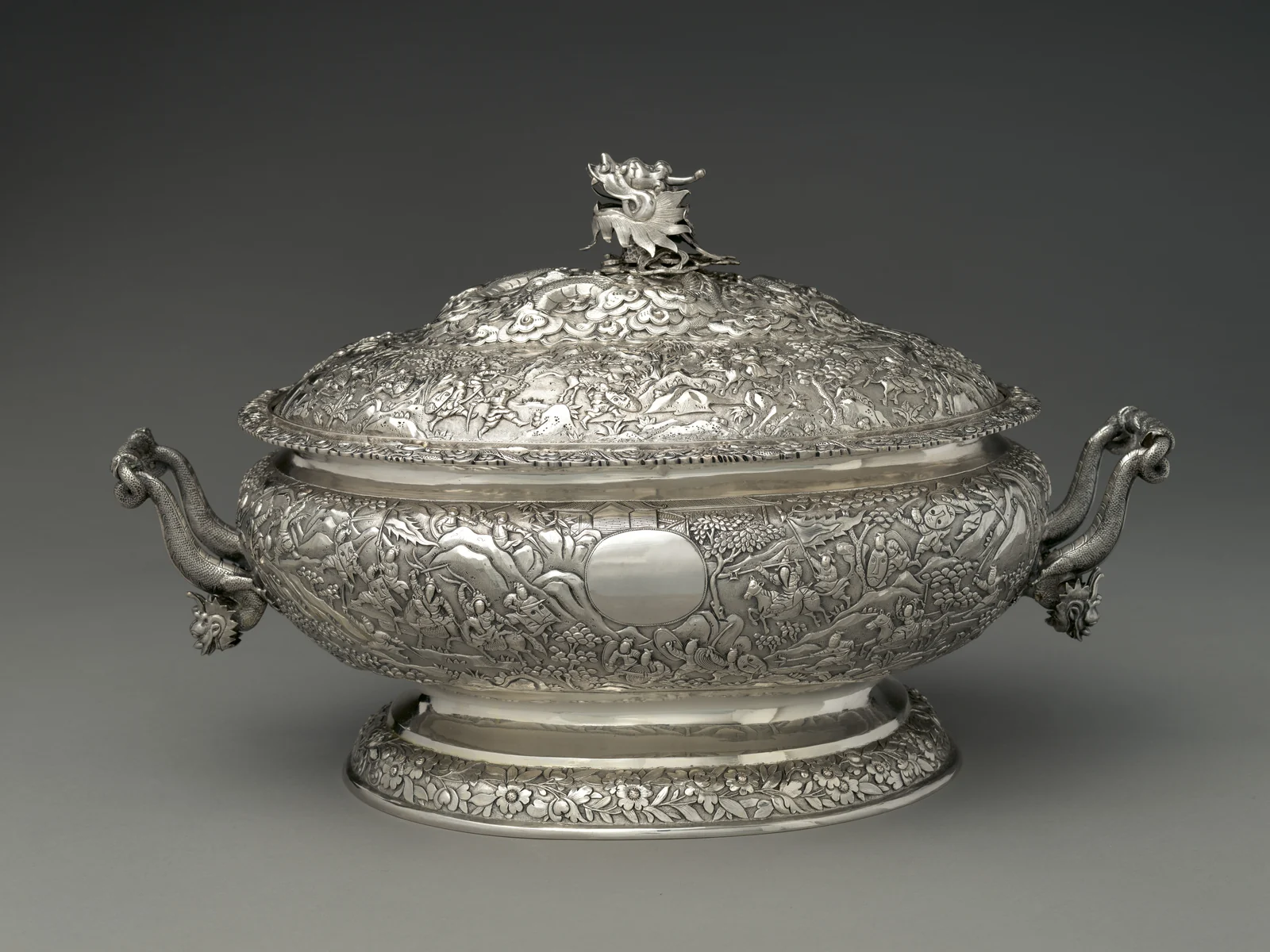
The Met’s Chinese soup tureen for the American market shows how a familiar dining form could travel across manufacturing traditions. Its body, lid and handles belong to the practical act of serving, while the finished vessel also participates in the display of a table.
Look beyond the largest object in a group. A spoon, strainer or stand may explain how a vessel worked. Missing removable elements can change both the silhouette and the experience of use. Before treating an empty socket as damage, compare an intact documented example of the same form.
A teapot that becomes a scene
A Khecheong-marked teapot in Christie’s lot 32 takes a different approach from the quieter faceted vessel pictured here. Figures inhabit landscapes, appear on fish and emerge from shells. Dragon forms shape the handle and spout, while claw feet lift the body. The pot’s practical features become part of its animated world.
This is a nineteenth-century object; the lot record dates it to the second half of that century, while a related collecting-guide caption gives an earlier date. The difference is a reason to preserve the attribution carefully, not to choose whichever date sounds more desirable. The visible scenes should not be assigned to a particular novel or battle without further evidence.
What can be appreciated immediately is the relationship between vessel and ornament. The handle and spout do not merely carry decoration pasted onto a neutral shape: their forms participate in the design. Comparing this catalogue example with the photographed teapot and tureen reveals several ways to solve the same artistic problem, making an everyday function feel extraordinary.
A tureen in detail
The Met tureen gives the eye several different speeds. The long oval body is easy to take in, but the dense relief slows us down. A smooth cartouche interrupts the worked surface at the centre. On either side, the handles extend upward and outward; the lid rises toward a small sculptural finial. Smooth bands divide those busy areas so that the vessel does not dissolve into decoration.
That balance is worth comparing with the faceted teapot. On the pot, polished edges separate the relief panels, and the angular silhouette remains clear. On the tureen, broad curves and bands organize a much larger continuous surface. Both invite close looking, but they do it differently. “Ornate” is an accurate first impression and an incomplete final description.
For a collector, describing those relationships produces a better record than repeating a list of motifs. Note where the ornament changes, how the blank spaces work, and whether a lid’s pattern and shape continue the body’s design. Such observations are useful when comparing a prospective matching piece, even before its marks are fully understood.
The people inside a presentation cup
A presentation cup can look like the end of a story: a splendid object made to celebrate an achievement. Read its inscription, however, and it can become the beginning of a much more interesting question.
The Peabody Essex Museum’s Coolidge cup is a silver standing cup with cover, dated about 1840 and catalogued as retailed by Cutshing of Guangzhou. Dragons form its handles; squirrels and grapevines share the decoration with clouds and rowing scenes. A European trophy shape has become a setting for several visual traditions.
The dedication names American merchant Joseph Coolidge and the Canton hong merchants who presented it. But the museum’s research did not establish exactly when or why the gift was made. Rowing scenes do not, on their own, prove a rowing prize. The object is more revealing when we resist completing its story for it.
A related discovery adds another person to the picture. A gold filigree bracelet dedicated to Coolidge’s wife carried the same group of merchant names. The bracelet later joined the cup at PEM. These are different materials and different kinds of possession, connected through people rather than through matching form.
That distinction matters when documenting silver at home. An inscription may establish a recipient without identifying the workshop, or preserve a relationship without explaining the occasion. Keep those discoveries separate instead of turning every clue into a single confident biography.
Read the dedication in layers
- Record what is visible. Photograph the whole inscription, then transcribe names, spelling and line breaks. Keep an unreadable character as a gap rather than silently guessing.
- Separate the roles. List the recipient, giver, retailer and maker only where each is supported. A retailer’s mark is not a signature from every hand that worked the metal.
- Keep dates distinct. A date in a dedication, an estimated manufacturing date and an acquisition date answer different questions. Do not automatically substitute one for another.
- Leave room for the next discovery. Record the source of an identification and what remains uncertain. A later letter or related object may connect names that the silver alone could not explain.
For marks rather than dedications, continue with makers, marks and attribution. Together, the two kinds of evidence can make a modest personal object as absorbing as a grand trophy.
Collecting with context
A collector may be drawn to tea, botanical ornament, a port city, a trading house or a particular technique. All are useful routes through the material. There is no need to begin with a complete grand service: a well-understood small object can teach more than an impressive group with a vague description.
Condition, completeness, workmanship, documented history and demand all influence value. Weight alone does not measure the quality of a piece, and decorative richness does not guarantee a higher price. Compare like with like and keep auction estimates, asking prices and actual sale results distinct. Continue into The Silver Table for related collecting paths.
Before you buy a group
A matching appearance can conceal a mixed history. Ask whether a service is documented as a group or assembled by a later owner. Check every removable lid, stand and attachment, not only the most photogenic vessel. Different wear does not by itself prove a marriage, but it is worth understanding why one part looks almost untouched while another has seen heavy use.
Auction photographs are particularly good at presenting a group as a single composition. Make your own list of what is actually included. Does “tea service” include the tray? Is the finial present? Are there interior photographs? Does the condition report cover all the pieces or only selected faults? The answer may affect the pleasure of owning the group as much as its price.
If you intend to use historic silver, that is a further question, not an automatic benefit of purchase. A handsome vessel may contain old repairs or materials unsuitable for the use you have in mind. Establish condition and suitability first; a display collection is no less legitimate than a working table.