
Victorian roots of modern design
The form before the ornament
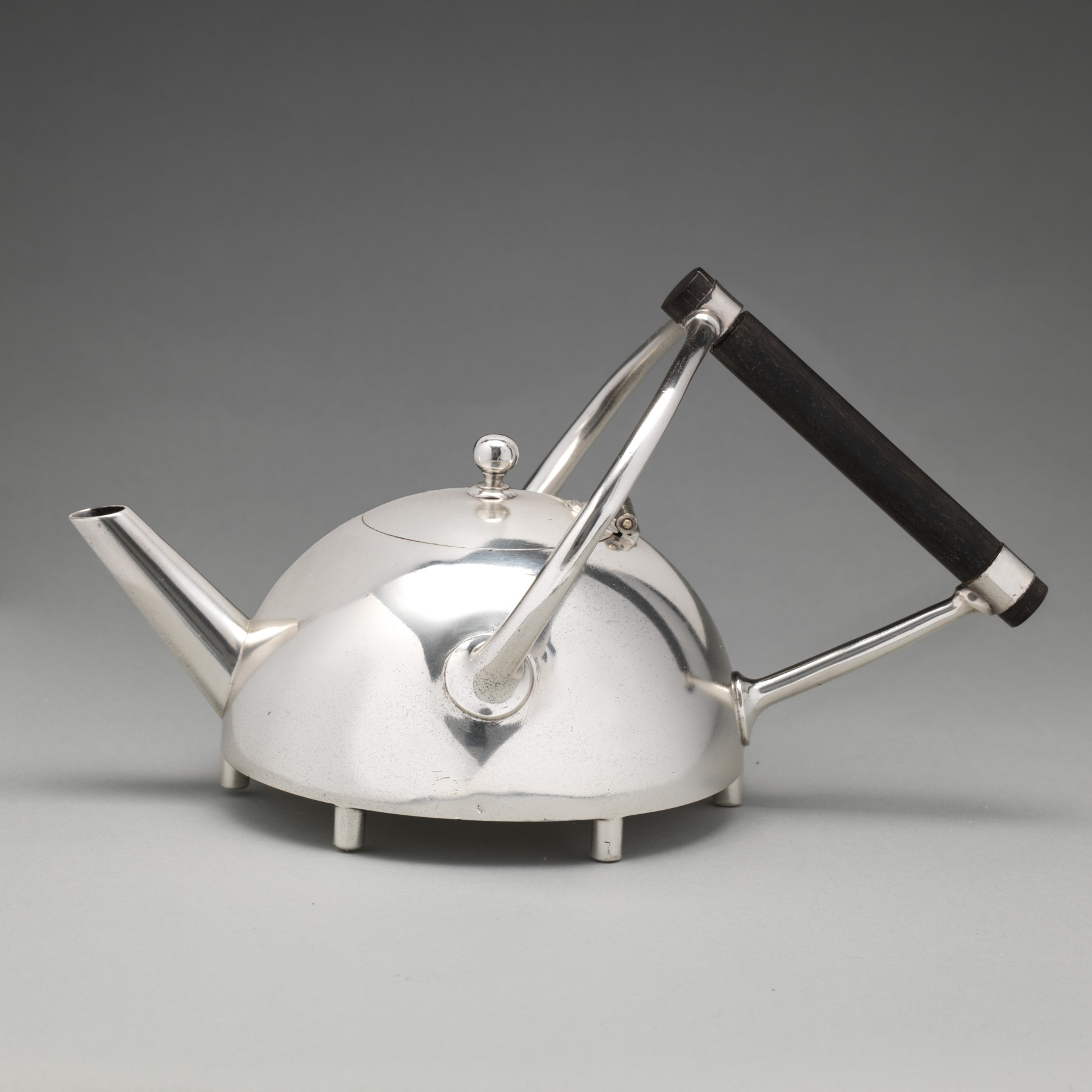
A straight spout, a dark angular handle and a low, rounded body: the teapot pictured here invites you to read its parts before looking for ornament. The Met dates it to about 1879, credits Christopher Dresser with the design and James Dixon & Sons with manufacture, and identifies silverplate and ebony. Its modern appearance belongs to a Victorian object.
Dresser (1834–1904) trained at London’s Government School of Design. His work moved between botany, writing and the design of domestic goods. He supplied manufacturers with designs in many materials rather than building a career around one silver workshop. Japanese art and his visit to Japan in 1876–77 informed his attention to shape, surface and construction.
Designing and selling were separate parts of his work. Dresser also imported Japanese objects and operated the Art Furnishers’ Alliance, a retail venture open from 1880 to 1883. A record can therefore name him as designer while another business manufactured the object and a third sold it. Follow the role attached to each name.
He is a useful precursor to modern silver design, but the later comparison has limits. The V&A’s acquisition account places an austere Hukin & Heath teapot within Victorian Aestheticism even while noting its resemblance to later Bauhaus forms. Seeing something familiar in an old silhouette should begin a comparison, not erase its own historical setting.
From the museum collection
One designer, different routes to the table
These museum objects let us compare form with the evidence for design and manufacture. The material and attribution belong to the particular example.
A Dixon teapot: geometry with a practical job
The Met’s teapot, 2021.153.2, places the light-colored metal beside a dark ebony grip. The long spout and handle project from opposite sides, making the small body part of a wider composition. Look at the relationship among the lid, grip and pouring opening as well as the outline.
The museum records thirty-seven designs sold by Dresser to Dixon between 1879 and 1882, with only some produced. A surviving drawing, a manufactured model and this museum object are different stages of evidence. Nor did every experimental design fulfill a simple promise of cheap production.
A spoon holder with a qualified attribution
The Met’s Spoon holder, 1988.164, is silver-plated brass and ebony, dated about 1878–81. Hukin & Heath is the named manufactory; the design is attributed to Dresser. The museum has not traced the object to a specific design by him. That qualification stays with the name even when its shape looks persuasive.
The curved body, straight handle and small projecting feet make an instructive comparison with the Dixon teapot. The museum relates those elements to Japanese metalwork and economical manufacture. Its title is Spoon holder, while its commentary also mentions spoon-warmer or egg-coddler terminology; keep the catalogue title visible when following the record.
This is a different question from whether Hukin & Heath made it. Workshop identification and individual design attribution can have different levels of certainty. The existing Hukin & Heath profile follows its racks and traveling services in greater detail.
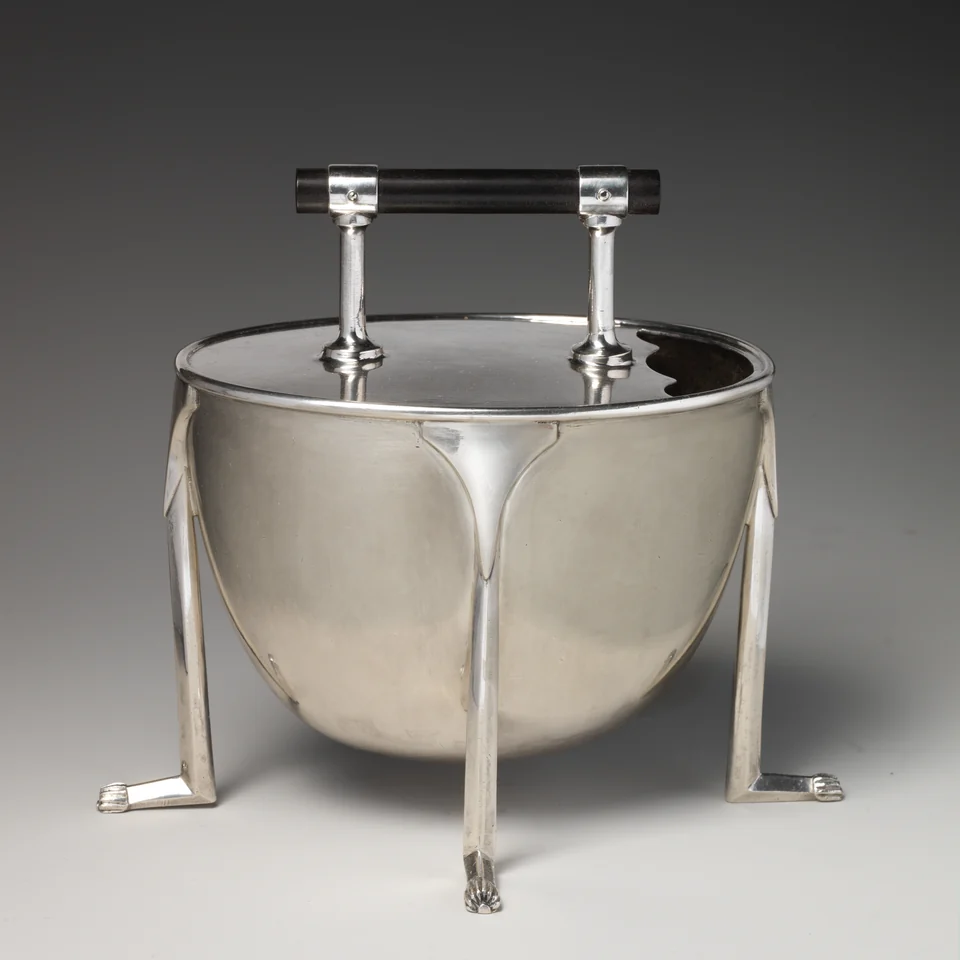
Spoon holder, design attributed to Christopher Dresser, manufactured by Hukin & Heath, c. 1878–81. Silver-plated brass and ebony.
The Met · 1988.164
View the full museum photographA covered tureen: round body, clear structure
Cleveland’s Covered Tureen, 1991.81, dates from about 1880. The museum credits Dresser’s design and Hukin & Heath’s manufacture, and lists silver-plated metal with ebony handles and knop. The round bowl, projecting feet and dark grips divide the object into clear functional parts.
Unlike the spoon holder, this record credits Dresser without an attribution qualifier.
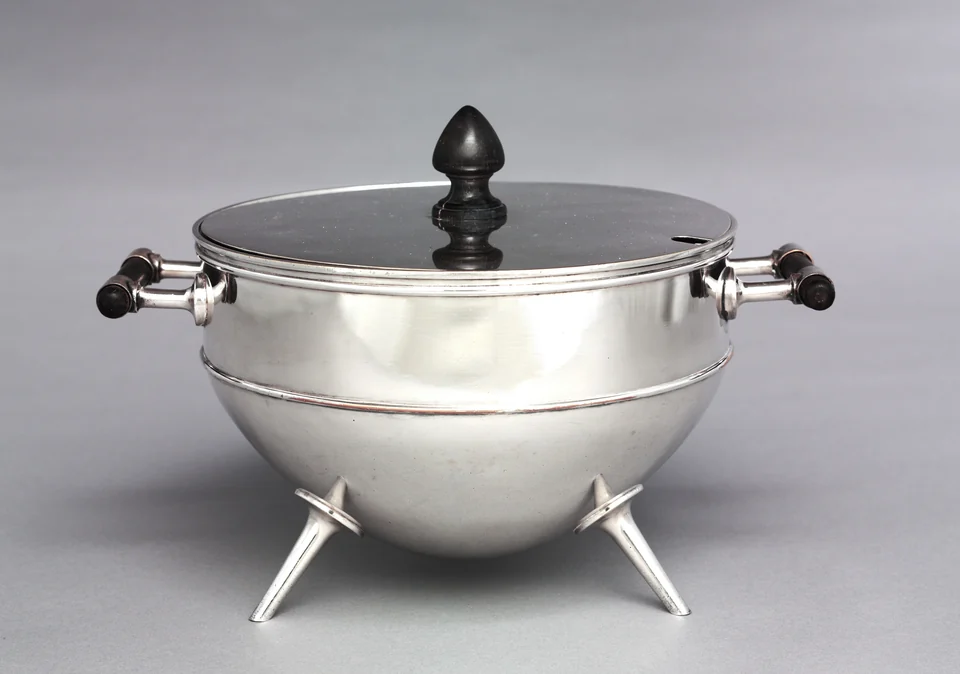
Covered tureen designed by Christopher Dresser and manufactured by Hukin & Heath, c. 1880. Silver-plated metal with ebony handles and knop.
Cleveland Museum of Art · 1991.81
View the full museum photographOpen the view, keep the object together
With the cover removed, the second photograph reveals the bowl’s interior and the notch in the lid rim. Follow how the cover meets the circular opening. This is another view of the same tureen, giving a closer look at its parts rather than documenting a second design.
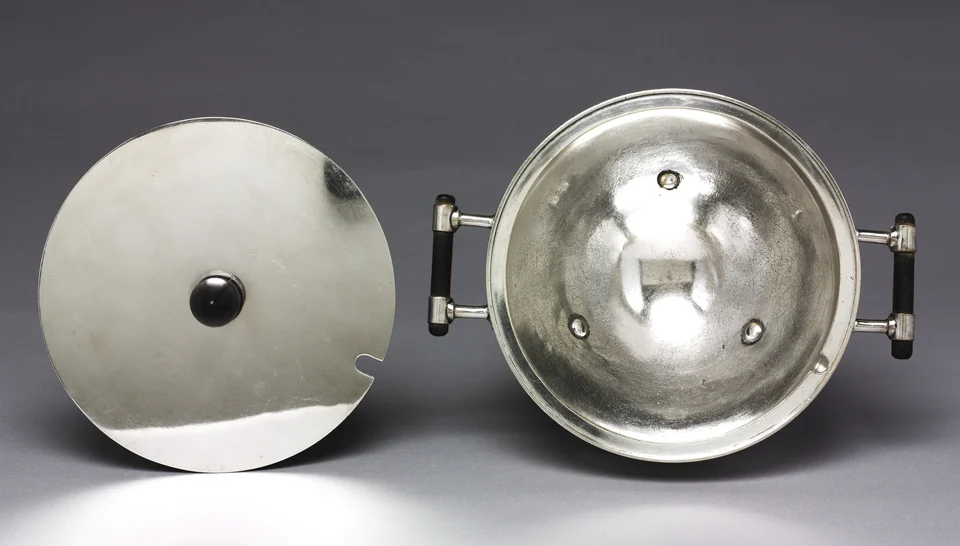
Covered tureen designed by Christopher Dresser and manufactured by Hukin & Heath, c. 1880. Silver-plated metal with ebony handles and knop. Official open view with the cover beside the bowl.
Cleveland Museum of Art · 1991.81
View the full museum photographNames & chapters
How the story developed.
- 1834–1904
A career across materials
Dresser’s lifetime spans Victorian design reform and the opening years of the twentieth century.
- 1876–77
Japan at first hand
He travels in Japan after earlier study of its arts and manufactured objects.
- About 1878–81
A qualified museum attribution
The Met dates the Hukin & Heath spoon holder to this interval.
- 1880–83
A separate retail venture
The Art Furnishers’ Alliance operates in London.
Follow an interest
What to explore.
A historical designer profile. Object dates and material descriptions follow the cited museum examples; later editions and similar forms require their own records.
Check the details
Before you buy.
Look at design, manufacture and material as connected parts of the object’s story.
Open the references
Research this name.
- Collect Silver guide
Follow the modern-design story
Compare Dresser’s industrial approach with Ashbee’s Guild and Knox’s work for Liberty.
- Collect Silver guide
Explore Hukin & Heath
See the manufacturer’s racks, traveling tea services and object-specific attributions.
- Collect Silver guide
Look across the silver table
Place experimental designs among the vessels and utensils they were made to serve.
- Collect Silver guide
Compare Archibald Knox
Follow a later designer through a retailer and manufacturing network.
- Museum object record
The attributed spoon holder
Read the complete attribution, materials and curatorial explanation.
- Museum object record
The Dixon teapot
Compare the photograph and exact object record.
- Museum object record
Compare the covered and open tureen
Follow the manufacturer, designer and materials through two photographs of one object.
Sources & further reading
- Christopher Dresser (1834–1904), by Sara J. Oshinsky The Metropolitan Museum of Art · Museum essay, October 2006
- Teapot, about 1879; 2021.153.2 The Metropolitan Museum of Art · Museum object record
- Spoon holder, about 1878–81; 1988.164 The Metropolitan Museum of Art · Museum object record; design attribution qualified
- Teapot by Christopher Dresser, 1878–9; M.5:1 to 2-2006 V&A Americas Foundation · Museum acquisition account
- Covered Tureen, about 1880; 1991.81 Cleveland Museum of Art · Museum object and exact-file open-access dataset
Museum references checked November 13, 2026. The Dresser attribution on the spoon holder remains qualified. Cleveland’s covered and open photographs depict the same tureen. The photographs are reused under CC0; the Met teapot image also appears in the existing tea-service guide.