
Modern design · Britain, c. 1880–1910
A new shape
for silver.
A handle becomes a sweeping line. Enamel interrupts a silver surface. A familiar household object becomes a place to try something new.
This first chapter follows three approaches to modern design: Christopher Dresser’s work with manufacturers, Charles Robert Ashbee’s Guild, and designs attributed to Archibald Knox for Liberty. Begin with the objects, then meet the people behind them.
Explore the designers ↓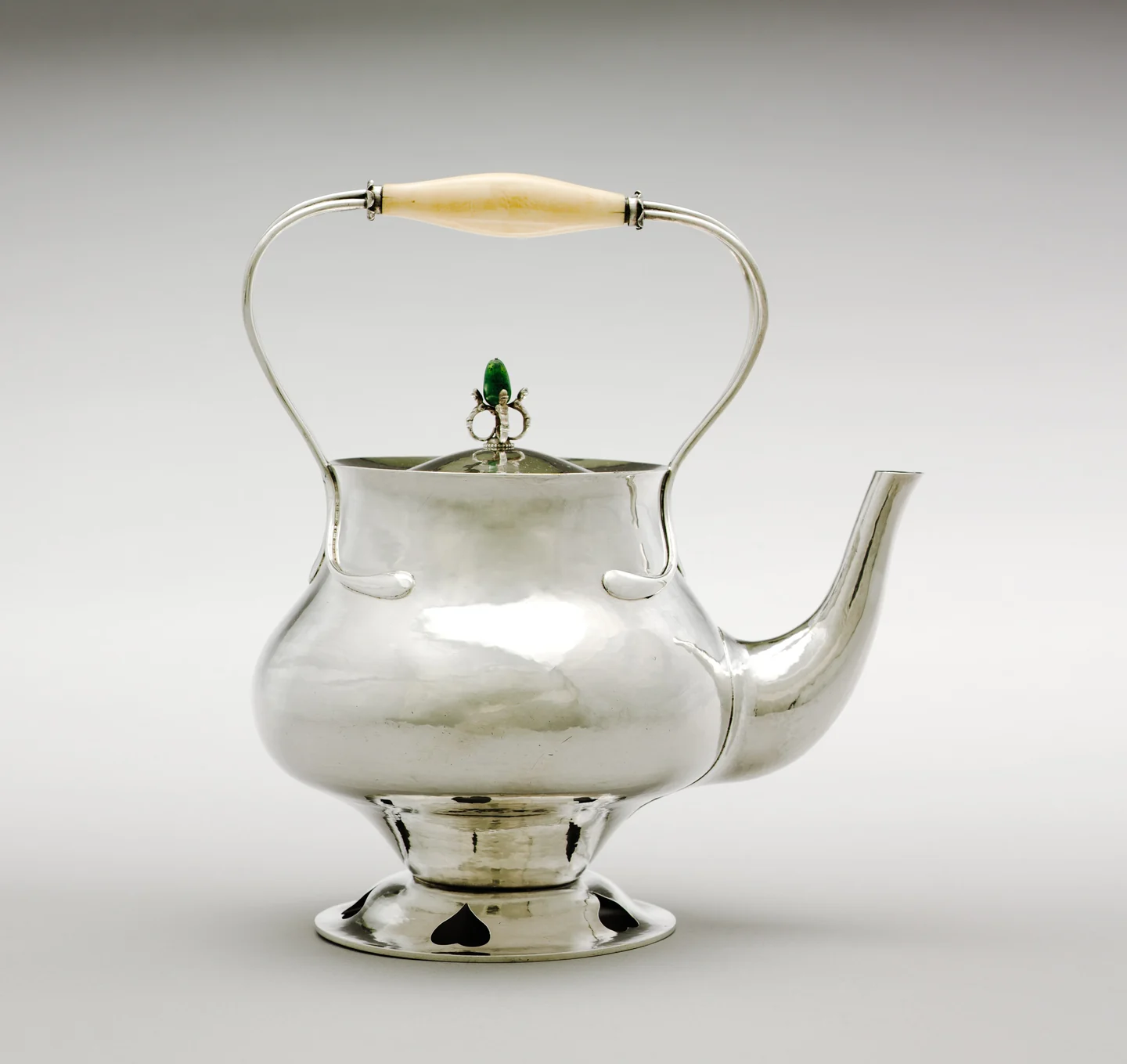
A beginning, not a single style
Modern silver has more than one shape.
“Modern” here describes a changing approach to design around the turn of the twentieth century. It does not mean that these pieces are contemporary, that every surface is plain, or that every object came from a production line. A rigorous teapot, a flowing handle and an enameled box offer different answers to the same question: what might an everyday object become?
The nineteenth-century precursor
Dresser: a design can travel.
Dresser’s name connects objects made by different firms, but it leaves the material question open. The Fitzwilliam Museum records a teapot associated with Dresser and Elkington & Co. in silver and ebony, dated 1882–83. Compare that record with the silver-plated examples in his profile: a familiar designer is the beginning of the inquiry.
His work provides a useful starting point for this group because it separates the invention of a form from its manufacture. Read the slant of a handle, the reach of a spout and the balance of a body as deliberate decisions. Then keep the manufacturer and the particular object’s evidence alongside the design credit.
Meet Dresser and compare the documented objects → · Explore Hukin & Heath
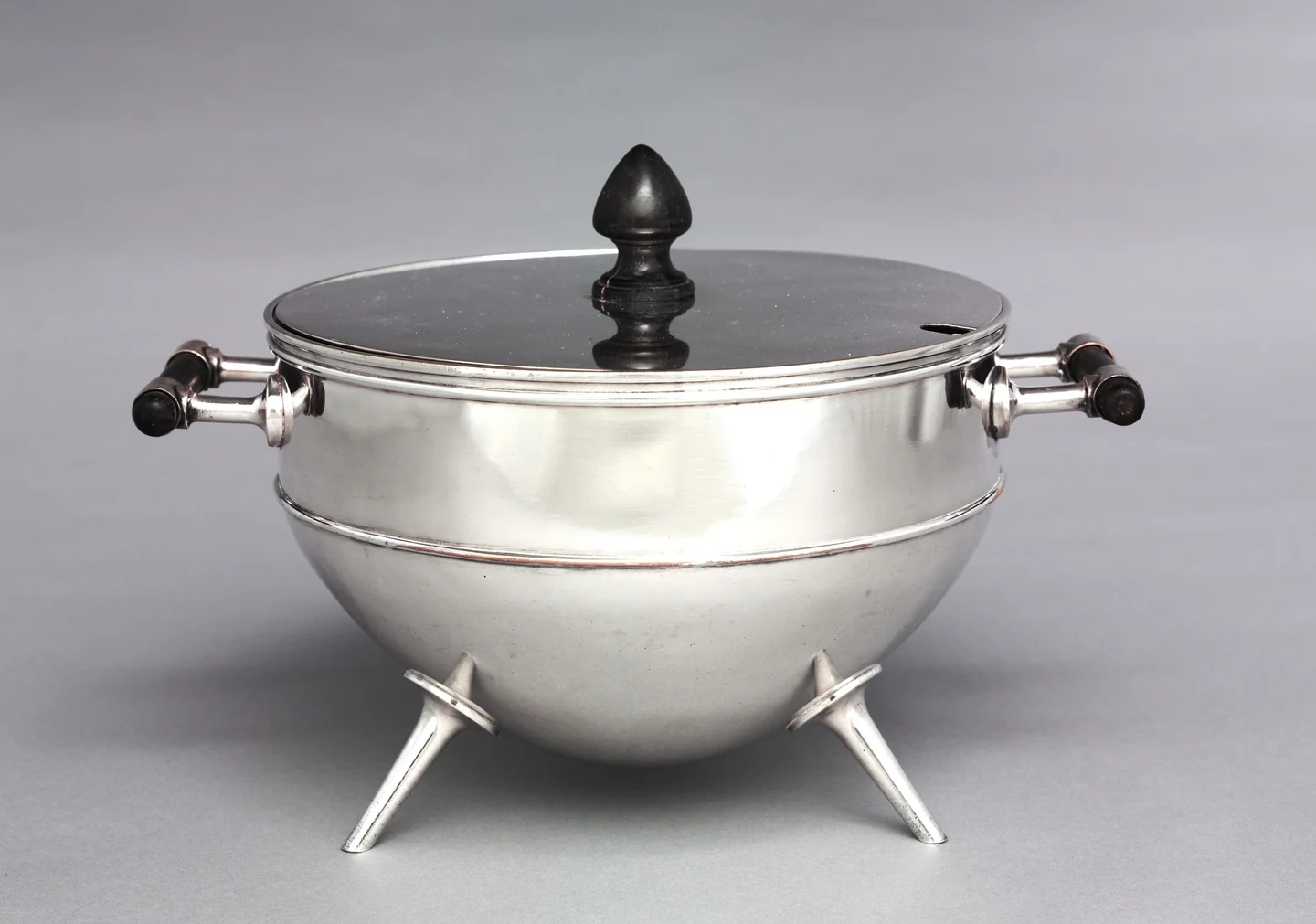
The tureen’s flat cover, dark grips and projecting feet make its parts easy to distinguish. Compare the open view in Dresser’s profile to see the cover beside the bowl.
Line & volume
Ashbee: the handle changes the whole object.
In the kettle pictured above, the high arch of the handle leaves an open space above the rounded vessel. Its pale grip and green finial punctuate the silhouette. Cleveland dates the kettle to 1900 and identifies silver, ivory and chrysoprase. Those materials belong to different parts of the object; calling it simply “silver” loses some of the design.
Ashbee founded the Guild and School of Handicraft in 1888. Museum records often distinguish his design from the Guild’s making. That distinction matters even when the complete object carries a strong, recognizable visual character.
Look beyond ornament alone. Compare where a handle begins, how much space it encloses and where its line returns to the body. These are observations about the photographed object, not a formula for attributing another piece. The Ashbee photographic study places this kettle alongside the profile’s other museum references for tableware and jewelry.
Color & pattern
Knox: the surface carries the rhythm.
The blue-green enamel in Cleveland’s box and spoon makes color part of the silver design. On the box, paired motifs sit within the lid’s rectangular outline. On the spoon, a small enamel panel brings the decorative emphasis to the top of the handle. The effect changes with scale: a broad container and a narrow utensil ask the eye to move in different ways.
Compare the photographs before following their records. How does the motif change between a broad lid and a narrow handle? The linked profile keeps the date, material and attribution attached to each example.
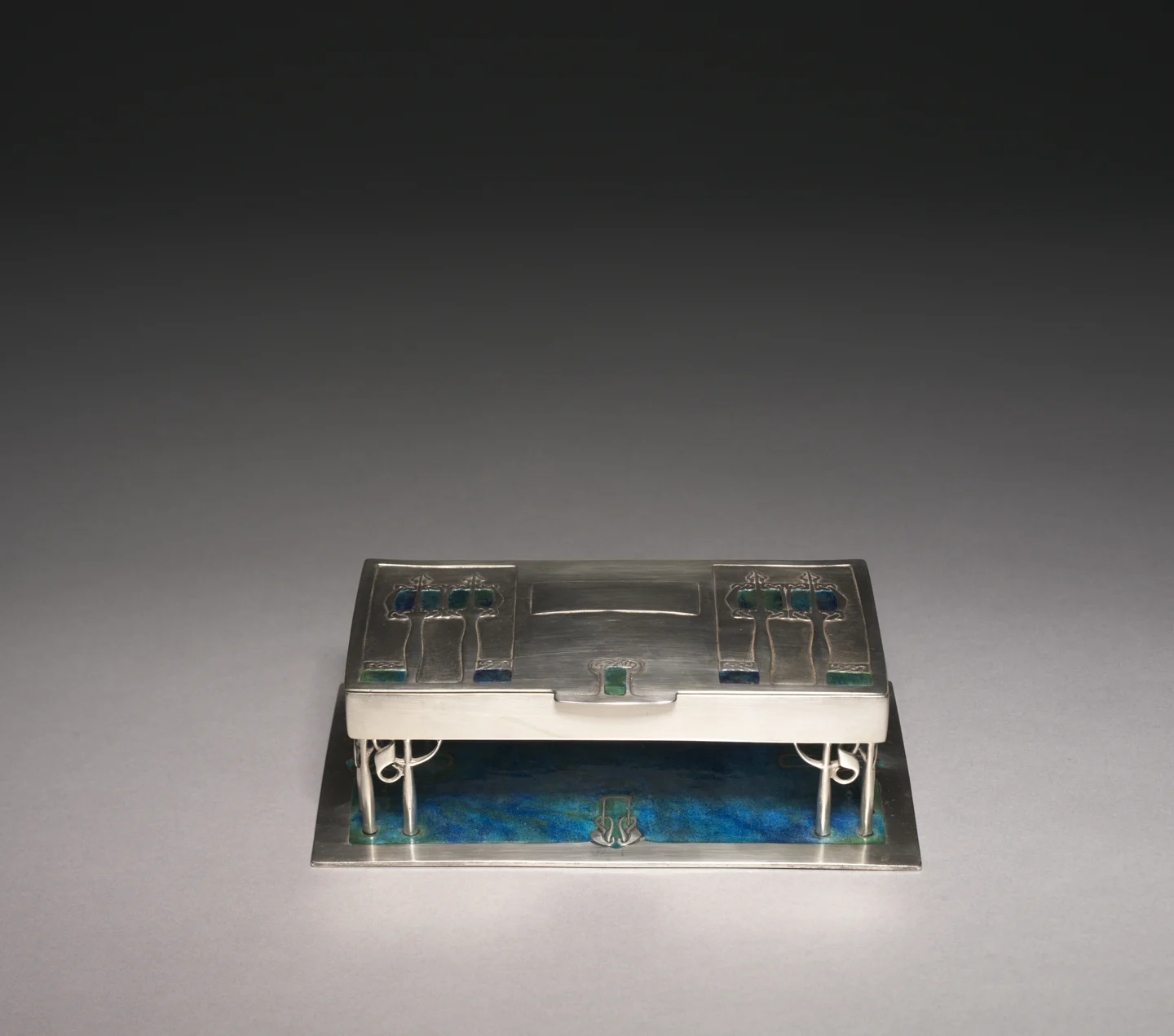
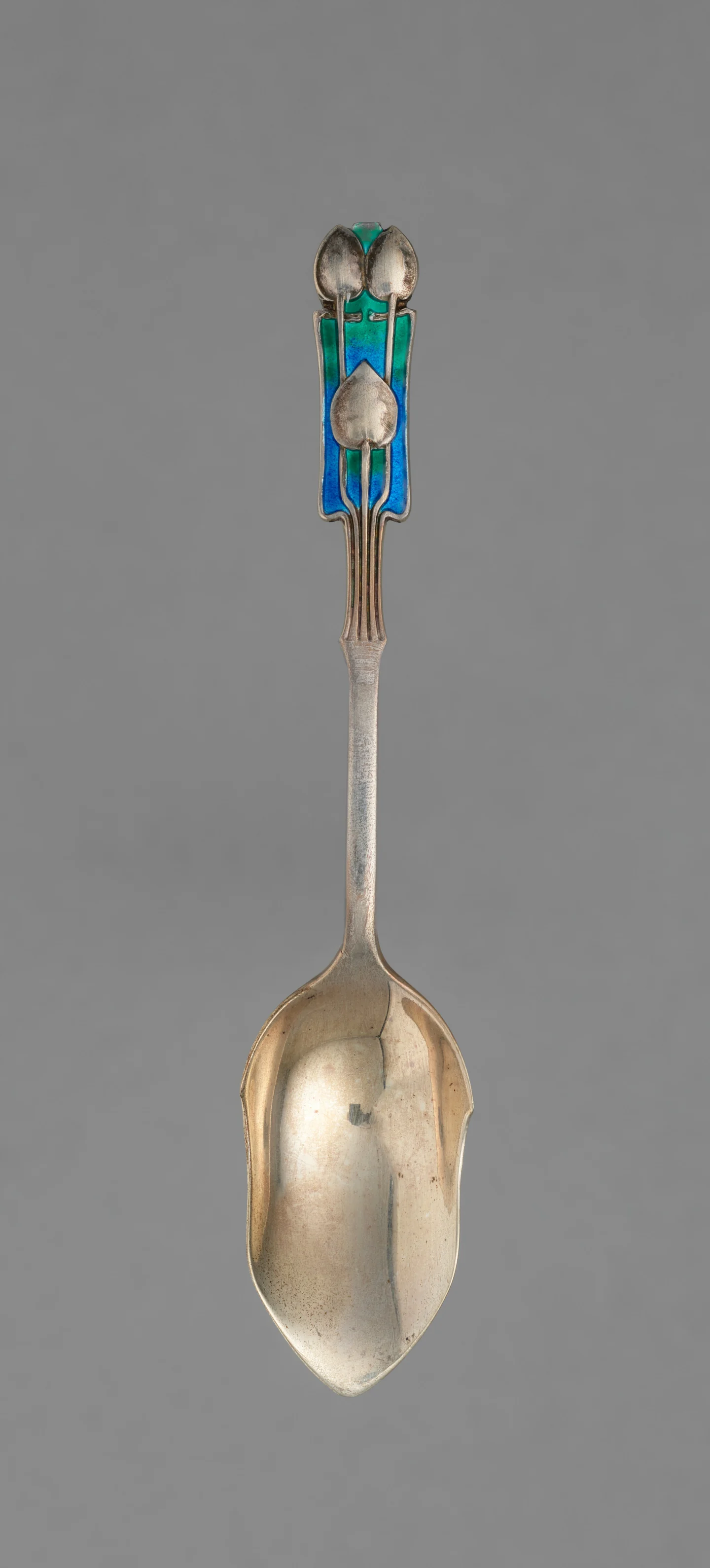
Manx National Heritage connects Knox’s designs with his study of the Isle of Man’s carved crosses. His work also extended beyond silver. Liberty’s Cymric silver and Tudric pewter are different material lines; the appeal of a related pattern does not make them interchangeable.
Explore Knox, Liberty and the maker behind a documented claret jug →
Read the collaboration
One object can carry several names.
An artist or designer may devise the form, a workshop may make it, and a retailer may commission or sell it. Sometimes one person or business fills several roles. The useful question is what the record establishes for this object.
- Artist / designer
- The credited creative role. It does not automatically mean that the person made every component by hand.
- Maker / manufacturer
- The person or workshop credited with production. A firm’s name need not identify an individual craftworker.
- Retailer / commissioning firm
- The business that sold or ordered the object. Its name can be prominent even when another firm made it.
- Attributed to
- A qualified identification. Preserve those words in a caption or collection record instead of silently making the credit certain.
The Met’s Knox claret jug offers a particularly clear example: Knox designed it, W. H. Haseler manufactured it, and Liberty was the firm for which it was made. That record does not authorize assigning Haseler to every Liberty object. Follow the specific jug record in the profile.
Keep looking
The wider story.
Georg Jensen
Compare existing museum photographs without confusing the founder with the later firm.
France · Designer & housePuiforcat
Follow Jean Puiforcat’s work and the longer history of the silversmithing house.
Wearable formJewelry
Take the same attention to line, color and material into objects worn on the body.
Continue by function through servingware and tea and coffee, or compare form in the sculpture hub. A vessel can have sculptural qualities while still being cataloged as a vessel.
Sources & further reading
- The Met: Dresser and James Dixon & Sons teapot, 2021.153.2
- Fitzwilliam Museum: Dresser / Elkington teapot, AAL.107 & A-2018
- The Wilson: C. R. Ashbee and the Guild
- Cleveland Museum of Art: Dresser / Hukin & Heath covered tureen, 1991.81
- Cleveland Museum of Art: Ashbee kettle, 1976.23
- Cleveland Museum of Art: box attributed to Knox, 1971.141
- Cleveland Museum of Art: spoon from a set, 2008.166.6
- Manx National Heritage: Archibald Knox
- The Met: Knox / Haseler / Liberty claret jug, 1992.346
Museum records supply dates, materials and attribution. Descriptions of line, spacing and visual rhythm are observations of the photographs. This is a focused first chapter, not a complete history of modern silver.