
Manx artist · British design network
A line that connects people and objects
Archibald Knox (1864–1933) was an artist, designer and teacher from the Isle of Man. Manx National Heritage connects his interest in interlacing pattern with the island’s carved Celtic and Norse crosses. His work ranged beyond metalwork to watercolors, illustration and memorial design; silver belongs within that wider artistic practice.
Liberty & Co. brought his designs into a commercial network. The V&A describes a retailer that commissioned freelance designs, adapted them for production and generally promoted its own name. W.H. Haseler in Birmingham manufactured documented examples. Knox also supplied designs through the Silver Studio, a design business named for Arthur Silver, not a description of its material.
Those relationships need checking object by object. Cleveland lists Liberty as retailer of its enamelled box, but as manufacturer in the spoon-set record. Both designs are attributed to Knox. The difference is useful: a museum’s company credit does not necessarily identify the individual craftworker, and an attribution should not become an unqualified signature.
Keep the product families distinct too. Cymric encompassed gold and silver wares; Tudric was a pewter range. A related curving pattern can occur in different metals. Knox’s design language is a reason to look closer, not a test for silver.
From the museum collection
Color, line and the names behind the object
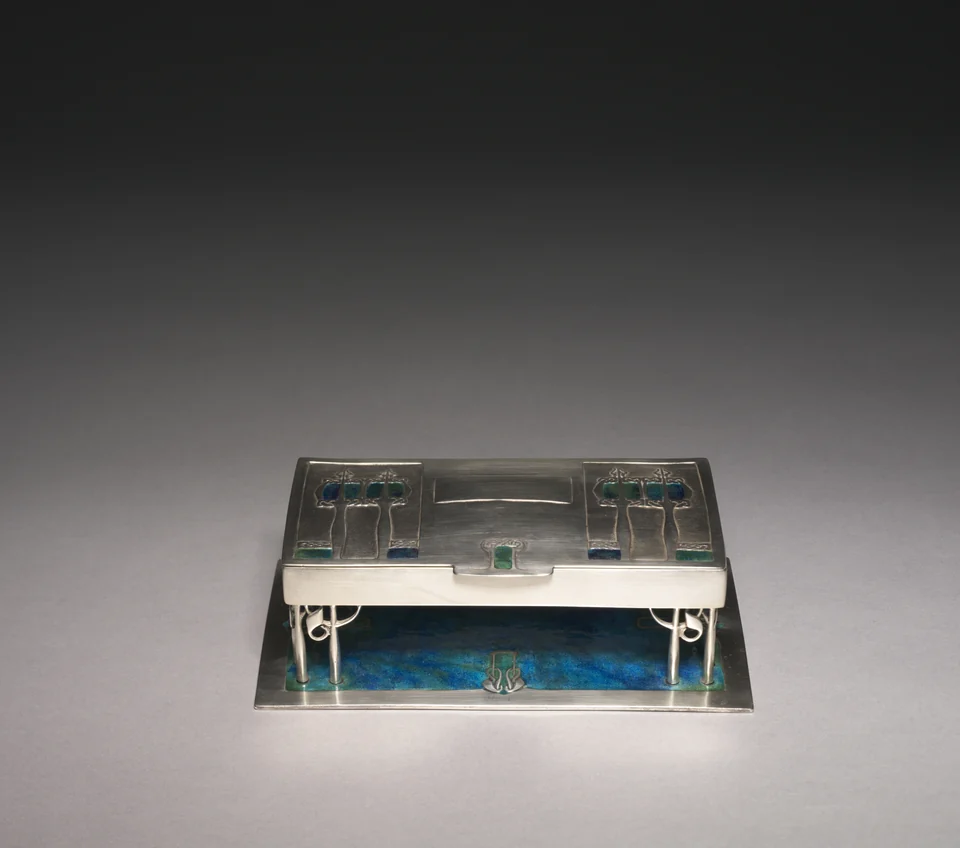
The two Cleveland photographs show different scales of silver-and-enamel design. Their records retain “attributed to Archibald Knox”; the linked Met examples add a more explicit manufacturing history.
A box raised above its base
Cleveland’s Box, 1971.141, is dated about 1901 and cataloged as silver and enamel. At 20.3 cm wide, it is a small object with a carefully divided surface: blue-green enamel interrupts the silver, while the raised body and lower platform make the sides part of the design.
The record attributes the design to Knox and identifies Liberty and Company as retailer. It does not name a separate manufacturer. Do not supply Haseler’s name simply because that firm made other Knox designs.
Look at the lid and body together. The front pull, repeated enamel shapes and open space beneath the box let useful parts participate in the composition. A close inspection should also distinguish original enamel from repaired or replaced areas.
One spoon from a six-piece set
The second Cleveland record, 2008.166.6, is titled Set of Six Spoons in Original Box and dated about 1895–1910. Its photograph shows one spoon, with an enamelled terminal above a long stem and pointed bowl. The set’s material entry includes silver, enamel decoration and a leather box; the photograph does not show all of those components.
The museum names Liberty and Company as manufacturer and attributes the design to Knox. Keep that catalogue wording rather than assuming a particular bench worker or converting the broad date range into a single year.
At this scale, a small colored terminal becomes the focal point. Compare the bowl, stem and enamel before matching a loose spoon to a boxed set; the case and remaining pieces have their own history.
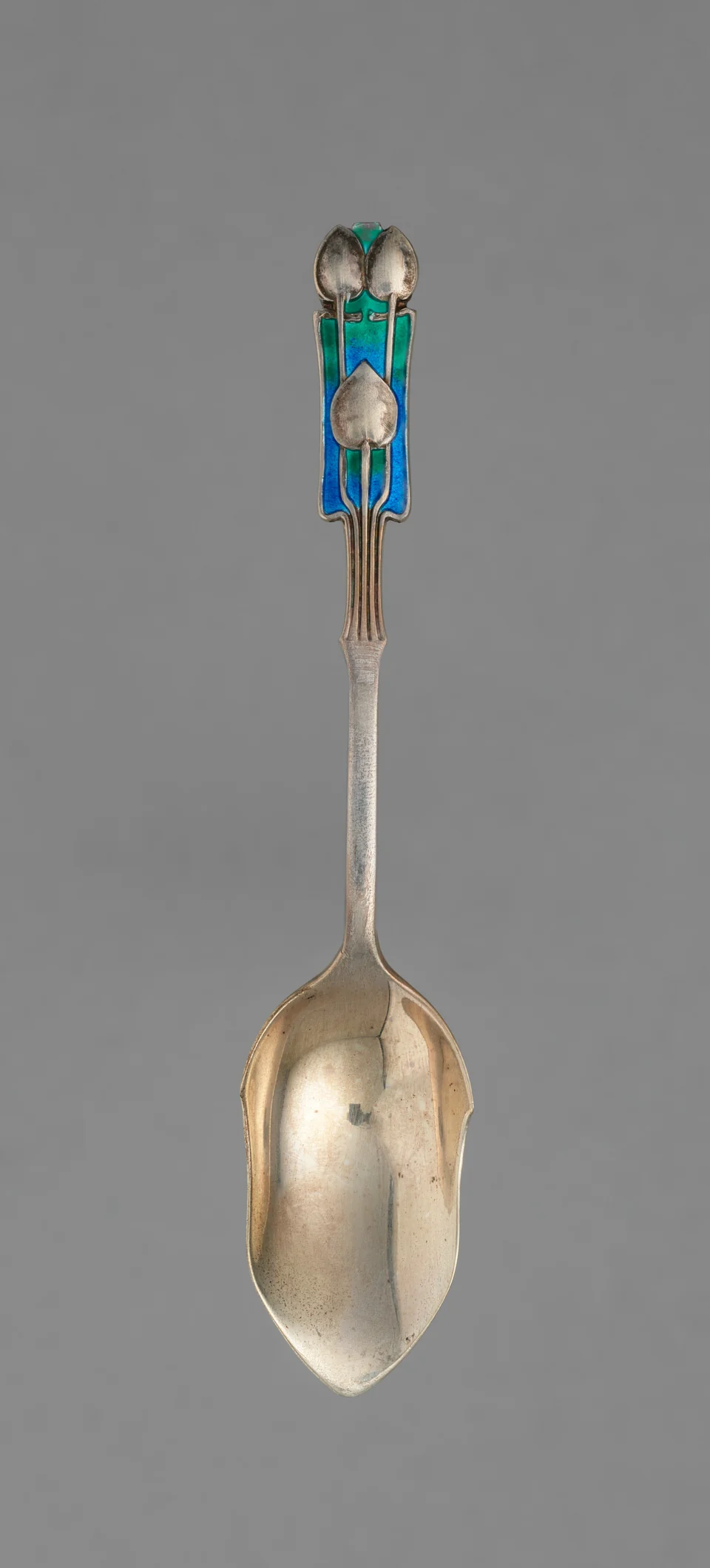
One spoon from a set of six, design attributed to Archibald Knox; Liberty and Company is catalogued as manufacturer, c. 1895–1910. Silver and enamel.
Cleveland Museum of Art · 2008.166.6
View the full museum photographA jug with three distinct credits
The Met’s Claret jug, 1992.346, dated 1900–1901, is silver and chrysoprase. Here the record is more explicit: Knox designed it, W.H. Haseler manufactured it, and Liberty & Co. was the firm for which it was made. These are connected contributions, not interchangeable names.
In the linked museum view, a flat circular foot steadies a curving vessel and a projecting thumbpiece extends the lid mechanism. The stone introduces another color and material. This is a useful comparison with the box and spoon, but its more specific maker credit belongs to this jug.
What a hammered surface can tell you
The Met’s Vase of 1903, 2021.7.3, is silver and turquoise, designed by Knox and cataloged as manufactured and retailed by Liberty. Its commentary explains that many Cymric objects were machine-spun before hammering was added. A hammered appearance alone therefore cannot establish that a vessel was raised entirely by hand.
Enjoy the surface as part of the design while keeping the manufacturing question open. A record that specifies a process is stronger evidence than an assumption based on texture.
Names & chapters
How the story developed.
- 1864–1933
An artist from the Isle of Man
Knox’s career includes teaching, painting and design in several media.
- About 1901
Silver meets colored enamel
Cleveland dates its box to around this year, with the design attributed to Knox.
- 1900–1901
Designer, manufacturer and firm
The Met’s claret jug records Knox, Haseler and Liberty as distinct contributors.
- 1903
Surface and production
The Met vase provides a dated example for examining the relationship between design and finish.
Follow an interest
What to explore.
A historical artist and designer profile, with Liberty and Haseler discussed through specific museum objects. It is not a complete list of Knox designs or a claim that every Liberty object was designed by him.
Check the details
Before you buy.
Follow the named object, its materials and the evidence for each person or firm.
Open the references
Research this name.
- Collect Silver guide
Follow the modern-design story
Compare Knox’s design network with Dresser and Ashbee’s Guild.
- Collect Silver guide
Compare Charles Robert Ashbee
Look at another route from a designer’s idea to a workshop-made object.
- Collect Silver guide
Compare Christopher Dresser
Explore an earlier designer’s relationships with manufacturers.
- Collect Silver guide
Explore silver jewelry
Follow enamel, settings and the balance between decoration and wear.
- Collect Silver guide
Explore flatware and cutlery
Consider a spoon as a particular utensil within a wider service.
- Museum essay
Knox, Liberty and the Celtic Revival
Follow the design and manufacturing network through documented V&A objects.
- Museum object record
The claret jug’s three-party record
Read the separate designer, manufacturer and firm credits.
- Museum object record
A 1903 vase and its surface
Read the museum’s explanation of hammering and machine production.
Sources & further reading
- Archibald Knox: From Manx Schoolmaster to Liberty’s Designer Manx National Heritage · Museum biography and archive guide
- Archibald Knox, Liberty and the Celtic Revival style Victoria and Albert Museum · Museum essay, updated August 2025
- Box, about 1901; 1971.141 Cleveland Museum of Art · Museum object record; attributed design
- Set of Six Spoons in Original Box, about 1895–1910; 2008.166.6 Cleveland Museum of Art · Museum component record; attributed design
- Claret jug, 1900–1901; 1992.346 The Metropolitan Museum of Art · Museum object record; text reference only
- Vase, 1903; 2021.7.3 The Metropolitan Museum of Art · Museum object record; text reference only
Museum references checked November 13, 2026. Both Cleveland designs remain attributed to Knox. The Met jug and vase are linked for research; their restricted photographs are not reproduced.