
A Boston maker and engraver
A portrait with a working book beside it.
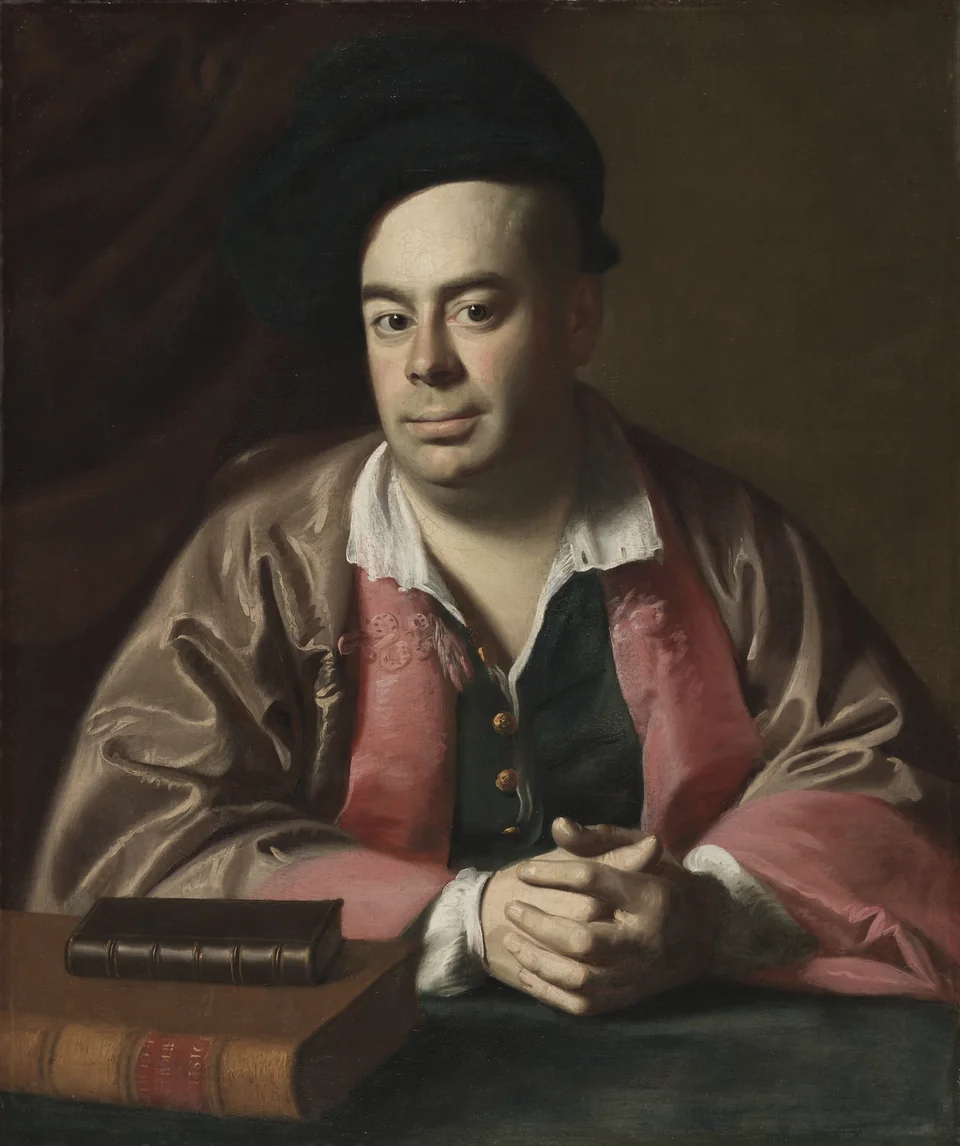
John Singleton Copley painted Nathaniel Hurd seated with his hands resting beside two books. Cleveland dates the portrait to about 1765. The open collar and dark turban give the sitter an informal appearance; the museum suggests that his expression reflects a friendship with the painter. At his elbow, the title on the larger book connects the image to a working world of heraldry.
Hurd was a Boston silversmith and engraver. Yale’s library describes him learning metalworking from his father, Jacob Hurd, and records his production of armorial bookplates as well as other printed work. His skills reached beyond objects made under his own name: The Met documents an instance in which another silversmith entrusted him with engraving a customer’s silver.
The painting has an ownership history of its own. Cleveland traces it through Benjamin Hurd and his descendants in Halifax, then Mrs. Thomas Barry and Walter Wesselhoeft, before a Boston gallery sold it to the museum in 1915. The teapot’s published provenance is much shorter: the museum names collector Hollis French, whose gift brought it to Cleveland. Neither chain supplies every earlier owner of the teapot.
From the museum collection
From a painted book to silver and paper.
Four connected lines of evidence show how a collector can move from an image to an object, and from a maker’s mark to the work of an engraver.
The Gibbs teapot and the book at Hurd’s elbow
The Cleveland teapot is silver with a wooden handle, dated about 1755–60 and cataloged as made by Hurd. Its rounded body carries the Gibbs family arms within a scrolling frame. Cleveland says the design was probably taken from John Guillim’s Display of Heraldry, in its 1724 edition, and identifies that title on the book spine in the Copley portrait. The museum’s “probably” matters: the painted book and the engraved vessel are related evidence, not a surviving record of the moment a design was chosen.
A study published by the Colonial Society of Massachusetts places a printed Gibbs design beside the teapot and compares the treatment of the hatchet handles and the surrounding cartouche. Such comparisons can reveal how a motif changes between paper and metal. They do not establish that the particular volume painted by Copley was the copy consulted for this particular vessel, or identify why it was included in the portrait.
Look at the whole vessel as well as its arms: the curved spout, foot, domed lid and wooden handle are part of its construction. An emblem can guide research into a family, but it is not a complete chain of ownership or proof of every later owner’s identity.
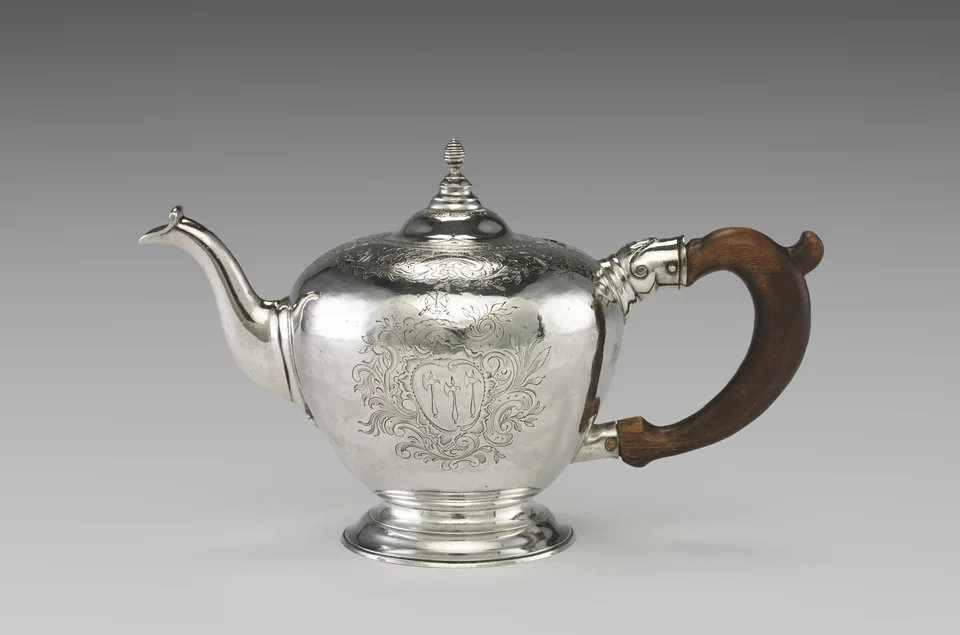
Nathaniel Hurd, Teapot, c. 1755–60. Silver and wood; 14.5 × 24.4 cm including handle.
The Cleveland Museum of Art, Gift of Hollis French, 1940.228. Museum record · CC0
View the larger museum photographA second life for heraldry: the bookplate
Cleveland’s engraved bookplate names Jonathan Jackson beneath a shield with four shells, surrounded by foliage and a motto. The museum dates the print broadly to 1745–78 and credits Hurd as artist. It is a different commission and a different set of arms from the Gibbs teapot, but it makes the range of his engraving visible in another medium.
A bookplate could identify a book’s association with a person or institution. Keep the name and image as evidence from the print; do not assume that every book containing a similar plate has an unbroken history of ownership. Yale’s collection preserves many examples of Hurd’s bookplate work and supplies a broader context for comparison.
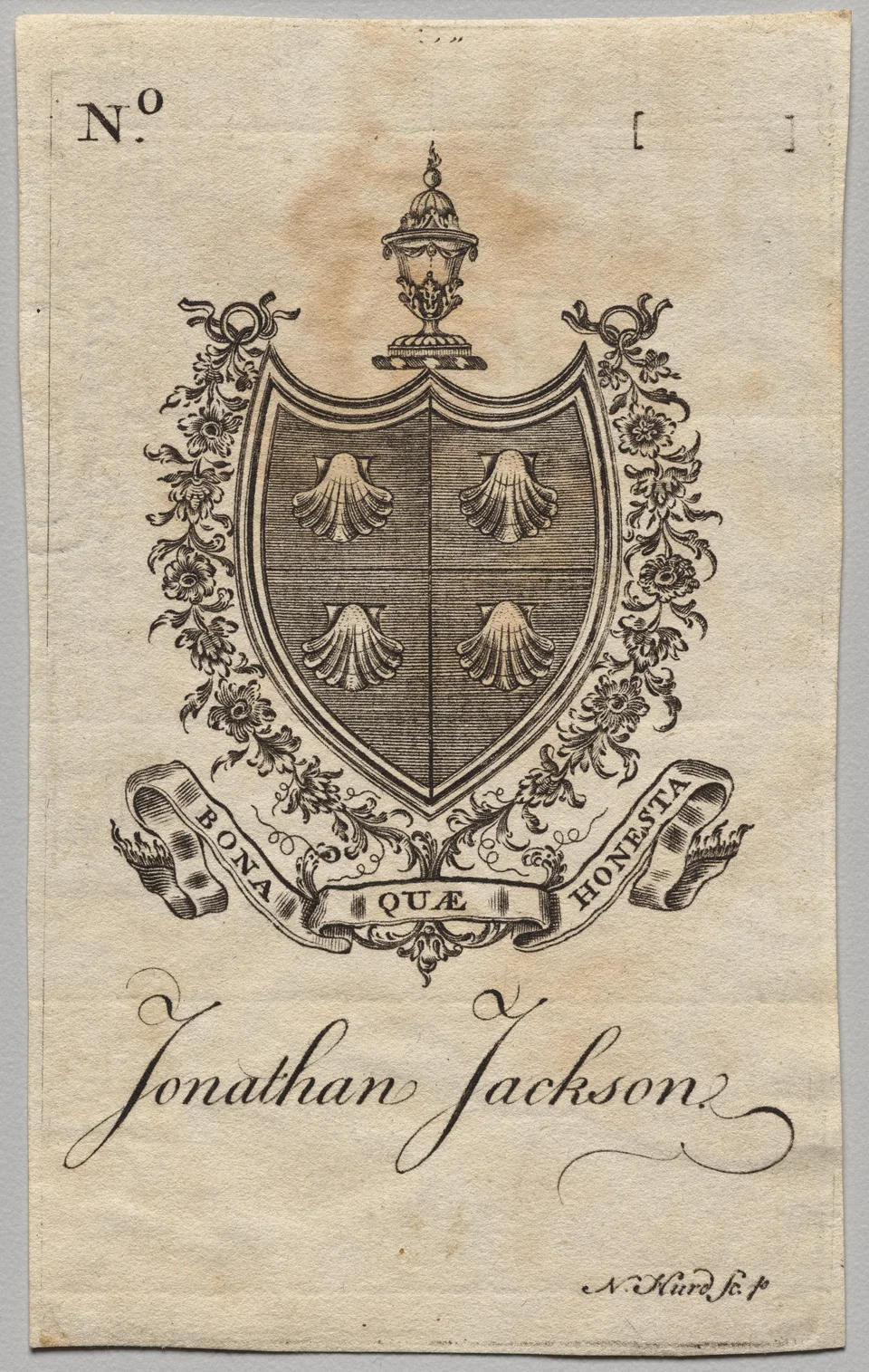
Nathaniel Hurd, Bookplate: Coat of Arms with Jonathan Jackson inscribed, 1745–78. Engraving.
The Cleveland Museum of Art, Membership Income Fund, 1917.934. Museum record · CC0
View the larger museum photographA salver, its mark and the whole object
The Met attributes this silver salver to Hurd, dates it about 1756 and records its place of manufacture as Boston. The shallow form, ornamented edge, feet and central arms are useful to study together. The museum gives its diameter as 20.3 cm; the object number is 2010.197.
Small salvers gave a single drinking vessel a place to rest while catching drips. The Met’s catalogue identifies this example’s engraved arms as Belcher quartering Allen, for Jonathan and Abigail Allen Belcher. That family connection is not a complete ownership history: the catalogue says the salver’s later descent is untraced.
Collect Silver’s existing authenticity guide pairs this whole-object view with a close photograph of the N·Hurd impression near the rim. Compare the letters and the shape of the impression with the documented object, while recording construction, condition and provenance. A similar name on an offered piece is a lead, not authentication; the mark alone does not establish a numerical silver fineness.
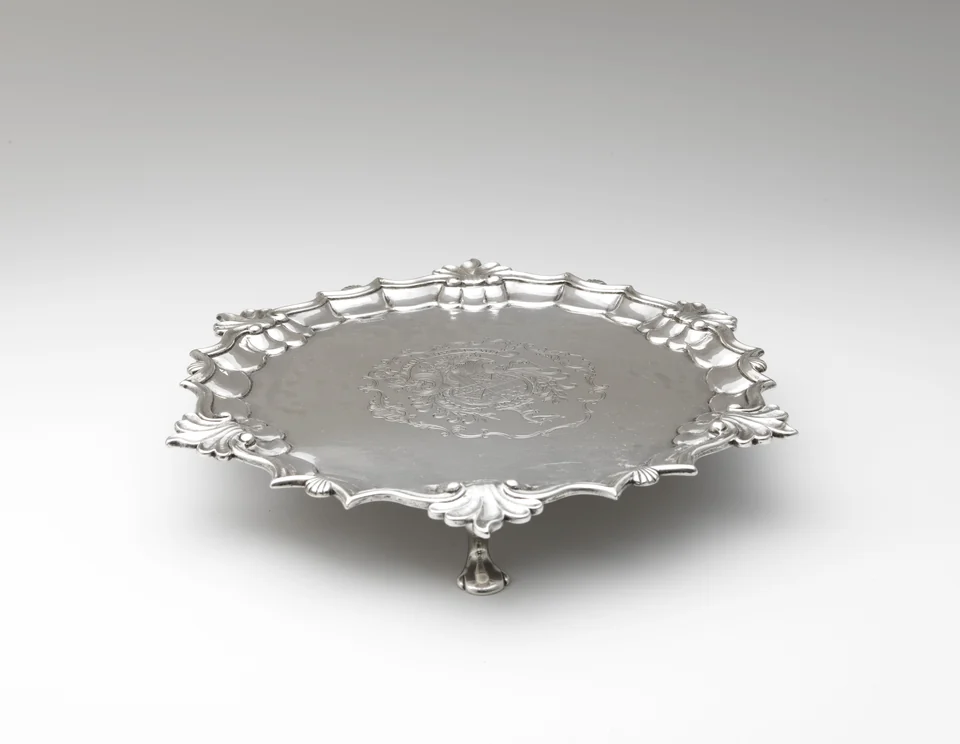
Nathaniel Hurd, Salver, Boston, ca. 1756. Silver; diameter 20.3 cm.
The Metropolitan Museum of Art, Sansbury-Mills Fund, 2010, 2010.197. Museum record · CC0
View the larger museum photographWhen maker and engraver were different people
The Met’s 1763 creampot for Moses and Anna Brown is cataloged to Benjamin Burt. Surviving correspondence, the museum explains, documents Hurd’s engraving of its Brown arms for Burt. That evidence assigns distinct roles to the two craftsmen: Hurd’s contribution is important without making him the vessel’s maker.
This is a useful question for any decorated piece. Ask what the record actually establishes: a maker’s mark, a documented engraver, an attribution based on style, or a later inscription. Keep those claims separate, along with the evidence supporting each one.
Names & chapters
How the story developed.
- c. 1730
Boston and a family trade
Yale identifies Jacob Hurd as Nathaniel’s father and teacher. Sources differ on Nathaniel’s life dates: Cleveland uses 1730–1778; The Met uses 1729/30–1777.
- c. 1755–60
The Gibbs teapot
Cleveland’s current catalog date for the silver-and-wood vessel.
- 1763
A documented engraving commission
Burt’s Brown creampot and surviving correspondence show Hurd working as an engraver for another maker.
- c. 1765
Copley’s portrait
Cleveland’s current catalog date for the portrait of Hurd with books.
- 1915 / 1940
Two gifts to Cleveland
The portrait entered the museum in 1915; the teapot was a gift of Hollis French in 1940. Their different collection histories should be recorded separately.
Follow an interest
What to explore.
A historical reference grounded in museum and library records, not an appraisal or authentication of an individual object.
Check the details
Before you buy.
A documented museum object offers a reference point. Keep its evidence distinct from the claims made for a piece you are considering.
Open the references
Research this name.
- Cleveland Museum of Art
Copley’s portrait of Nathaniel Hurd
Read the painting’s catalog record and collection history.
- Museum object record
Cleveland’s Gibbs teapot
Read the museum’s qualified comparison with Guillim and its object details.
- Museum object record
The Jackson bookplate
Compare a surviving paper engraving and its separate patron’s name.
- Museum object record
The Burt creampot engraved by Hurd
See how surviving correspondence distinguishes maker and engraver.
- Collect Silver guide
Look at the salver and its mark
Compare the existing full-object photograph with the close view of the impression.
- Collect Silver guide
Explore the silver tea set guide
Continue into tea-service forms, materials and care.
Sources & further reading
- Nathaniel Hurd, c. 1765, 1915.534 The Cleveland Museum of Art · Portrait, description and open-access image
- Nathaniel Hurd: provenance The Cleveland Museum of Art · Published ownership history
- Teapot, c. 1755–60, 1940.228 The Cleveland Museum of Art · Object record, qualified heraldry interpretation and open-access image
- Teapot: provenance The Cleveland Museum of Art · Published provenance and gift
- Bookplate: Coat of Arms with Jonathan Jackson inscribed, 1917.934 The Cleveland Museum of Art · Engraving, catalog date and open-access image
- Salver, ca. 1756, 2010.197 The Metropolitan Museum of Art · Object record and public-domain photographs
- Early American Silver, catalogue 39, pp. 110–113 The Metropolitan Museum of Art · Scholarly catalogue: salver function, identified arms and gap in descent
- Benjamin Burt, Creampot, 1763, 33.120.295 The Metropolitan Museum of Art · Maker, engraver and surviving correspondence
- Collection of Bookplates by Nathaniel Hurd, BKP 38 Yale University Library · Finding aid and biographical note
- Heraldic and Emblematic Engravers of Colonial Boston The Colonial Society of Massachusetts · Historical study comparing the Gibbs design and the teapot
Museum and library records supply the object details and attributions. Cleveland’s proposed connection between Guillim and the Gibbs arms remains qualified; ownership and maker claims should be traced to evidence for each individual object.