
A workshop’s name. An object’s story.
Follow the evidence beneath the silver.
Turn over a Ramsden & Carr basin and the makers announce themselves in an engraved Latin inscription. Turn it back and a coat of arms, leafy border and broad silver surface tell a different part of the story. This is silver made to carry a person’s identity as well as a workshop’s name.
Omar Ramsden (1873–1939) trained in Sheffield, combining a silver-manufacturing apprenticeship with design study. At Sheffield School of Art he met Alwyn Carr. The Oxford Dictionary of National Biography records their study at the Victoria and Albert Museum, Ramsden’s successful civic-mace design in 1897, and registration of their joint mark in 1898. Looking closely at old objects was part of their preparation for making new ones.
The Nelson-Atkins Museum dates Ramsden & Carr to 1898–1919. Keep that partnership separate from Ramsden’s later work under his own name. For a collector, the distinction belongs beside the object’s date and marks, rather than disappearing into a broad “Omar Ramsden” label.
From the museum collection
Read the object, then the inscription.
These documented examples are reference points for looking, not pieces offered for sale or templates for authentication.
A basin with a family story
The Nelson-Atkins basin, object 91-46, is dated 1904–1905 and measures just over 52 centimeters across. The museum identifies both Ramsden and Carr as artists, and Ramsden & Carr as manufacturer. Its label connects the design to earlier English rosewater basins. The catalog gives the medium as silver; no additional fineness is inferred here.
Notice how much information sits outside the maker’s name. An inscription may identify an occasion, a recipient or a later gift. Record its exact wording and location, including spelling that seems unusual. A presentation date and a hallmark date answer different questions. When a seller supplies a family story, ask what document connects that story to this particular object.
Tea service, several dates
Bard Graduate Center’s exhibition checklist records a Ramsden & Carr tea service dated 1907–1909, made in sterling silver and hardstone. The teapot carries an engraved MCMVII, while the listed hallmark date letter is 1908–1909. The milk jug and sugar basin complete the cataloged group. These are details of one documented service, not a universal construction or dating rule.
That compact record offers a useful way to examine a set. Photograph each vessel separately and record its own marks before calling the whole group a single-year service. Compare feet, handles, lids and ornament, but leave room for documented differences. A matching appearance deserves investigation; it is not a substitute for the evidence on each piece.
Silver for Westminster Abbey
Westminster Abbey describes a chalice and paten presented by the Girls’ Friendly Society in 1925. A chalice is the Communion cup; the paten accompanies it. The hand-worked silver cup includes an 18-carat gold figure of St Edward the Confessor beneath its bowl. Another chalice and paten, presented for St Faith’s chapel in 1928, are described as sterling silver and based on a fourteenth-century example in the V&A.
A ceremonial object can combine metals, stones and a highly specific purpose. Read a catalog’s material list in full. A gold-colored detail may require a different description from the silver body, and a gift inscription can document use without dating every stage of manufacture. Keep those observations together instead of reducing the object to its gross weight.
Marks, signatures and the workshop
The Bard checklist records RN & CR on partnership pieces and OR on a 1921 sideboard dish attributed to Ramsden alone. It also distinguishes engraved signatures from the struck hallmark group. Its entries are examples tied to particular objects; they are not a complete chronology of every punch or inscription.
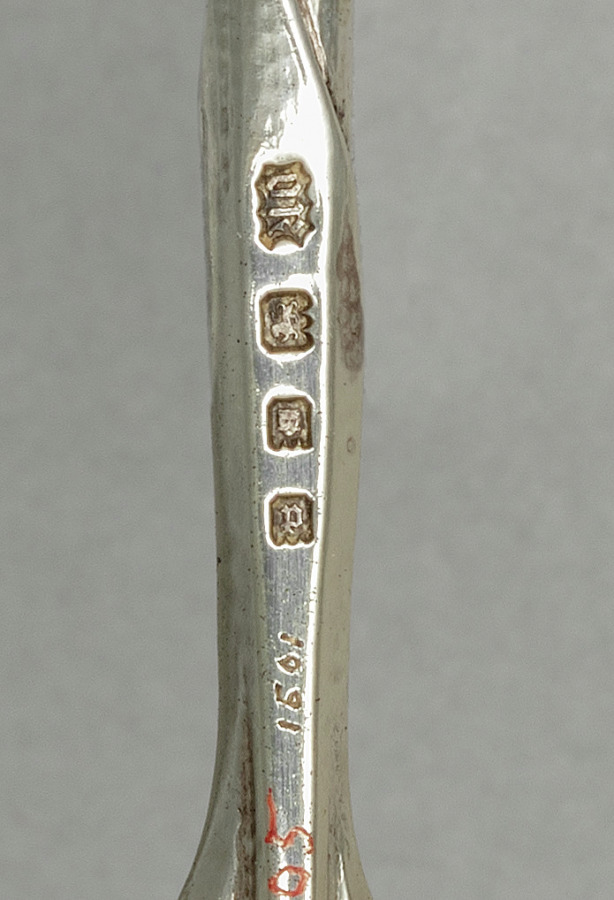
The British Hallmarking Council recommends looking closely at hallmarks, including when buying online. Ask for sharp photographs of the entire group, not only the most recognizable initials. Include the surrounding metal so its position and condition can be understood. For an uncertain reading, consult an appropriate assay-office reference or specialist rather than assigning a date from style alone.
An engraved name is one clue among several. Save photographs of the underside, inside and detachable parts, and note any marks that do not agree. Avoid polishing first to make an inscription easier to read; document the surface as received and seek conservation advice when necessary.
Look at the whole group
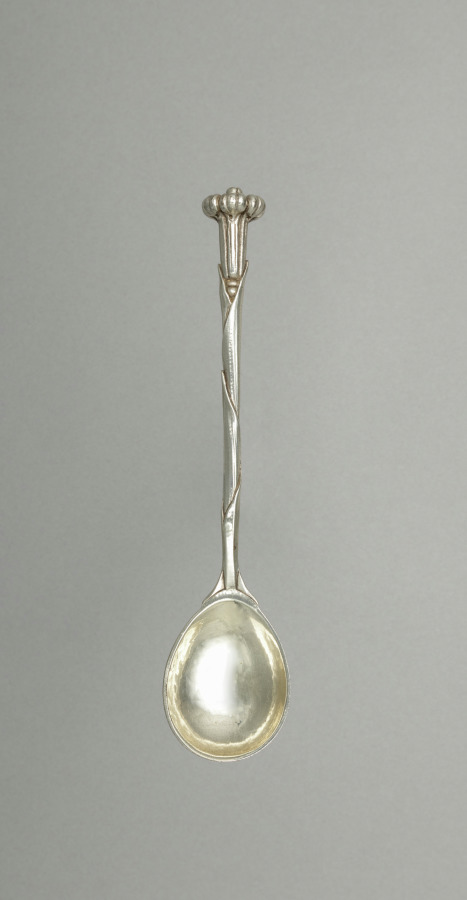
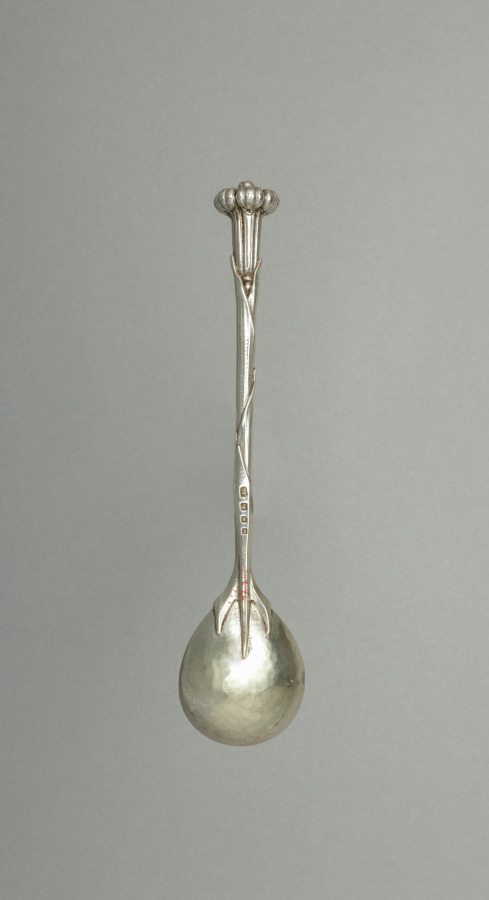
This detail belongs to the 1930 caviar spoon pictured above. Compare the struck marks with their position on the complete reverse view. The scratched and painted collection markings below them are separate evidence.
The Cleveland Museum of Art, Sundry Purchase Fund, 1972.205. Museum record · CC0 / public domain
Open the full-size detailNames & chapters
How the story developed.
- 1898
A joint mark
Ramsden and Carr register their joint mark after their design training and European travels.
- 1904–1905
Presentation silver
The Nelson-Atkins basin belongs to the partnership period.
- 1921
Ramsden’s own name
The Bard checklist records a sideboard dish with OR and an engraved Ramsden signature.
- 1925 and 1928
Gifts for the Abbey
Westminster Abbey records presentations of the two chalice-and-paten examples discussed here.
Follow an interest
What to explore.
A historical, object-led introduction to Ramsden and the Ramsden & Carr partnership. This is not an appraisal, authentication service, exhaustive mark chart or statement of current availability.
Check the details
Before you buy.
Begin with the complete object, then record its marks, inscriptions and condition.
Open the references
Research this name.
- Collect Silver hub
Explore the silver tea table
Follow the parts, materials, marks and history of a tea service.
- Collect Silver guide
Read marks in context
Separate the maker’s or sponsor’s mark from other evidence.
- Collect Silver resource
Keep the object’s record
Save dimensions, inscriptions, photographs and provenance together.
Sources & further reading
- Ramsden, Omar (1873–1939), public biographical extract Oxford Dictionary of National Biography / Anne Shannon and Muriel Wilson · Public extract: training and registration of the joint mark; full subscription article not consulted
- Basin, 1904–1905, object 91-46 The Nelson-Atkins Museum of Art · Museum object record and partnership dates
- English Silver: Masterpieces by Omar Ramsden from the Campbell Collection (PDF) Bard Graduate Center · Checklist for the 1995 exhibition, compiled in 2022; tea service item 5 and sideboard dish item 15
- Omar Ramsden: silver for Westminster Abbey Westminster Abbey · Institutional account of objects, materials and gift dates
- Hallmarking in the UK: consumer protection British Hallmarking Council · Practical guidance on inspecting hallmark evidence
- Caviar Spoon, 1930, accession 1972.205The Cleveland Museum of Art · Object record, front and reverse photographs, and marks detail. CC0 photographs supplied through the museum’s Open Access API.
Museum and institutional records, a historical exhibition checklist and the public Oxford biographical extract were checked November 11, 2026. The reference objects are not current sale listings. The caviar-spoon photographs are from the Cleveland Museum of Art and are released under CC0.