
A Boston workshop
Meet the silversmith behind the famous ride.
Most people meet Paul Revere on horseback. A collector can meet him at the table. Born into a Boston artisan family, he learned metalworking from his father, the immigrant silversmith Apollos Rivoire, who had adopted the name Paul Revere. The familiar patriot and silversmith is the younger man: the Paul Revere Jr. or Paul Revere II found in museum records.
His business served many kinds of customers. Alongside substantial tea services, the shop sold small personal objects and earned money from engraving and repairs. It was a workplace shared by family members, apprentices and journeymen. In the 1780s his son Paul increasingly managed its daily work while Revere pursued other businesses. A workshop attribution need not mean that one celebrated pair of hands performed every operation.
That range makes Revere a rewarding subject even when an original is far beyond a collection’s reach. Look at the proportions of a spoon, the way a handle joins a bowl, and the information preserved in an inscription. The museum examples below provide a way to practice looking. They are reference objects, not examples of current inventory.
From the museum collection
A wedding gift. A working shop. A public statement.
Three ways into the silver: the person who used it, the craft that shaped it, and the message it carried. Each leaves a different kind of evidence.
A spoon with a date in its story
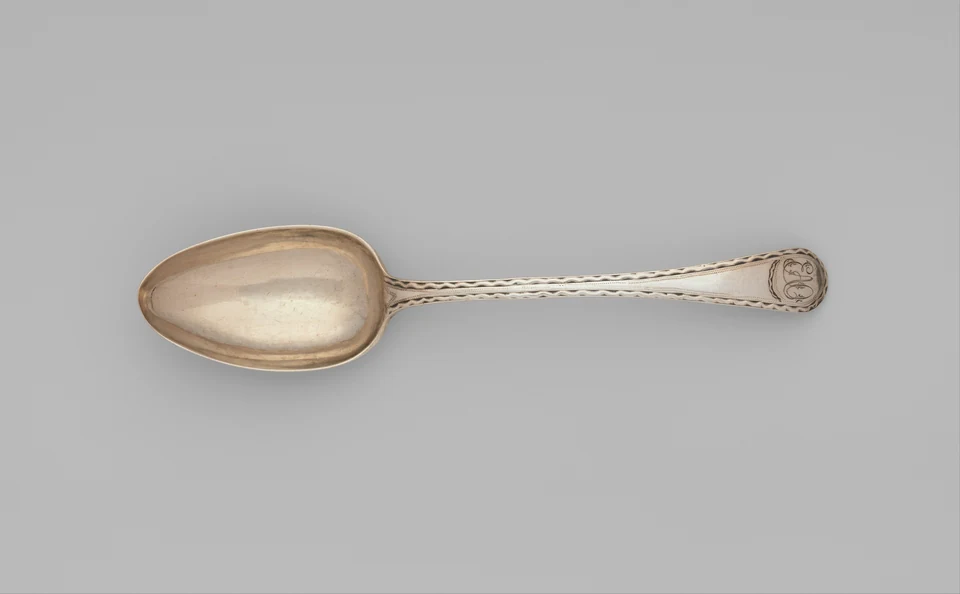
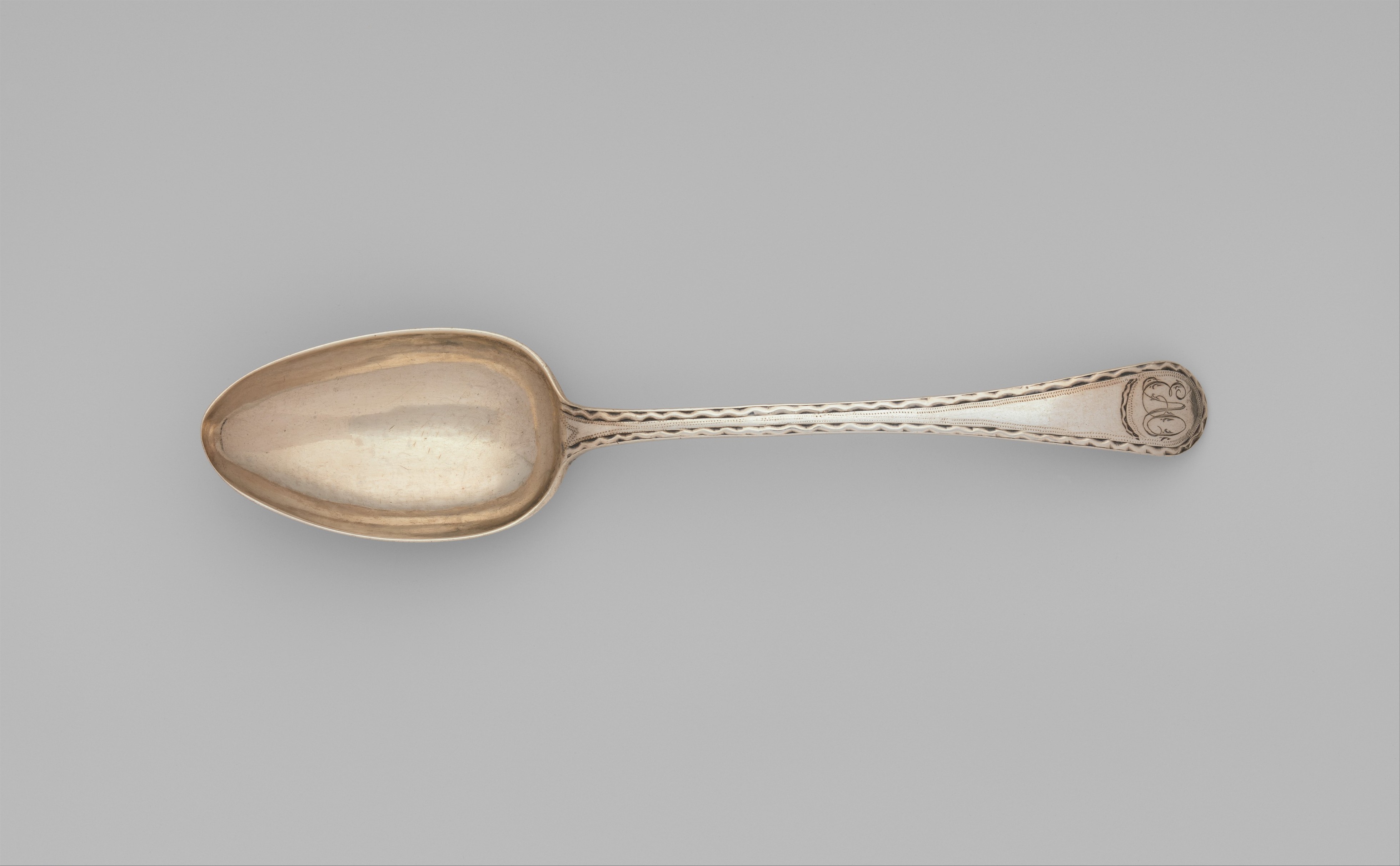
The spoon pictured here is one of a pair at The Met, dated about 1787. The museum records the pair as a gift from Edward A. Oliver to Edward Brattle and Esther Parkman Oliver for their marriage on September 13, 1787. It is silver, made in Boston, and measures 20.3 cm long. A small utensil opens onto a particular family occasion. Keep that documented history with accession 33.120.398; it is not a biography that can be transferred to a similar-looking spoon.
How a bar became something comfortable to hold
The Paul Revere House’s account of hand production follows a spoon from a silver bar through forging, repeated annealing, shaping the bowl, bending the neck, marking and polishing. The outline was only part of the job: the curve and balance had to work in the hand. When studying a piece, look along its profile as well as straight down at its decoration. Wear, later repairs and polishing can complicate what the surface now tells you.
A bowl made to be read
Revere’s Sons of Liberty bowl of 1768 carries political conviction in its engraving. The Museum of Fine Arts, Boston, describes its challenge to British taxation and its later life as a civic treasure. The bowl entered the museum in 1949 after a fundraising effort that included contributions from Boston schoolchildren. Its history continued long after it left the workshop. For a collector, that is a reason to study inscriptions and ownership records together rather than treating decoration as the whole story.
Why the name alone cannot identify the maker
The Paul Revere House distinguishes silver made in Revere’s workshop from later Revere bowls inspired by its forms. Its own shop listing documents a Reed & Barton reproduction of the 1768 bowl in silver plate. That is a useful, specific example of a later maker producing the familiar form. A reproduction can be worth enjoying on its own terms. Record its actual maker, material and date instead of promoting a design name into an eighteenth-century attribution.
Names & chapters
How the story developed.
- 1734
A Boston beginning
The museum biography gives December 21, 1734 in the Old Style calendar, equivalent to January 1, 1735 in the modern calendar.
- 1768
Silver with a political message
Revere makes the Sons of Liberty bowl, now in the Museum of Fine Arts, Boston.
- 1787
A wedding pair
The Met connects its pair of spoons with the Oliver marriage of September 13.
- 1780s
A family workshop changes
His son Paul takes on daily shop management as Revere develops other businesses.
Follow an interest
What to explore.
A historical collecting reference based on museum and institutional sources. It is not a seller review, appraisal or authentication of an offered object.
Check the details
Before you buy.
A famous name deserves careful reading. These questions help distinguish a documented workshop object from a later design or reproduction.
Open the references
Research this name.
- Collect Silver guide
Look closely at silver flatware
Compare utensil forms, construction, wear and the records worth keeping.
- Collect Silver profile
Understand the Reed & Barton name
Continue into a later American silver manufacturer’s history.
- Collect Silver resource
Keep a useful object record
Save the evidence that supports the story.
Sources & further reading
- Spoon, ca. 1787, 33.120.398 The Metropolitan Museum of Art · Museum object record, gift history and public-domain image
- Paul Revere Biography Paul Revere Memorial Association · Institutional biography and calendar-date clarification
- Revere’s Silver Shop Paul Revere Memorial Association · Workshop history and surviving business records
- Making Silver Paul Revere Memorial Association · Interpretation of hand-made flatware production
- Sons of Liberty Bowl, by Ethan Lasser, April 1, 2025 Museum of Fine Arts, Boston · Museum account of the 1768 bowl and its 1949 acquisition
- Revere Silver Paul Revere Memorial Association · Collection examples, workshop marks and attribution cautions
- The Paul Revere Bowl: Reed & Barton reproduction Paul Revere Memorial Association · Documented later silver-plated reproduction; not a stock recommendation
Museum records and the Paul Revere Memorial Association supply the historical evidence. Reproduction and marking examples are comparisons, not authentication of a prospective purchase.