
Know the business
The useful overview.
The company’s ancestry begins with Babbitt & Crossman’s Britannia-ware business in 1824. Old Colony History Museum dates Leonard, Reed & Barton to 1837 and the shorter Reed & Barton name to 1840. It describes a move into electroplating from 1848 and the later addition of sterling silver. These are stages in a manufacturing history, not interchangeable founding dates for one unchanged legal entity.[1]
The objects make that progression tangible. The Metropolitan Museum of Art records a pewter coffeepot made by Leonard, Reed & Barton in Taunton in 1837–40. Its material matters: an early piece associated with this famous silver name is not necessarily silver. The museum’s attribution and date apply to that particular coffeepot, accession 1985.343.3, rather than every object carrying a similar name.[7]
Reed & Barton’s design history also includes acquired patterns and outside designers. The museum history records its 1928 purchase of Dominick & Haff, bringing Pointed Antique into the business, and collaborations with Eliel Saarinen and Belle Kogan. Gio Ponti’s Diamond design was adapted by John Prip and Theodore Cayer before its 1958 debut.[1]
The independent business’s bankruptcy and the survival of its brand should be read separately. On May 14, 2015, Lenox announced that it had bought operating assets and certain liabilities of Reed & Barton. This was an asset transaction, not evidence that the old factory, workforce or production arrangements continued unchanged.[5][4]
Lenox’s current brand page presents Reed & Barton across flatware, barware, ornaments and gifts. That is the appropriate official starting point for the modern brand. A historical pattern name or museum attribution does not establish the material, origin, maker or availability of a newly offered object.[6]
The research trail is unusually rich. RISD Fleet Library holds catalogs and design and technical drawings. Old Colony’s linked-archives guide distinguishes these from business records at Harvard’s Baker Library and drawings, orders and photographs at Winterthur. A collector can therefore pursue a shape in design records, a model in catalogs and a business question in company papers rather than expecting one mark chart to answer everything.[4][3]
Names & chapters
How the story developed.
Follow an interest
What to explore.
Historical materials and patterns are research subjects, not live inventory. This profile is not an authentication service, assay, appraisal or endorsement of a seller.[6]
Check the details
Before you buy.
Read the current item and checkout terms. These notes summarize dated company policies, not a promise about your order. Applicable consumer rights still matter.
Open the references
Research this name.
- Museum / archive record
Explore the virtual archive
Start with the museum’s guide to dispersed collections.[2]
Catalogs and drawings need to be matched to the exact object.
- Museum / archive record
Study RISD design records
Browse catalogs, technical drawings and other company material.[4]
A design drawing does not prove a particular example was manufactured.
- Museum / archive record
Compare a museum-recorded sterling mark
Read the coffee spoon’s material and mark transcription.[8]
This is one documented object, not a complete mark chronology.
- Museum / archive record
Compare a documented plated frame
See how a museum records a mixed-maker glass-and-metal set.[9]
Do not treat the frame attribution as an attribution of the glass.
- Company announcement, 2015-05-14
Read the 2015 acquisition announcement
Distinguish purchased assets from an unchanged historical company.[5]
The announcement describes 2015 plans, not current stock.
The evidence trail
Sources & review notes.
- Reed & Barton company history Old Colony History Museum · Museum / archive record · Checked Nov 5, 2026
- Reed & Barton Virtual Archive Old Colony History Museum · Museum / archive record · Checked Nov 5, 2026
- Linked Archives Old Colony History Museum · Museum / archive record · Checked Nov 5, 2026
- Reed & Barton collections RISD Fleet Library · Museum / archive record · Checked Nov 5, 2026
- Lenox announces Reed & Barton purchase Lenox Corporation via PR Newswire · Company announcement, 2015-05-14 · Checked Nov 5, 2026
- Reed & Barton brand page Lenox Corporation · Current official brand page · Checked Nov 5, 2026
- Coffeepot, 1837–40 The Metropolitan Museum of Art · Museum / archive record · Checked Nov 5, 2026
- Coffee Spoon, about 1890 Brooklyn Museum via Google Arts & Culture · Museum / archive record · Checked Nov 5, 2026
- Caster set with plated frame and cut bottles Corning Museum of Glass · Museum / archive record · Checked Nov 5, 2026
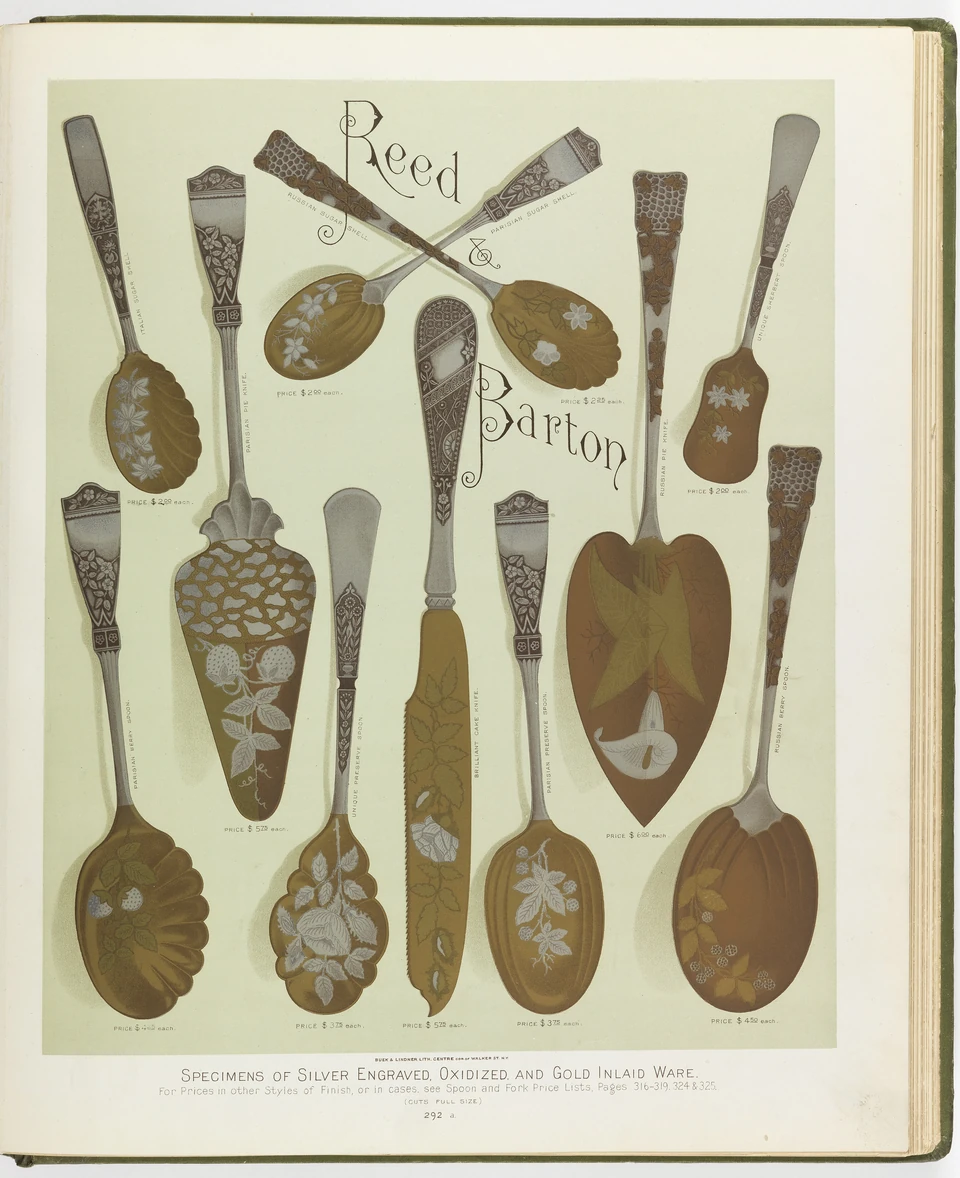
- Reed & Barton 1884 illustrated catalog plate Wikimedia Commons; collection of Smithsonian Institution Libraries · Public-domain historical illustration and file rights record · Checked Nov 5, 2026
Company pages describe company policies and claims. Independent references and Collect Silver’s first-hand reviews are labeled separately. A source link is not an endorsement.