
The short version
Desk silver brought craftsmanship to the tools of correspondence: containers for ink, cases for pens, seals for documents and ingenious pencils. The important question is not simply “How much silver?” but “How did these parts work together?” A missing liner, replacement handle or seized mechanism can matter more than weight.
A desk before the disposable pen
An old inkstand can look like a miniature table service. There is a tray, perhaps a pair of small containers, and sometimes a bell or another fitting between them. But this arrangement belongs to writing, not dining. Its purpose becomes clearer when you stop looking at it as one silver object and start reading it as a collection of tools.
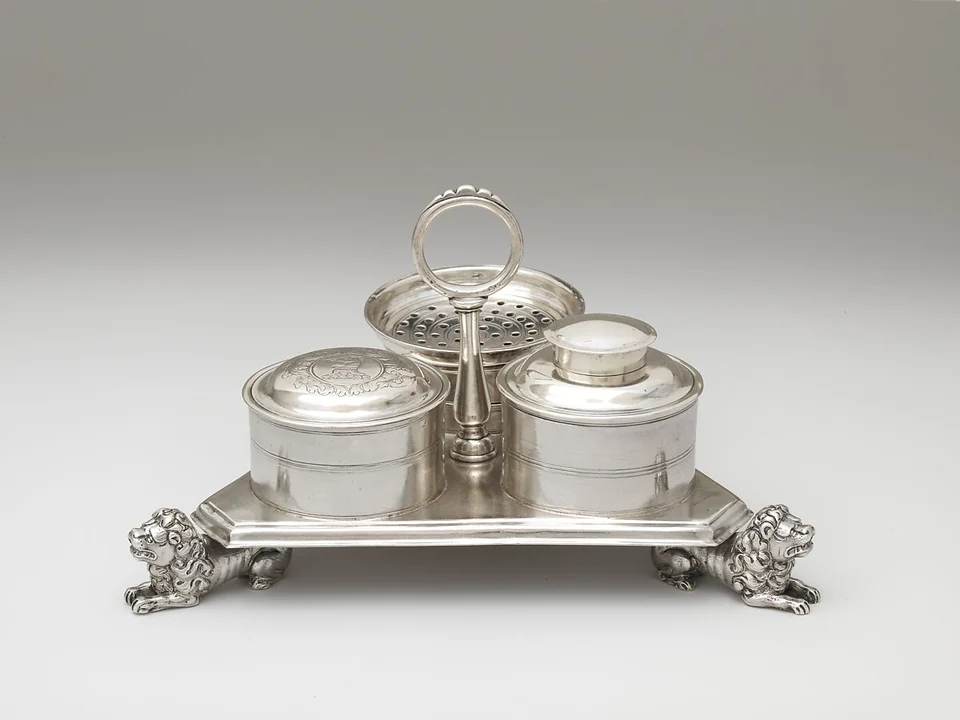
That is the appeal of desk silver. The objects invite you to reconstruct an action: opening a lid, taking out a pen, pressing a seal, advancing a pencil lead. Their beauty is connected to use, even when the setting was far grander than an ordinary working desk.
An inkstand also asks a useful collector's question: what is still here, and what has disappeared? A handsome tray might survive after its bottles have broken. A silver mount might outlast the glass it once held. Understanding the assembly is the first step toward understanding the piece.
Start with the assembly, not the seller's label
Inkstand describes an arrangement for writing equipment; standish is another term you will encounter in older descriptions and catalogues. There is no single layout that every example must follow.
An inkwell holds the ink. A sander or pounce pot belongs to the handling of writing powders, but those names are often used loosely in listings. A small box might have held sealing wafers or another accessory. Some stands include a bell or a fitting for a light. Do not assign a function from position alone. Compare the whole object with a documented example, including the shape of lids and openings.
Glass reservoirs, metal collars and lids should be recorded individually. A replacement bottle can make an inkstand usable or presentable again, but it should not quietly become “all original” in the description.
A working object made for a court
The Metropolitan Museum of Art holds a silver-gilt inkstand from Turin, dated about 1753. Its design is attributed to Francesco Ladatte, and it was probably made by Andrea Boucheron. Those qualifications matter: this is not a securely documented joint signature.
The arms of the House of Savoy appear beneath the bell. The Met relates the piece to royal commissions and to French Rococo design, while preserving uncertainty about who supplied its model. A writing accessory thus becomes a meeting point between court administration, sculpture and silversmithing.
For a collector, it is also a reminder to separate three questions: who designed an object, who made it, and who commissioned it. A single maker field does not always tell the whole story.
Silver did not have to form the whole object
A much earlier pen box in The Met, dated to the thirteenth century and attributed to Northern Iraq or Western Iran, offers a different approach. Its body is brass, engraved and inlaid with silver. Calling it a solid-silver pen box would erase the very technique that makes it interesting.
Inside, a receptacle accommodates an inkwell; the remaining space held reed pens and penknives. The exterior and interior carry elaborate decoration. The museum interprets the celestial imagery on its lid as having astrological and protective significance.
Set beside the Turin inkstand, it broadens the story beyond a European desk. Silver could provide the body of a writing object, its surface decoration or just one carefully worked component. Those distinctions belong in a collection record, not merely in a footnote about value.
A seal carried authority
Jacob Boelen's seal for Marbletown, New York, brings the story closer to an actual commission. The Met reports that surviving town records document his hiring in 1704. The object combines silver and wood; its engraved imagery refers to the town and its surroundings.
A seal is especially rewarding to study because decoration and purpose meet on the same small surface. The working face, the handle and any inscription all deserve photographs. Do not assume a familiar coat of arms identifies an owner without further research, or that an old handle and an old matrix necessarily began life together.
An inscription can open a research trail. Keep an exact transcription, including unusual spelling, alongside the photographs rather than replacing it with a modern interpretation.
The pencil becomes a collectible mechanism
Silver writing tools were not confined to the desktop. Propelling and telescoping pencils made writing portable, and novelty designs turned a practical mechanism into a small surprise.
In 1822, Sampson Mordan and John Isaac Hawkins patented a propelling-pencil design in Britain. Mordan became an important name in the collecting field, with later pencils taking an extraordinary variety of forms. The British Antique Dealers' Association describes examples shaped around animals, tools, musical instruments and other familiar objects.
The mechanism is part of the appeal, but a reluctant mechanism is not an invitation to force it. Before buying, ask whether it operates and whether that was actually tested. Record an untested pencil as untested. A silver exterior does not tell you the condition or materials of the working parts inside.
Portable writing accessories connect naturally with Pocket Silver and silver calling-card cases. Keeping those connections visible is more useful than treating every small object as a separate collecting world.
What to record before buying
A useful record goes beyond a maker's name and a weight:
- The complete assembly: list the tray, containers, lids, liners, handle and accessories actually present.
- Materials by component: distinguish solid silver, silver plate, silver inlay, glass, wood and unidentified materials.
- Marks where they occur: photograph each accessible mark and note which part carries it. A mark on a lid does not identify every other component.
- Fit and condition: note cracks, looseness, repairs, missing pieces and whether a mechanism was tested.
- Evidence for attribution: retain words such as probably, attributed to and circa when they appear in a reliable source.
Differences between marks deserve investigation, not an instant verdict. Consult the hallmark reference guide and compare documented examples before declaring an assembly original or “married.”
Preserve the object before chasing a shine
The Canadian Conservation Institute advises examining construction before cleaning. Hollow parts and mixed materials can make immersion inappropriate; wood, linings and other nonmetal components introduce their own vulnerabilities. Cleaning also removes material, so it should not become an automatic first step.
Do not force out a liner, loosen an old handle or dismantle a mechanism to make cleaning easier. Photograph the piece first. If its construction, repair history or residues are unclear, seek qualified conservation advice.
Our guide to weighted bases, hollow handles and mixed materials covers these decisions in more detail. For inherited desk pieces, Inherited Silver helps keep the family record alongside the object.
The most revealing desk collectible is not always the largest or brightest. Sometimes it is the small tool whose function becomes clear only when you turn it over, read its inscription or discover what once fitted inside.
Sources & image credit
Reviewed November 13, 2026. Museum records describe their own objects and do not authenticate a privately owned piece. The Met identifies the Coney inkstand image as Public Domain; it is resized proportionally without cropping.