
At a glance
Silver sewing tools occupy the space between practical equipment and personal adornment. A thimble protects a working finger; a bodkin draws a lace through fabric; a chatelaine keeps small objects close at hand. Their appeal lies in the way makers gave useful things a decorative life, sometimes combining silver with steel, enamel, glass or leather.
For a collector, the important questions are not simply “Is it silver?” or “Is it complete?” They are which parts are silver, what each component did, and what evidence connects the pieces now grouped together.
Small tools, substantial stories
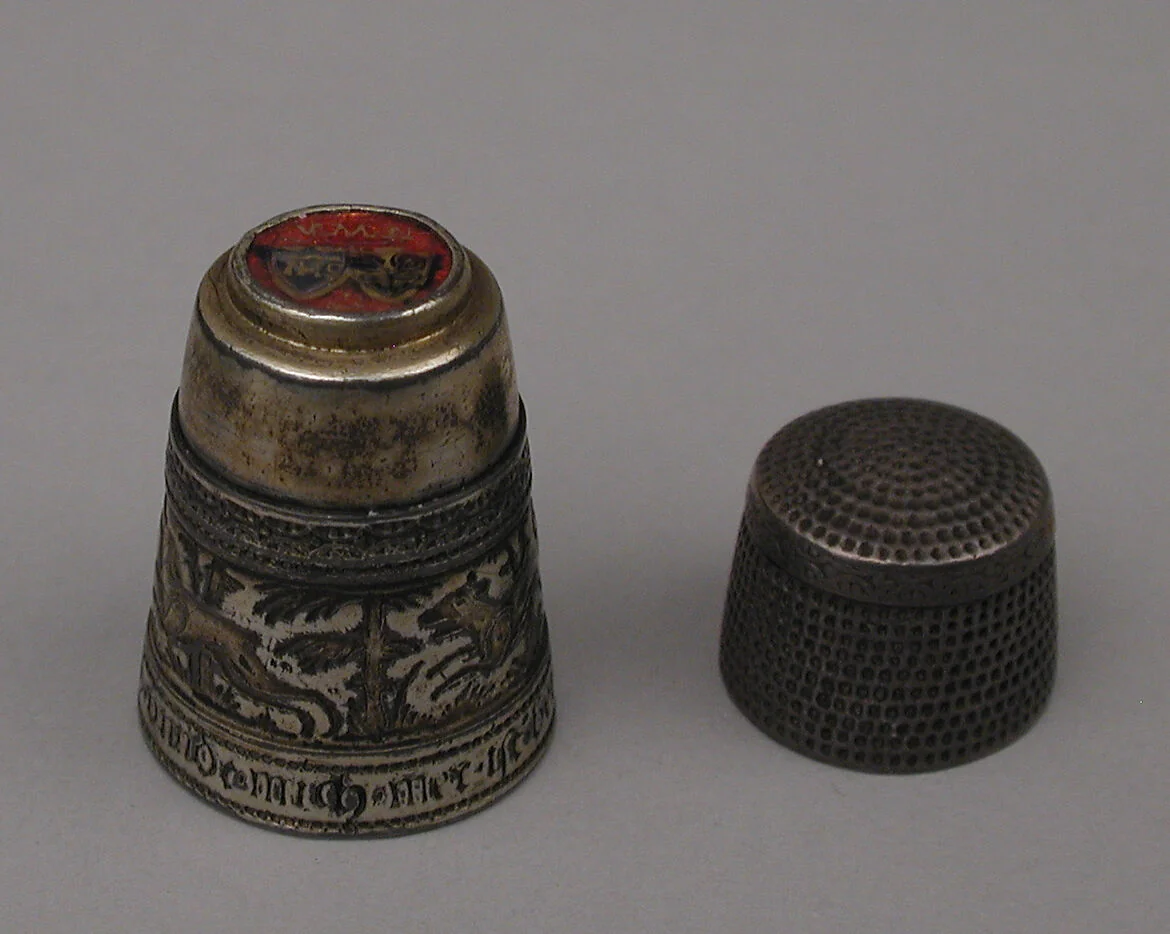
A sewing tool can look unassuming until its scale becomes clear. The Metropolitan Museum of Art's silver thimble dated 1577 is only about an inch high. Its partly gilded surface and enamel place decoration on an object designed to fit over a finger. It is both an implement and a small piece of metalwork worth looking at closely.
The museum identifies it as German, probably Nuremberg. That qualification matters: an attractive object does not become more interesting when its uncertain origin is made artificially precise. Nor does its richness tell us who first owned it or whether it was a gift. Those are stories to investigate, not details to invent.
Surviving decorated tools offer a particular view of the past. They show what someone could make of a familiar task, not what every household used. This guide follows that distinction through objects that protected fingers, threaded clothing and carried everyday essentials.
Begin with the job the object performed
An unfamiliar piece is easier to understand when its working features come before its decoration.
Thimbles provide a surface against which to push a needle. Examine the working end as well as the ornamental border. A beautifully decorated rim cannot tell you whether the top is pierced, repaired or worn thin.
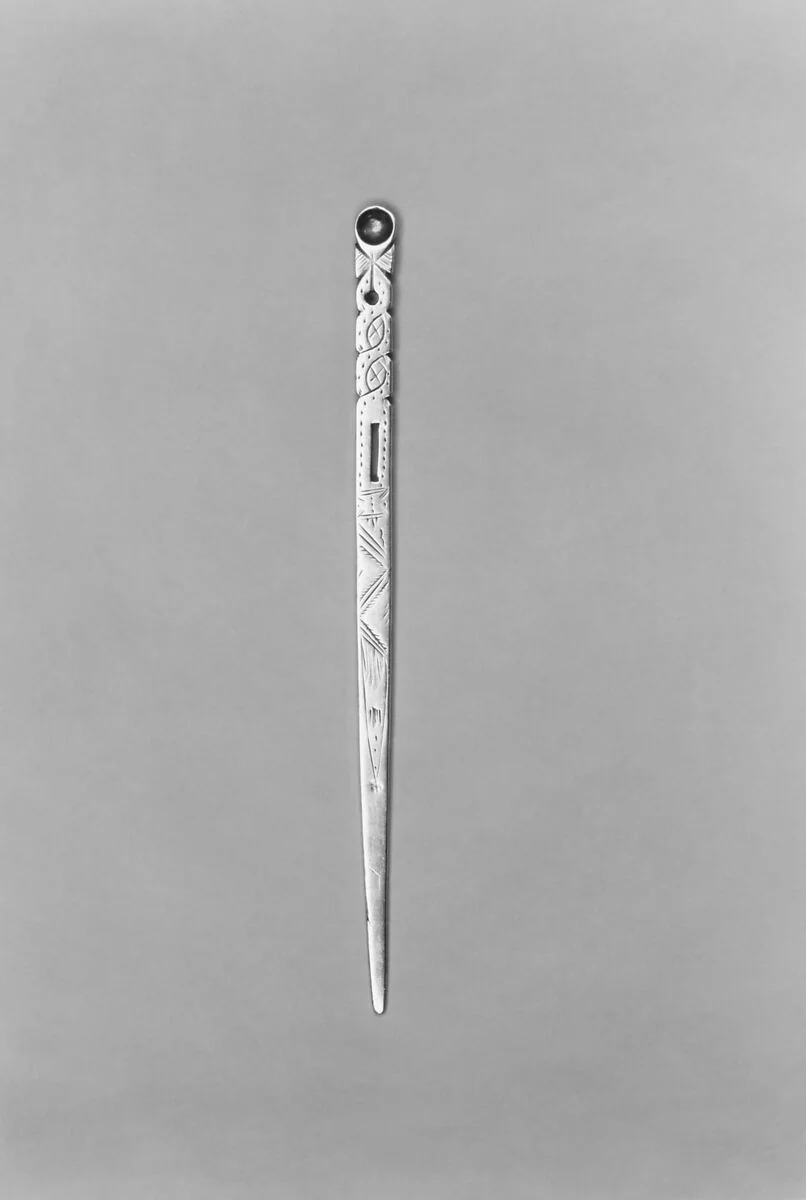
Bodkins include implements used to draw laces or ribbons through openings. The term needs context: the Met's British silver bodkin of about 1620–40 is described as serving both lace-threading and hairpin functions. Objects can cross the categories we use to organize a modern collection.
Needle cases are containers rather than needles. Their closures, internal arrangement and scale help explain what they held. Do not assume every narrow silver case has the same purpose.
Scissors and their sheaths should be considered component by component. A silver handle or protective cover does not make a steel cutting blade silver. Record the material of the blade separately from the mounts.
Étuis and fitted cases bring implements together. Look first at the compartments and the tools that fit them, rather than accepting an inventory supplied by a seller. A vacant recess may be evidence of a missing implement, but its exact contents need research.
Chatelaines are wearable suspension arrangements for small objects. They are not a fixed kit with one mandatory number of chains, and their attachments need not all be sewing tools. A writing implement, a container and a tool can belong to the same broader world of portable equipment.
One bodkin, more than one use
The Met's silver bodkin, catalogued as British, probably London, is about 13.3 centimetres long. The museum dates it to about 1620–40 and notes that bodkins could thread laces and serve as hairpins. Its simple incised patterns are compared with decoration more usually found on wood or bone objects.
That is a useful reminder that silver did not exist apart from other materials. A familiar form could move between materials, and an implement could sit between sewing, dressing and ornament. The point is not to make the object mysterious. It is to look for evidence before assigning it to a single modern category.
A chatelaine is an arrangement, not a formula
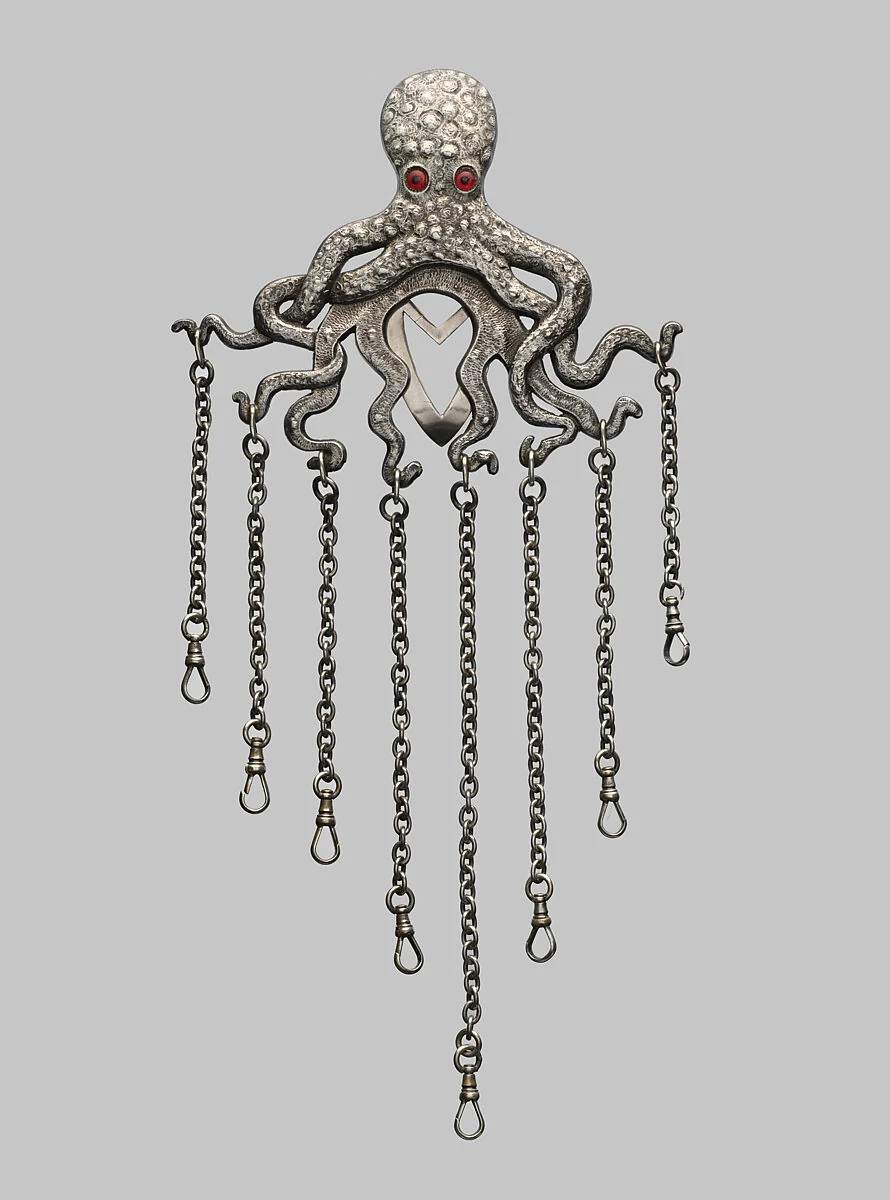
The Gorham chatelaine made in Providence in 1887 takes the form of an octopus, with chains hanging from its curling arms. It shows why the category reaches beyond plain silver. The Met records its materials as silver, red glass and black beads. Calling the red elements gemstones would change the object, not improve its description.
A chatelaine can be studied at several levels: the part that attaches to clothing, the connections that carry weight, and the objects suspended from them. Decoration helps hold the composition together visually, but a collector also needs to understand how those parts connect mechanically.
It is tempting to judge originality by whether every component looks alike. The more useful approach is to record the evidence. Are marks present on the main fitting and on individual attachments? Do closures work without force? Are there repairs, open links or differences in wear? Is there an old photograph, fitted box or documented provenance that connects the components?
Differences deserve attention, but they are not a verdict. A different maker's mark does not by itself prove a recent assembly; matching decoration does not by itself prove that everything began together. If the relationship is uncertain, say so.
When silver needed reinforcement
Silver's decorative possibilities did not solve every practical problem. A thimble must withstand the repeated pressure of a needle. Charles Horner's patent offers a particularly clear account of the problem and one proposed solution.
The United States patent issued on June 11, 1889 describes a steel core placed between inner and outer precious-metal layers. Its specification references a British patent dated June 14, 1884. The construction was intended to combine the appearance of precious metal with resistance to puncture.
This is not a reason to describe a reinforced thimble as silver all the way through. Its layered construction is the interesting part. Nor should Horner be credited with inventing every combination of steel and precious metal: the patent itself acknowledges earlier steel-ended thimbles and defines a more specific claim.
For collectors, the lesson extends beyond thimbles. A mixed-material object can be thoughtfully engineered rather than inferior or misleading. The description becomes misleading only when its construction is concealed or misunderstood.
Makers, retailers and the names on a label
The Met identifies Gorham Manufacturing Company as the maker of its 1887 chatelaine. Other records assign a business a different role. That distinction belongs in a collector's notes.
For example, a separate Met chatelaine dated about 1890 identifies Tiffany & Co. as a department store and lists the materials as leather and metal. The record does not establish that the metal is silver or that Tiffany manufactured it. A prestigious business name cannot supply facts missing from the object record.
Keep three questions separate:
- Who designed or made it? Use the documented role, including “attributed to” when applicable.
- Who sold it? A retailer may be important to the object's history without being its manufacturer.
- What is it made from? Record the actual material evidence, not an assumption based on the name.
Use the Gorham maker profile for the company's broader story. Consult the hallmark references and silver-authenticity guide for marks; this guide does not replace a jurisdiction-specific hallmark reference.
Condition without guesswork
Start with a written description and clear photographs before cleaning or rearranging anything. Photograph the complete object, its reverse, closures and marks. For an assembled group, keep each attachment identifiable in your record.
A useful examination looks for:
- holes, splits and possible repairs in thimbles;
- loose or distorted links and closures;
- rust or seized mechanisms in steel components;
- loose enamel, glass or other decorative elements;
- implements that do not fit their compartments comfortably;
- inscriptions or marks that need to be recorded separately from later interpretation.
Do not force a mechanism to prove that it works, or push a tool into a fitted recess to make the set appear complete. When a problem is uncertain, a qualified conservator or specialist can distinguish a condition issue from a feature of construction.
Care begins with construction
The Canadian Conservation Institute advises examining silver for joins, hollow sections, gilding and nonmetal components before choosing a cleaning method. These are especially relevant to sewing accessories, where silver may sit beside steel, enamel, fabric or another vulnerable material.
Polishing is not simply the removal of unwanted color: it removes some material, and it can damage gilding. Immersion is unsuitable for many hollow or composite objects. A treatment appropriate for a plain silver surface may be inappropriate for the rest of the piece.
Keep delicate components supported and avoid making a fragile chain carry unnecessary weight during storage. Do not apply a general cleaning recipe to an unknown assembly. Active rust, lifting decoration, loose fittings or seized mechanisms call for individual advice, not more vigorous polishing.
The site's guide to weighted and composite silver explains this construction-first approach in more detail. For an old sewing object, preserving the evidence of how it was made is often more valuable than making every surface equally bright.
Where the collection leads
These objects connect naturally with several collecting paths. Pocket silver explores small things carried close to the body. Jewelry introduces ornament, wear and personal expression. Writing-desk silver follows the pencils and other implements that can overlap with a chatelaine's attachments.
The best record allows an object to have more than one connection without losing its identity. A bodkin can belong in the history of sewing and dress. A reinforced thimble can reveal both decorative ambition and a practical engineering decision. A chatelaine can bring several such stories together, provided we let the evidence determine which stories it actually tells.
Objects kept across generations.
Sewing tools are one part of a larger family archive. Explore childhood silver, presentation gifts and the stories families kept.