
A drawer full of questions.
A familiar spoon can become an unfamiliar object when the person who knew its story is no longer there to tell it. The initials might belong to a great-grandparent. The little box beside it might hold a missing fitting, or nothing related at all. Before asking what the silver is worth, give yourself time to find out what is here.
You do not need to identify an entire household in one afternoon. Start with one group: a tray of tea things, a jewelry box, an album of coins. Keep the rest safely together until you can return to it. The aim is not a perfect catalogue on the first attempt. It is a record that lets the next person pick up where you stopped.
Keep the context with the object.
Before rearranging a drawer or emptying a case, take an overview photograph. Then record which objects were found together. A fitted case, an old receipt, a handwritten label or an apparently unimportant envelope may explain a name or date later.
Keep loose lids, stands and fittings with their possible companions, but record the relationship as a possibility until it is established. Two things found in the same cupboard are not necessarily a matching set. A replacement lid can fit beautifully without belonging to the original service.
Our suggestion is to give each group a simple reference, such as Family-01, and each piece a suffix. Put that reference on a separate label and in the photograph filenames, not on the silver itself. If a piece must move, note its new location. Keep receipts and personal addresses in the private record rather than a public photo gallery.
Look before making it shine.
The temptation to polish everything is understandable. A bright surface seems easier to inspect. But the Canadian Conservation Institute advises examining construction and surface treatments before cleaning: gilding, plating, joins and hollow sections change what is appropriate, and repeated tarnish removal takes away some silver.
For this first pass, leave unfamiliar surfaces alone. Do not pry open a watch, pull a chain to test it or dismantle a weighted base to find the silver. Photograph damage without trying to straighten it. If a part is loose or unstable, stop handling it and seek suitable conservation advice.
Coins deserve their own approach. The U.S. Mint warns that cleaning or polishing can reduce a coin’s value and recommends handling by the edges over a soft surface. Keep an existing protective holder and its paperwork together. A table-silver polishing routine is not a coin-care routine.
For the next step, use our silver-care reference and guide to weighted and composite pieces.
Make a record you can recognize.
Photograph the whole object, its reverse or underside, and any marks, inscriptions or distinctive damage. Include the case or packaging separately. A close-up of a hallmark is useful; a close-up with no view of the object can be hard to interpret.
ICOM’s Object ID standard is a useful foundation: photographs and a short description sit alongside material, measurements, identifying marks, maker and other distinguishing details. Unknown answers can remain unknown. Keep the record securely rather than relying on memory.
- What can you see? Describe the shape, decoration and exact visible lettering.
- What have you measured? Record the unit and what was included. A weight with a wooden base or stones is not a fine-silver weight.
- What needs checking? Separate a tentative maker, date or material from an established identification.
Our object-documentation guide takes this further. For now, a clear record of one piece is more useful than a spreadsheet full of confident guesses.
Keep the memory, and name its source.
“Grandmother’s wedding present” is a valuable lead. It becomes more useful when you record who remembers that, when they told you, and whether a photograph, inscription or receipt supports it. A family story does not need to be discarded because it cannot yet be proved; it needs to remain distinguishable from documentary evidence.
Ask open questions: Who used it? On what occasions? Was it bought new, inherited or brought home from a journey? Did anyone repair it? Are other pieces with another relative? Write down the answer in the speaker’s own words where possible, with their permission.
That small separation makes room for later discoveries without turning a memory into a false attribution. Save a scan of both sides of relevant documents, retain the originals, and keep another copy of your digital record. Our family-archives reference covers caring for the paper and photographs themselves.
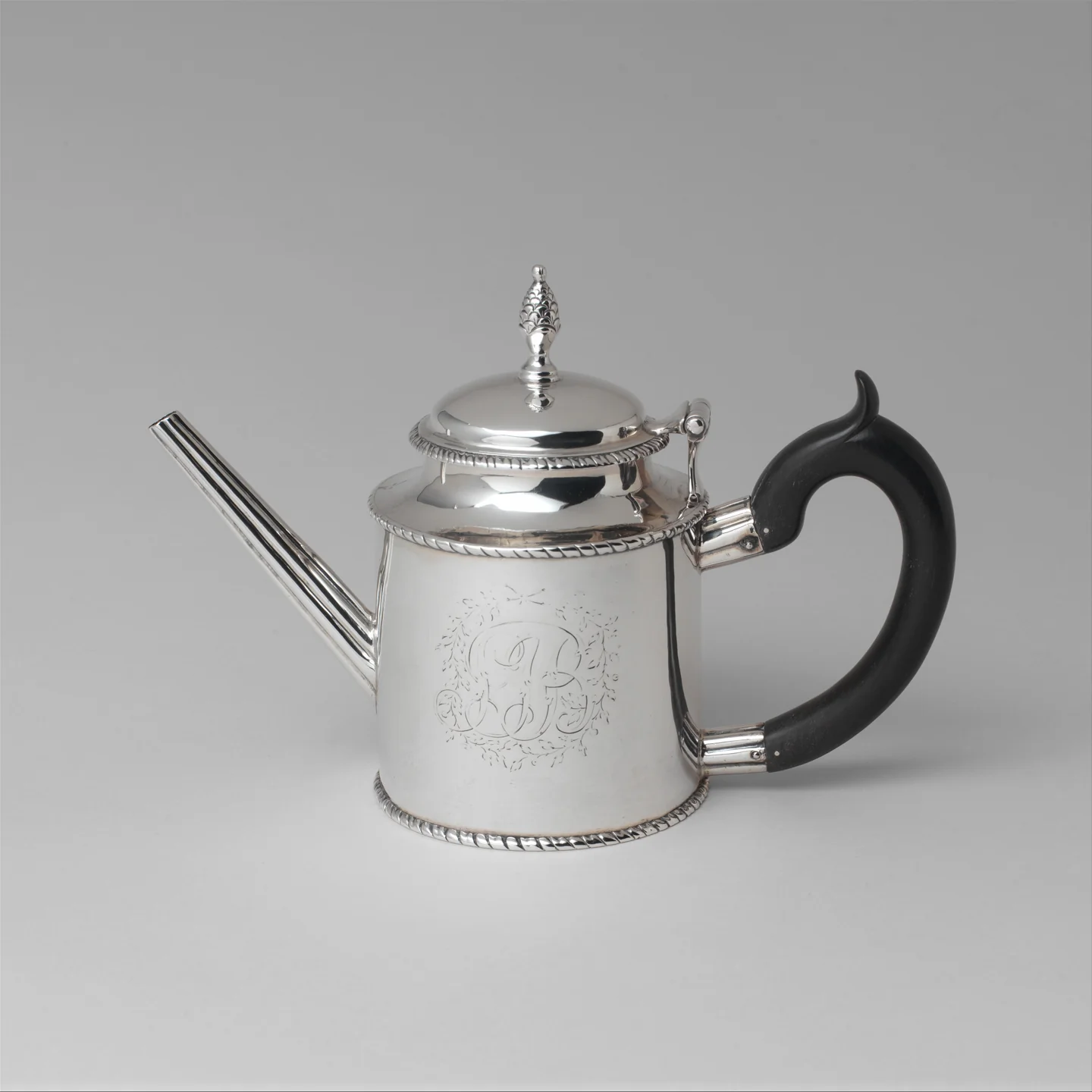
Passed down through the Bruce family until 1969, this Paul Revere teapot shows how engraved initials can preserve a family connection. Boston, about 1782.
The Met · 69.147 · Select the photograph to view it larger in a new tab.Follow the piece into its own story.
A mixed inheritance does not need one answer. Follow the objects into the guides that fit them, keeping the original group record as the connection between them.
- The Silver Table: start with flatware, serving pieces and the objects around a place setting. For a service, continue to Silver Tea Sets.
- Silver Jewelry: explore forms, materials, makers and fastenings before assuming everything in a jewelry box shares one metal.
- World Coins: read the issuer, date and denomination. Use Silver Dollars for the separate U.S. collecting story.
- Silver Sculpture: follow figures, miniatures and their makers while keeping bases and mixed materials in the record.
- British hallmarks: study the complete mark group. For broader identification questions, use Silver Authenticity.
Choose the next question, not the final answer.
Once a piece has a record, the next question becomes easier to explain. You might need a specialist to identify a maker, a conservator to assess a damaged surface, or an appraiser for a particular purpose. Tell them what you need to decide rather than asking only, “What is it worth?”
Keeping an object, dividing a family group, insuring it and selling it are different decisions. Do not treat a dealer’s asking price, a metal calculation and an insurance valuation as the same number. For table silver, our inheritance and value guide explores those distinctions. Estate authority, deadlines and tax questions belong with the appropriate qualified adviser.
You may finish this first pass without a price, and still have achieved something important: the pieces are identifiable, their companions are still together, and the stories are no longer resting on one person’s memory. That is a good place to begin.
Sources & further reading
Conservation and documentation references checked November 12, 2026. The grouping method, family questions and fictional record above are Collect Silver’s editorial suggestions, not an appraisal or legal determination.