
The collector’s dossier / United States coinage
Silver dollars, read closely.
Start with the coin’s identity, not its shine. The date, design and purpose tell you which silver-dollar story you are holding.
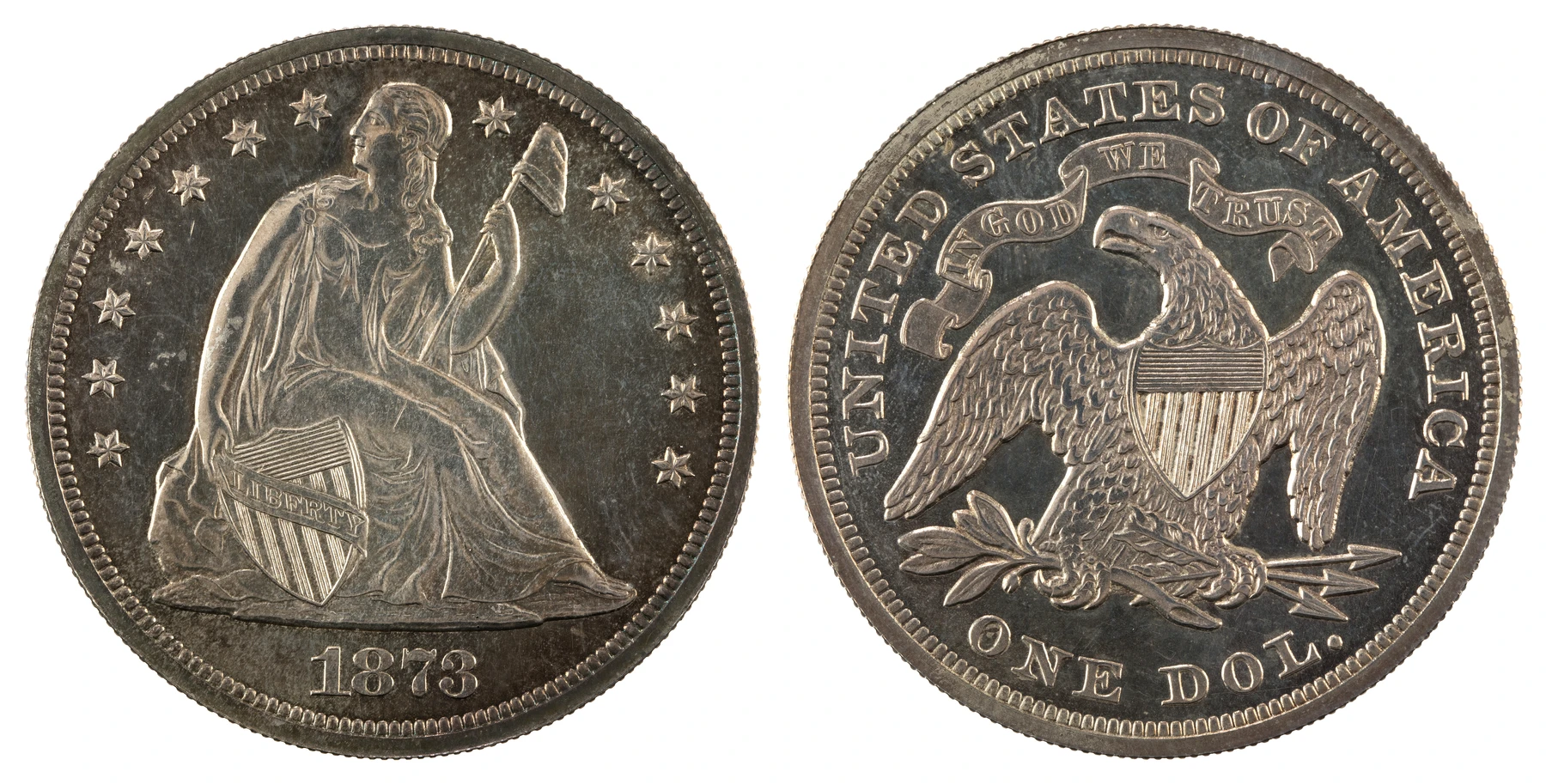 View both faces at full size
One dollar is a denomination, not a recipe
A silver dollar can be a piece of circulating history, a coin made for overseas trade, a modern collector issue or a bullion coin. Those purposes matter. A portrait, date and dollar inscription may look familiar while the metal specification belongs to an entirely different issue.
This guide concentrates on United States coins. Do not apply its dates or silver percentages to dollars from another country. Begin with the issuing country, then identify the design, date, mint mark and production version. “Silver-colored,” “proof” and “one dollar” are not interchangeable with “contains silver.”
The same year, two different dollars
The Seated Liberty standard dollar series ran from 1840 to 1873. In the photographed 1873 example, Liberty sits beside a shield; the reverse has an eagle and ONE DOL. The Trade dollar also shows a seated Liberty, but its reverse explicitly reads TRADE DOLLAR and 420 GRAINS 900 FINE. Turn the coin over before naming it.
The Coinage Act of 1873 omitted the standard silver dollar from its authorized denominations while authorizing the Trade dollar. It did not abolish all silver coinage: half dollars, quarters and dimes remained in the law. The Trade dollar was intended for export to China, a different role from the standard domestic denomination.
Those reverse numbers describe two different things. The Trade dollar’s prescribed total weight was 420 troy grains; its prescribed fineness was 900 parts silver per thousand, or 90%. The whole coin was not pure silver. An inscription identifies the specification being claimed, not the authenticity or measured composition of an unknown specimen.
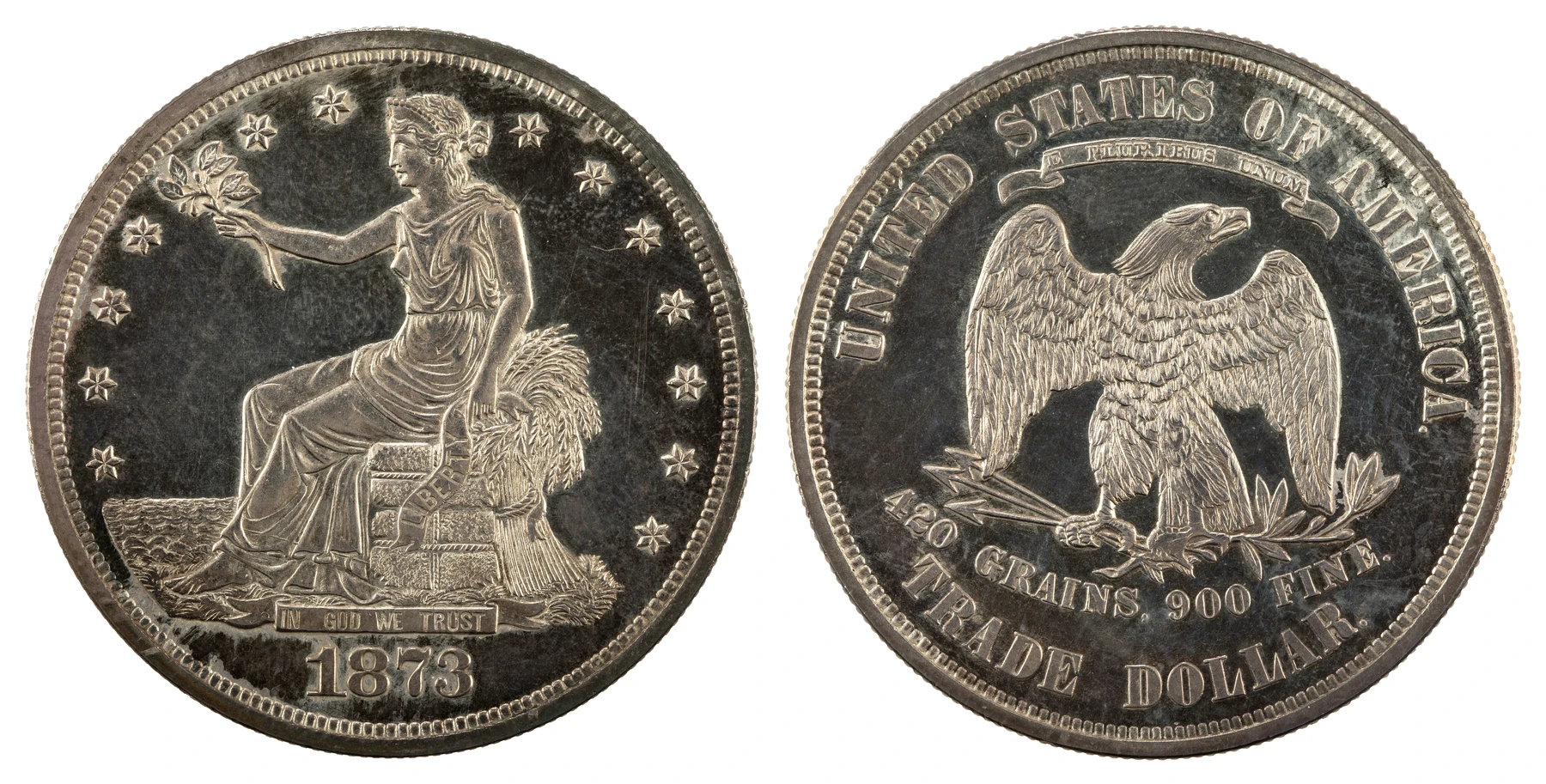 View both faces at full size
The familiar historic silver dollars
Morgan dollars were struck from 1878 through 1904 and again in 1921. Peace dollars followed in 1921–1928 and 1934–1935. Both original series were specified as 90% silver and 10% copper. These are historic circulating-coin series, although that does not mean every surviving example actually circulated.
Look for Liberty’s capped profile and the eagle within a wreath on a Morgan. A Peace dollar has Liberty wearing a crown of rays and a perched eagle on the reverse. The shared date 1921 is especially useful: it can belong to either design, so the year alone does not identify the series.
Production followed policy as well as demand for money. The Bland–Allison Act restored the standard silver dollar in 1878. Later, the Pittman Act authorized the melting of millions of dollars and required replacement silver purchases; Morgan production resumed in 1921 before the change to the Peace design. A collection can explore these changes without chasing a complete date-and-mint set.
Large and silver-colored is not enough
Eisenhower dollars require a second question after identification: which composition? The Mint made copper-nickel clad coins for circulation and special silver-clad collector coins. The latter have an overall composition of 40% silver, not 90%. “Clad” describes layered construction; it does not, by itself, mean either silver or silver-free.
Silver collector issues include the 1971–1974 issues and the dual-dated 1776–1976 Bicentennial version. Bicentennial dollars also exist in copper-nickel clad, while the 1977 and 1978 issues were copper-nickel clad only. Do not read 1776 as the coin’s production year.
Proof is another trap. The Mint included a silverless copper-nickel Eisenhower in its 1973 proof sets. A reflective finish or a mint mark is therefore not a substitute for identifying the exact issue. Match the coin to its documented specification and original product description; keep any packaging and certificate together, but do not treat packaging alone as proof.
A bullion dollar and a collector revival
The American Silver Eagle program began in 1986. Its bullion coin contains one troy ounce of .999 fine silver and bears a one-dollar denomination. Collector versions also exist, including proofs. The denomination is not a statement that the coin contains one dollar’s worth of metal, and a Silver Eagle is not simply a newer Morgan dollar.
Modern Morgan and Peace dollars returned in 2021 as collector issues. The 2021 coins used 99.9% silver rather than the historic 90% alloy. Check the specifications for the particular modern release rather than borrowing the weight or composition of an old coin with the same design.
The 2021 Morgan offers a useful lesson in marks: its O and CC privy marks commemorate New Orleans and Carson City. Those versions were made in Philadelphia, not at the historic mints represented by the letters. Record the year and the kind of mark before drawing a conclusion about where a coin was made.
Build a record before building a set
Photograph the front, back and edge in good light. Write down the country, denomination, exact date, visible mint or privy mark and any holder information. Separate what you can see from what the seller claims. If the identity is uncertain, describe the visible features rather than assigning a confident series, grade or silver content.
Compare measurements only with the specification for that exact issue. A plausible weight, attractive toning or familiar design is not an authentication certificate. Before a consequential purchase, ask an experienced coin specialist to assess the physical coin and explain any uncertainty. Do not scratch, file or acid-test a collectible to settle the question.
For a manageable beginning, choose a theme: the two designs of 1921, the change in silver content across eras, or the inscriptions that reveal a coin’s purpose. Keep receipts, identification notes and original documentation. Handle coins by their edges over a soft surface, use PVC-free holders, and resist polishing: cleaning can damage surfaces and reduce collector value.