
The collector’s field guide
The Value of Money
Explore silver dollars and the stories that give money meaning at the Smithsonian’s National Museum of American History, then plan a free visit on the National Mall.
National Museum of American HistorySmithsonian Institution · National Mall
Begin with silver, then follow the story
The Value of Money brings a silver collector into the wider world of money at the Smithsonian’s National Museum of American History. Head to 1 West for an exhibition drawn from the National Numismatic Collection. The museum’s December 2024 refresh announcement identifies 1804 silver dollars among its highlights, alongside gold rarities and banknotes. Use those celebrated coins as a starting point: what made a piece valuable to the people who made it, used it or decided to preserve it?
An 1804 date needs a second look
A date on a coin can be the beginning of the investigation. The Smithsonian’s record for its Class I 1804 dollar explains that eight dollars bearing that date were made in November 1834 for gift sets. That is a useful lesson to bring to any cabinet of silver: read the production history as carefully as the inscription. Look for the distinction between the date a coin carries, when it was struck and how it entered a collection.
Look beyond the metal
The exhibition follows five themes: money’s origins, technological change, political and cultural messages, artistry, and collecting. Try comparing a coin’s denomination with its imagery, then consider what the design asks its audience to trust or remember. Give the banknotes and other monetary objects some attention too. They make useful companions to silver because they widen the question from what a coin contains to how people exchange value. This is a history visit that can sharpen the way you look at your own collection.
Separate the collection from the cases
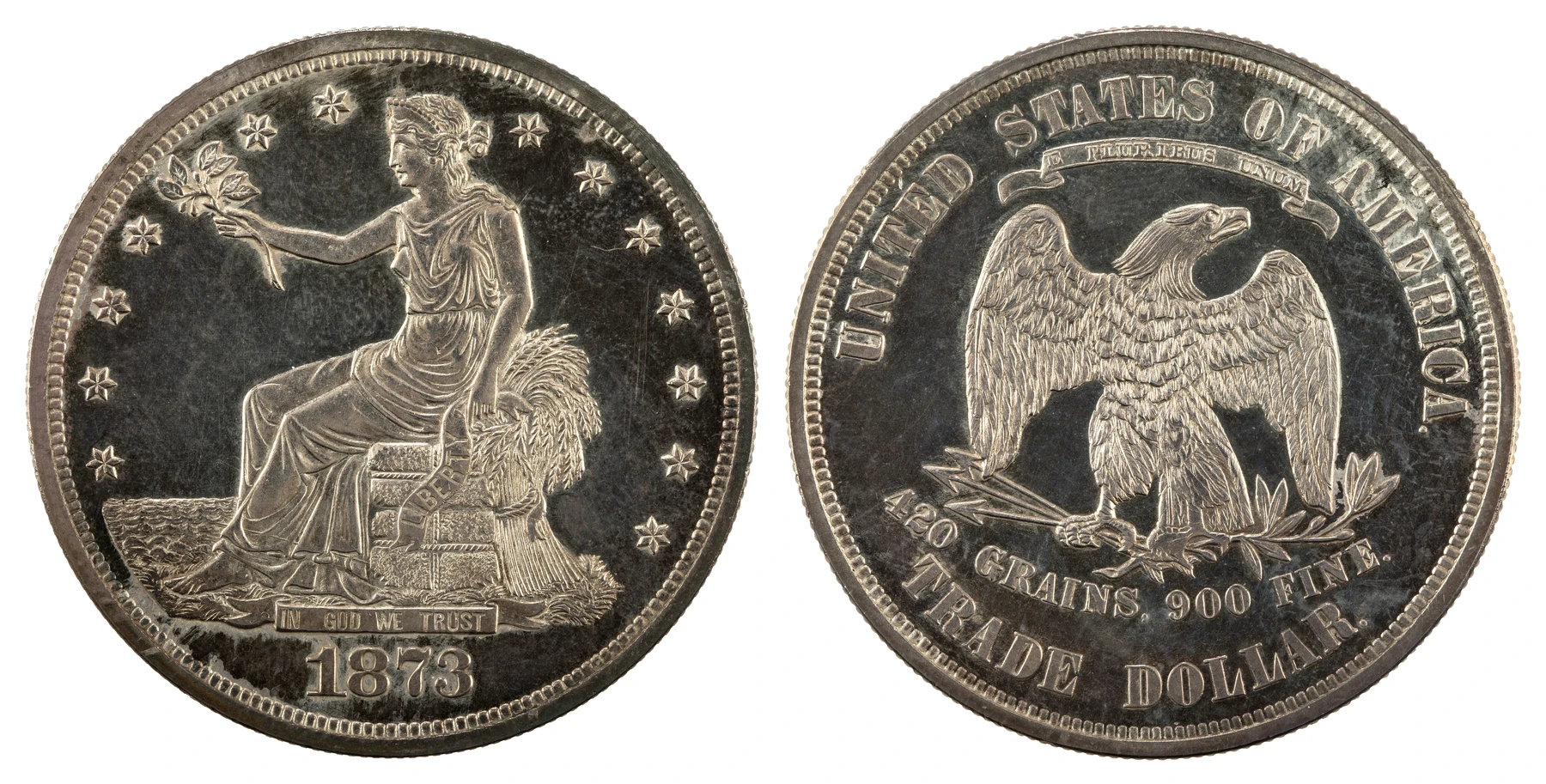
Only part of the National Numismatic Collection is exhibited. The online companion is valuable for studying objects before or after a trip, but the museum expressly warns that its pictured objects may differ from those currently on view. There is also a changing display case. Treat collection photographs as research references, and confirm any must-see coin directly with the museum before making a special journey. The 1873 Trade dollar pictured in this guide is a documented collection example; its photograph does not establish that it is in the gallery today.
Plan the visit
The museum’s visitor address is 1300 Constitution Avenue NW, Washington, D.C. Published general hours are 10 a.m.–5:30 p.m. daily, with a December 25 closure. General admission is free and does not require tickets or passes. Recheck the official visitor page for exceptional closures before travelling. Constitution Avenue enters on the first floor; Madison Drive, on the National Mall side, enters on the second. Federal Triangle and Smithsonian are nearby Metro options.
Choose the entrance that works for you
The museum describes its exhibitions and public areas as accessible to wheelchair users and other visitors using mobility devices. In the museum’s accessibility notice reviewed on 6 November 2026, it directed visitors needing a fully automated door to Constitution Avenue because the Madison Drive automatic accessible door was out of service. Check that notice again before travelling. A limited supply of non-motorized wheelchairs is available first-come, first-served; ask security on arrival. The Value of Money also offers a visual description through a QR code at its entrance.
Find the museum
National Museum of American History: The Value of Money1300 Constitution Avenue NW, Washington, D.C., United States
The Value of Money is in 1 West. Constitution Avenue enters on the first floor; Madison Drive on the second. The map locates the museum, not a particular display case or an accessible route.
Share a good find.
Sources & further reading
Guide checked 6 November 2026. Confirm opening, access notices and any must-see object with the museum before travelling.
The exhibition & collection
- The Value of Money (opens a new tab)
- Money and Medals (opens a new tab)
- New Numismatic Rarities on View in The Value of Money (opens a new tab)
- 1 Dollar, United States, 1804 (Class I) (opens a new tab)
- About the online Value of Money exhibition (opens a new tab)
- Changing Display (opens a new tab)
Planning a museum visit
- Visit the National Museum of American History (opens a new tab)
- Calendar of Exhibitions and Events November 2026 (opens a new tab)
- Getting Here (opens a new tab)
Accessibility
- Accessibility (opens a new tab)
- Tactile Elements and Accessible Exhibition Features (opens a new tab)