
01 · A wider view
Start before the trading port.
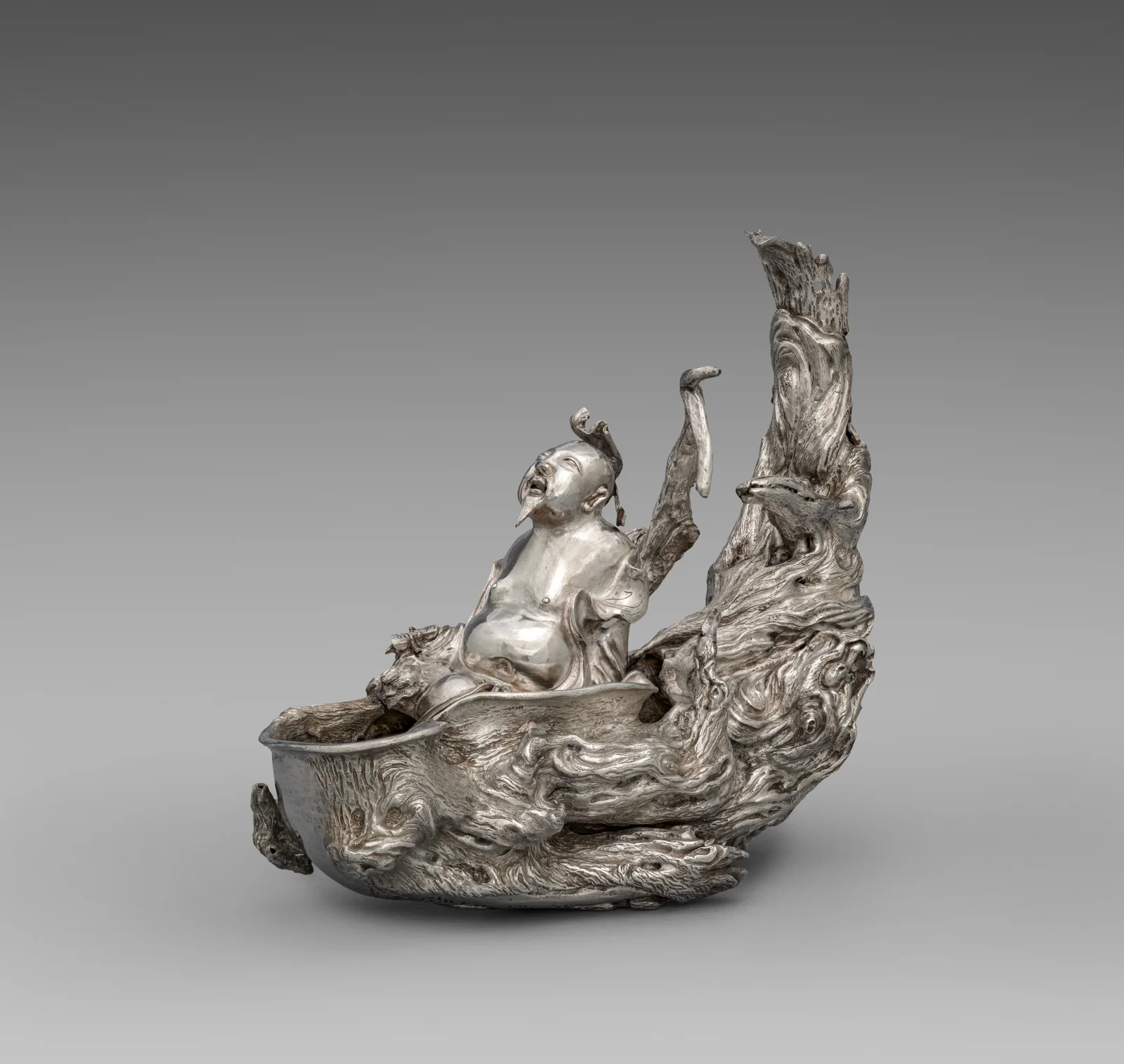
Imagine approaching Chinese silver through a drinking vessel that looks like a weathered tree. There is no neat separation between bowl, sculpture and story. Its rough bark is metal; its passenger seems absorbed in something beyond the rim. Before we ask who exported it, there is a more interesting question: what did a maker want silver to become?
The familiar world of export tea services and presentation bowls occupies only part of that question. Chinese makers used precious metal for vessels, personal ornaments, furnishings and images. Silver could form the body of an object, clothe another material, or appear as a fine bright shape within a contrasting surface. Those differences matter as much as the amount of metal.
This is a route through selected objects, not a continuous history of every region or community in China. The earliest examples belong to the Tang dynasty. A later cup brings literary imagination into three dimensions. The final objects overlap the export era without supplying a documented export destination. Keep that distinction in view: an object's date, place of making and market are separate pieces of its history.
For the trading ports, retail names and overseas table, continue to Chinese Export Silver. Here, we begin with the surfaces and structures that make the longer story worth exploring.
02 · Early 700s
A small cup with a wide horizon.
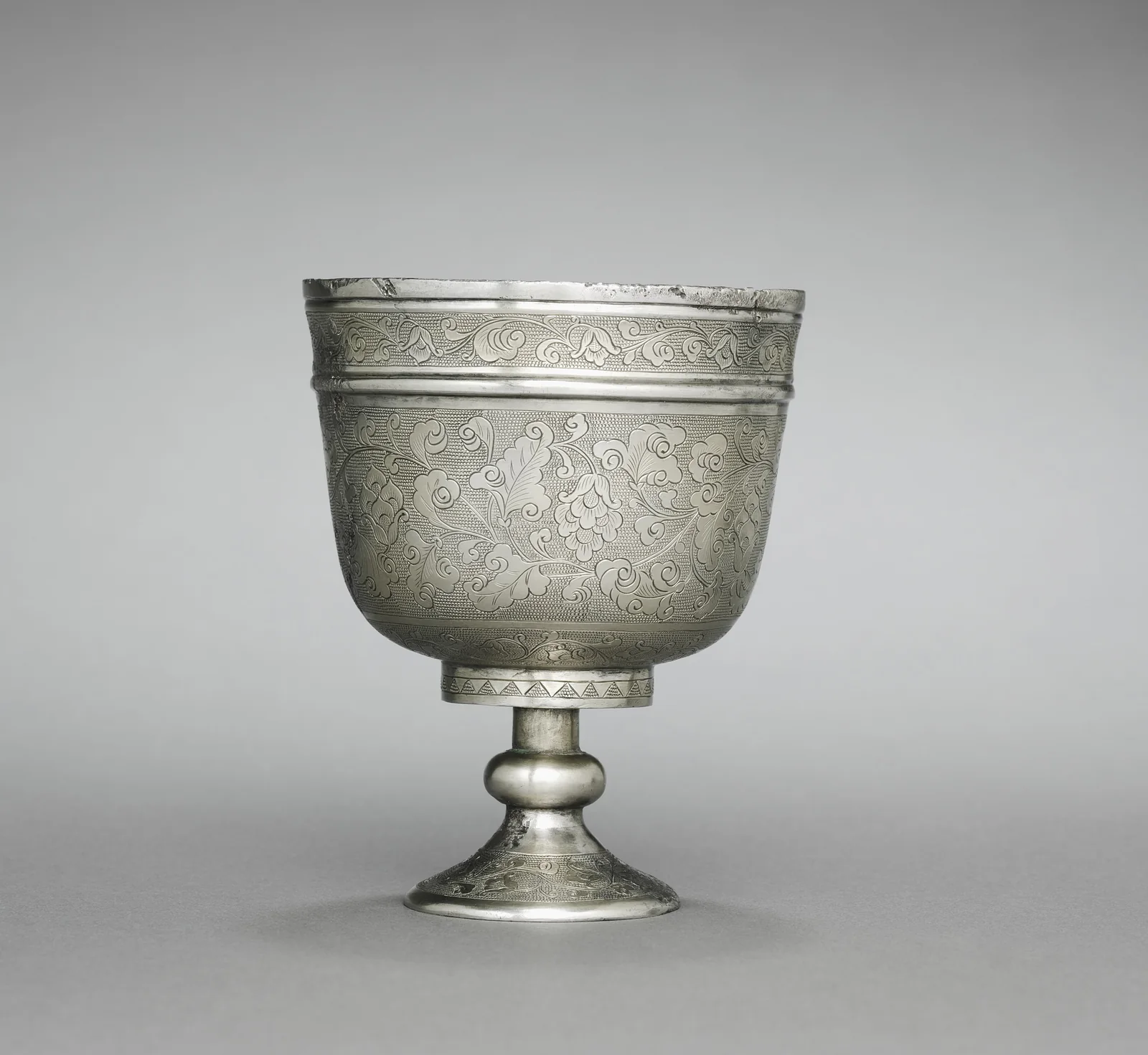
The Cleveland stem cup is only nine centimetres high. Its rounded bowl sits on a short stem with a swelling knob; the foot opens outward to give the vessel a poised, upright stance. Bands around the rim interrupt the dense plant decoration. That alternation—busy surface, quiet band, busy surface—makes the little cup surprisingly easy to read.
Cleveland dates it to the early 700s and describes silver with a gilded interior, incision and chasing. The gold is a surface treatment, not evidence that the whole vessel is gold. The profile photograph cannot show the interior: that part of the description comes from the museum record. Cleveland connects such cups with elite tea and wine drinking and notes that stemmed cups were also popular in Sasanian Iran. Read the object record.
That connection opens a much larger landscape. The Smithsonian's account of Silk Route luxury arts describes silver vessels, materials and fashions moving through networks linking China, Central Asia, Iran and the Mediterranean. Craftspeople combined local and foreign forms; prestigious metal vessels could even inspire ceramic shapes. The Tang cup belongs within a world of exchange centuries before the export trade usually encountered in a collector's catalogue. It does not, by itself, prove a particular maker's birthplace or itinerary. Explore the Smithsonian's Silk Route guide.
Look at the space between the leaves
Follow a single curling stem, then shift your attention to the tiny marks around it. The ornament is made legible by its background. Instead of treating every mark as a separate motif, notice how the maker changes the way neighbouring areas catch light.
03 · Mid-700s
Silver can be the drawing, not the body.
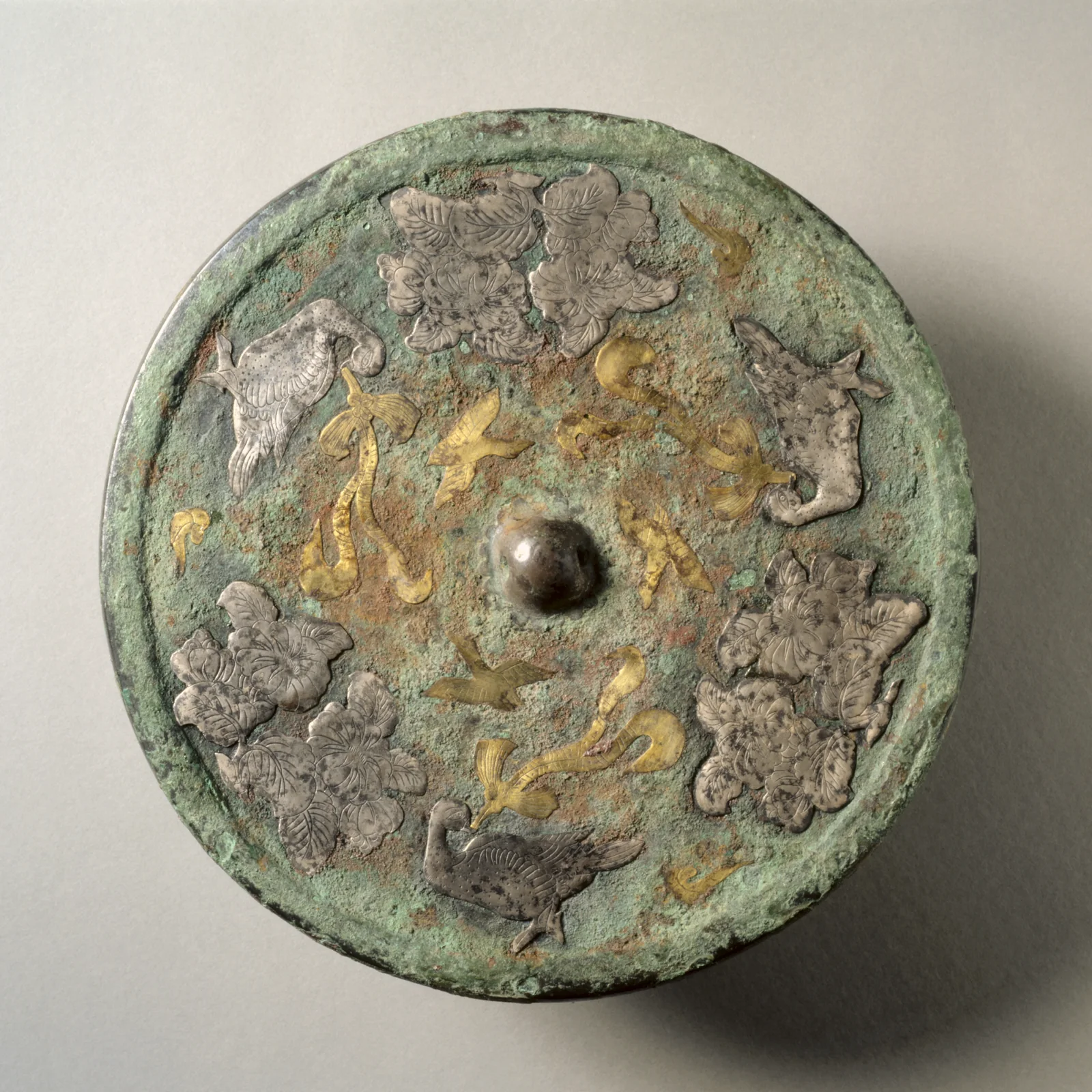
Three large flower clusters and three birds circle the central knob. Their pale surfaces stand out against the weathered ground, while smaller gold shapes thread through the spaces between them. The photograph shows the decorated back of a mirror, not its reflecting face.
Cleveland's title identifies gold and silver cutouts over a lacquer base; its medium field identifies the underlying bronze. Calling this a “solid-silver mirror” would erase the very thing that makes it interesting. Its effect depends on materials doing different jobs: a structural metal body, a prepared ground and precious-metal ornament. The museum dates it to the mid-700s, in the Tang dynasty. Read the mirror record.
The decoration is associated with jinyin pingtuo, a term used for gold-and-silver cutout work commonly described as being attached to a prepared surface, covered and finished to reveal the metal designs. But a technique name is not a laboratory report. Research by Quanyu Wang and colleagues on two other Tang objects challenged the assumption that their ground necessarily contained lacquer. That finding does not reidentify Cleveland's mirror; it reminds us to retain its own catalogue description rather than invent a universal recipe. Read the research summary.
Edges tell a different story from colour
The outlines of the birds and flowers help you see ornament as cut shapes. Their fine interior lines add another scale of work. A gold-coloured patch alone would not tell you whether you were looking at gold sheet, gilding or another material; the catalogue and technical examination supply that distinction.
The present green and brown surface is part of the object's surviving condition. It is not a colour chart for the original appearance, and the photograph is not a guide to polishing it back to an imagined newness.
04 · 1300s–1400s
A voyage made from hammered silver.
Return to the Raft Cup at the top of this page. The rim follows an irregular hollow trunk rather than a perfect circle. A branch rises far above the reclining passenger. Across the surface, curling ridges turn metal into bark and knots. Seen this way, the vessel works like a miniature landscape that can be approached from several directions.
Cleveland catalogues it as attributed to Zhu Bishan, with a date of 1300s–1400s and a Yuan or early Ming dynasty designation. Its record describes hammered parts joined with solder and finished with chasing. Assembly matters here: a unified sculptural shape need not have been cast as a single mass.
The record transcribes a signature and an inscription bearing the year 1345. That is evidence of what is inscribed on the cup, not an unconditional proof of manufacture in that year. Cleveland also notes that Zhu's name was used by followers and competitors. Keep the inscription, the museum's broad dating and its qualified attribution together. Examine Cleveland's record and inscriptions.
Legend, identification and history
The museum interprets the passenger as probably Zhang Qian. The journey to the Milky Way, the Weaving Maid and her loom stone belong to a legend. They are not a documented account of the historical envoy travelling into the sky. The cup's literary allusion is part of its appeal without becoming literal biography.
There is a useful pleasure in leaving the attribution open. You can admire the handling of the surface, study how the upright branch changes the silhouette, and ask how the separate parts work together without promoting a museum's cautious description into certainty. Looking closely and knowing who made something are related activities, but one does not have to wait for the other.
05 · Reading technique
Four different ways to work a surface.
“Decorated silver” can conceal a great deal of skilled work. Begin by separating the shape of the object from the decoration on it. A maker might form a vessel, join its parts, work its surface and add another metal. The finished object gathers those operations into one appearance.
Hammer & join
Hammering shapes metal; soldering joins components. The Raft Cup's museum description records both. Its construction is therefore a question about several pieces working together, as well as the surface we see.
Chase & incise
Chasing works the surface with tools; incision cuts lines into it. Cleveland explicitly records both on the Tang cup. A visible pattern alone does not establish the exact tool, order of work or workshop.
Gild
Gilding introduces a gold surface. Selective or parcel gilding leaves other areas ungilded. The Cleveland cup is specifically described as having a gilt interior; its record does not establish the gilding process used.
Cut & apply
The mirror uses gold and silver cutouts on another material. These shaped additions should not be confused with a cup made chiefly of silver or with an undifferentiated silver coating.
Repoussé raises relief by working from the reverse, while chasing can refine and articulate the front. Ring-matting creates a textured ground with small ring-shaped impressions. Scientific studies of Tang and Liao vessels document combinations of these operations, alongside different gilding methods. Those studies demonstrate a repertoire, not a licence to assign every technique to every photographed object. See the technical study of Tang and Liao vessels.
For a broader illustrated vocabulary, follow How Silver Is Decorated. To follow the metal through sheet, wire, alloys and making, use From Ore to Object. The Chinese inkstone already illustrated on the site is a particularly useful companion: stone supplies the grinding surface and sheet silver forms its housing. Its materials explain its function more clearly than the phrase “silver object” can.
06 · 1800–1916
The later story has more than one audience.
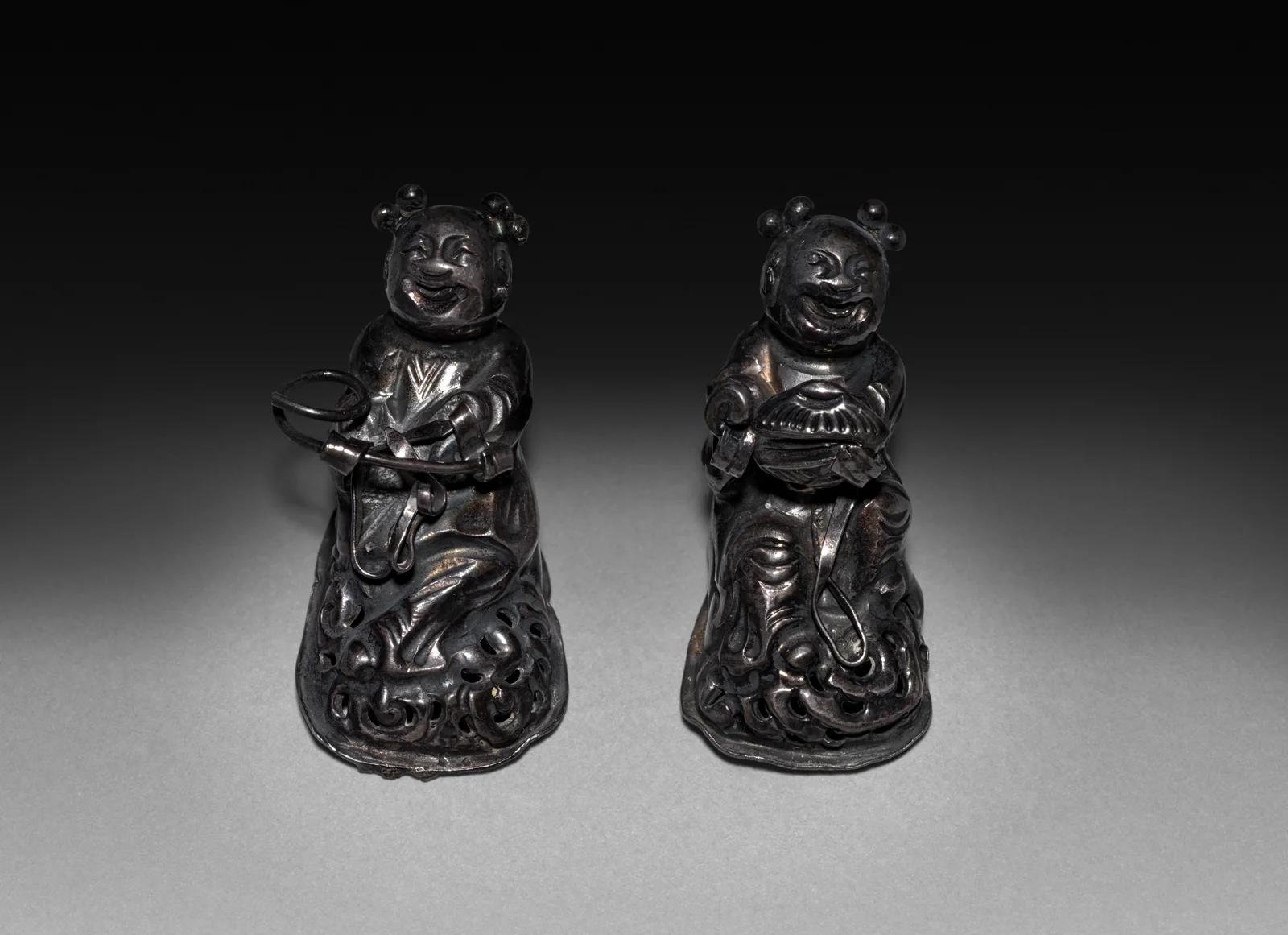
These two seated figures change the scale again. At 3.6 centimetres high, they ask for a close view: smiling faces, hands occupied with objects, robes descending toward pierced bases. Their small openings and projecting details make shadow as important as shine. This is an observation about the photograph, not an identification of the figures' names or ritual roles.
Cleveland dates the pair to 1800–1916, spanning the Qing dynasty or Republican period, and records the material as silver. It does not identify a maker or original customer. They can therefore illustrate Chinese silver from the years of the export trade, but they cannot prove a domestic commission. Read the Seated Figures record.
Personal adornment offers another way into this wider world. The Pitt Rivers Museum's study of a group of Chinese hair ornaments describes cut silver pieces combined with kingfisher feathers, coloured glass and spring-mounted elements. It also explains how little is known about their collecting history and treats aspects of their dating and use as interpretations. These are valuable examples precisely because the material description is fuller than “silver jewellery” and the gaps remain visible. Read the museum's hair-ornament study.
A buyer in an overseas port, a wearer arranging her hair and a person displaying a small figure present different questions to a maker. The existence of an export market does not make every contemporary Chinese object an export product. Equally, a familiar Chinese subject does not tell us where a particular object was used. Original orders, inscriptions, documented collection histories and carefully bounded museum identifications are more helpful than style alone.
The export-silver hub supplies the complementary story through a Chinese-made tureen catalogued for the American market and named retail firms. Read the objects side by side: the strongest comparison preserves the evidence for each audience instead of assigning one from appearance.
07 · A collector’s way in
Give each object a more precise description.
Try writing a short object label before reaching for a grand conclusion. Begin with the body: silver, bronze, stone or a combination. Add the surface: gilding, cutouts, chased lines or another documented treatment. Then record the date and maker exactly as qualified by the source. “Attributed to,” “probably” and a broad century range are useful information.
Next separate three kinds of statement. A record may document a material or an accession history. A curator may interpret a figure as a character from a story. Your own eye may notice how the rim balances a tall branch. All three can make an object more interesting; they become misleading only when their different foundations disappear.
Finally, keep a photograph attached to the record for the exact object it shows. Two Tang stem cups are not interchangeable illustrations of one museum entry. A full view and a close detail do different jobs, and a maker's name in a caption deserves the same caution as the name in the catalogue.
Continue with Chinese export makers and marks for the distinction between retail names and workshop evidence, or construction and care for reading surfaces and joins. The reward is not simply a longer list of techniques. It is the ability to see a bright flower, a quiet band or a curling branch as a deliberate decision made in metal.
Sources & image credits
Object dates, materials and attributions follow the linked museum records, checked 15 November 2026. Visual observations are distinguished from museum interpretations. All four photographs are the exact museum-supplied images designated CC0; captions link to their individual records. Image resizing preserves the full frame.
- Cleveland Museum of Art: Raft Cup, 1977.7 — Qualified attribution, broad dating, construction, inscriptions and museum interpretation of the legend.
- Cleveland Museum of Art: mirror, 1999.217 — Mid-700s; bronze, gold and silver cutouts; lacquer base identified in the title.
- Cleveland Museum of Art: Stem Cup, 1951.396 — Early 700s; silver, gilt interior, incision and chasing; context for stemmed drinking vessels.
- Cleveland Museum of Art: Seated Figures, 1916.631 — 1800–1916, Qing dynasty or Republican period; silver and dimensions. No original market supplied.
- Cleveland Museum of Art: Open Access — CC0 policy, checked against each object’s API designation and exact supplied image URL.
- Smithsonian National Museum of Asian Art: Luxury Arts of the Silk Route Empires — Cross-regional exchanges, Sasanian and Tang metalwork, and ceramic responses.
- Shandong University: Quanyu Wang on jinyin pingtuo (2020) — Research summary concerning the ground materials of two other Tang objects; not a technical analysis of Cleveland’s mirror.
- Beyond the aesthetics of Tang and Liao dynasties artifacts in the British Museum’s collection — Scientific study documenting decoration on nine vessels; cited for the range of documented techniques, not object-specific findings for these photographs.
- Pitt Rivers Museum: Chinese hairpins, Imogen Clark — Mixed materials, contextual interpretation and acknowledged gaps in collection history. No photograph reused.