

Indian silver · Bhuj and Kutch
Read the craft in the curves
Curling leaves crowd the silver around a broad loop handle. Look closely at the polished relief against its stippled ground.
Oomersi Mawji worked in western India. The Nelson-Atkins Museum identifies him as court goldsmith to the ruler of Kutch and describes a practice embracing local and international styles. Its Roman-inspired cup makes that range tangible.
LACMA dates his workshop’s activity to about 1860–1890. Those are approximate working dates, not birth and death dates. Its ice pail is attributed to the workshop, rather than certified as Mawji’s personal handiwork.
This is a useful maker to approach through objects rather than a single signature. Compare the shape, ornament and function first. Then ask exactly whom the museum credits, how it dates the piece and what it actually records about the marks.
From the museum collection
A world of ornament from Bhuj
Three museum references offer three ways into this work: surface, historical borrowing and use. The photograph is a real collection image; the other objects can be studied at the linked museums.
An ice pail: follow the surface, then check completeness
LACMA’s Ice Pail and Cover, circa 1880, is silver repoussé from Gujarat’s Kachchh region. Accession M.2013.220.19a-b has an overall height, including cover, of 20.32 cm. The museum notes that its separate inner liner is missing.
The picture shows an alternate view of the pail without its cover. Look at the handle, rim and foot as distinct parts of the design. A close view is valuable, but it cannot replace photographs of every component when you are assessing completeness.
“Silver” in a catalog is not automatically a numerical assay. Do not assign sterling fineness or a melt value from the material label alone.
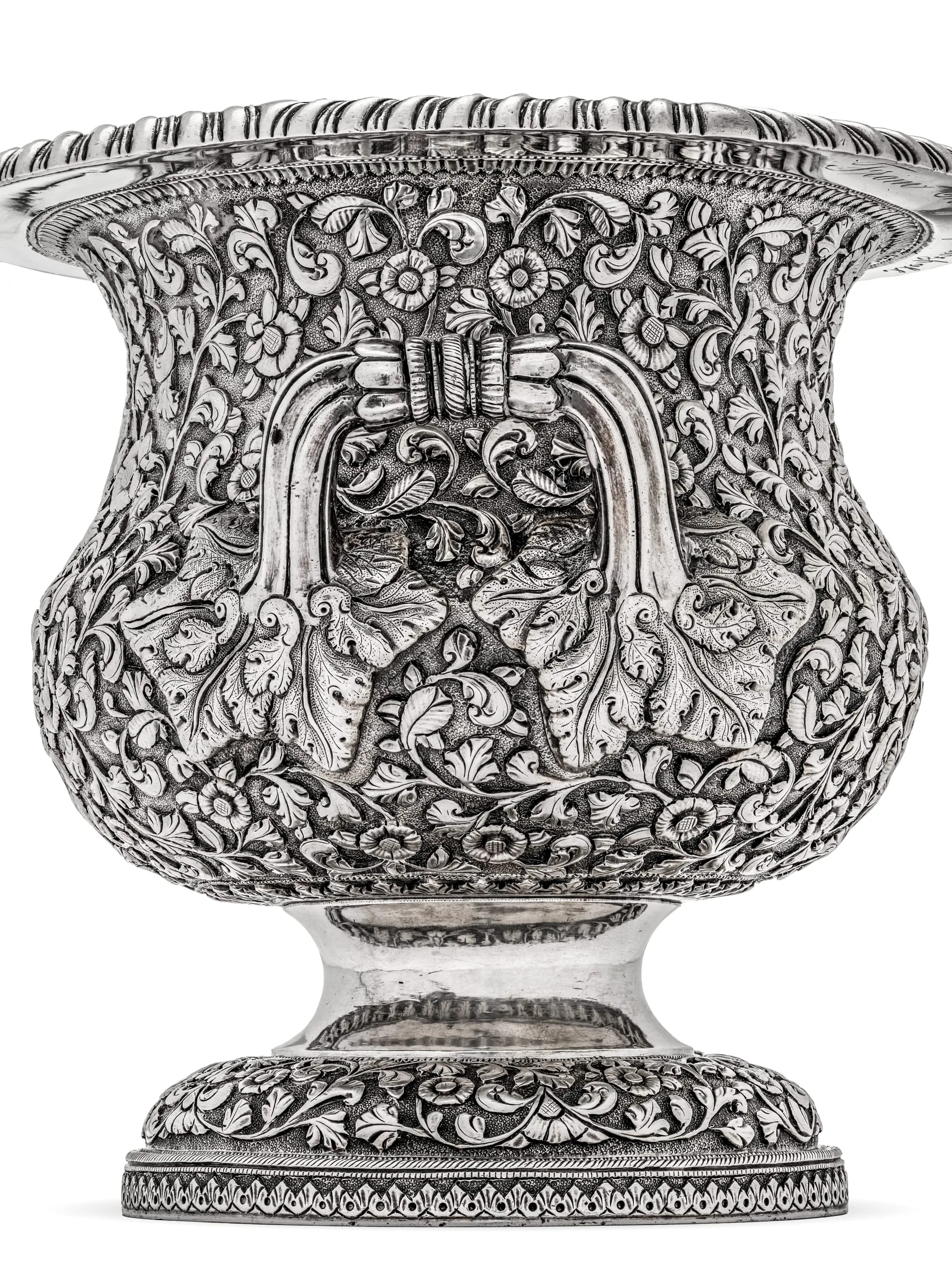
Attributed to Oomersi Mawji’s workshop, Ice Pail and Cover, circa 1880. Alternate view, cover not shown.
Los Angeles County Museum of Art, Gift of Julian Sands. Photo © Museum Associates/LACMA. www.lacma.org. Museum record · LACMA image terms
See the larger museum photographA Roman-inspired cup: separate a mark from a story
The Nelson-Atkins cup, circa 1880, is cataloged as silver, accession 2017.33.2. Beneath its base the record transcribes “OM” and “Bhuj”. These are evidence for this particular object, not a universal authentication test for similar-looking silver.
There is a useful wrinkle in the documentation: the rim inscription names Herculaneum, while the museum’s interpretation names Pompeii. Keep the inscription and curatorial explanation separate rather than silently making them agree.
Ask for an underside photograph with the whole mark group in focus. Record the seller’s wording exactly, including “attributed to” or “workshop of”. A familiar pair of letters cannot establish age, authorship, condition or metal purity by itself.
A tea set: put the vessel back into daily use
The V&A’s South Asia collection highlights identify a tea set by Oomersi Mawji, made in Bhuj, India, in 1880–90. This institutional reference broadens the story from an individual display vessel to a group intended to work together.
A set rewards a different kind of looking. Compare how its handles, feet and ornament relate across the pieces, and ask whether the seller has documented them as a group. Similar decoration does not establish that every component began life together.
Use Collect Silver’s tea-set guides to distinguish vessels and detachable parts before comparing value. A decorative object can be admired without assuming that it is complete, safe for food contact or ready for use.
Names & chapters
How the story developed.
- About 1860–1890
A documented workshop span
LACMA’s activity range, not a lifespan.
- Circa 1880
A classical reference
The Nelson-Atkins dates its Roman-inspired cup.
- 1880–90
Tea silver from Bhuj
The V&A dates its Oomersi Mawji tea set.
Follow an interest
What to explore.
A historical research profile, not a current business listing. Object descriptions follow the named museum sources; no physical piece has been examined or authenticated. The documented marks belong to the Nelson-Atkins cup. No maker’s mark is redrawn or presented as a universal reference.
Check the details
Before you buy.
Start with the object and its documented history. Let the attribution keep its qualifications.
Open the references
Research this name.
- Museum collection
Inspect the ice pail’s museum record
Read the workshop attribution and component description.
- Museum collection
Read the cup’s marks and inscription
Keep the inscription distinct from its interpretation.
- Museum collection highlights
Find the V&A tea-set highlight
Find the dated Bhuj tea set in the collection highlights.
- Museum image policy
Read the photographed object’s image terms
LACMA’s public-domain image provisions cover designated downloads.
- Collecting guide
Learn the vocabulary of tea-set construction
Connect surface decoration with how a vessel is made.
- Collecting guide
Check a tea set’s components
Separate matching appearance from documented completeness.
- Related article
Explore water vessels and their uses
Compare vessel function before relying on a familiar shape.
- Related maker profile
Compare workshop credit in Ashbee’s silver
Explore a different maker’s practice of distinguishing designer and workshop, without implying a connection between them.
Sources & further reading
- Ice Pail and Cover, circa 1880; M.2013.220.19a-b Los Angeles County Museum of Art · Object record: workshop attribution, activity dates, material, dimensions and completeness
- Silver Cup based upon a Roman Cantharus, circa 1880; 2017.33.2 The Nelson-Atkins Museum of Art · Object record: artist, court role, marks, inscription and interpretation
- South Asia collection highlights: Oomersi Mawji tea set, 1880–90 Victoria and Albert Museum · Museum overview: dated tea-set highlight and Bhuj attribution
- Terms of Use: designated public-domain images Los Angeles County Museum of Art · Image-reuse policy, read with the object’s public-domain download designation
Museum sources checked November 11, 2026. The V&A citation is its South Asia collection highlight. Dates are approximate. Photograph: designated LACMA public-domain image.