

Modern silver · Denmark and America
An artist between the studio and the factory
A coffeepot can be a small piece of architecture. In Erik Magnussen’s Cubic service, pointed handles and sharply divided black, gold and silver surfaces turn the familiar coffee table into something startling.
Magnussen (1884–1961) trained in sculpture in Copenhagen and silver chasing in Berlin. RISD records his own Danish studio in 1909 and his arrival at Gorham in 1925. His career therefore reaches well beyond his work for Gorham.
This is a story about both an artist and a company. Museum records name their roles separately. Follow those credits rather than treating every Gorham object as Magnussen’s design, or every Magnussen object as a Gorham product.
Start with the dramatic service, then compare two pitchers and a pair of candlesticks. Changing the question from “Who signed it?” to “How does the whole object work?” reveals a more varied practice.
From the museum collection
From angular coffee silver to a later pitcher
Four object studies connect form, surface and attribution. The coffee-service photograph comes from RISD; follow the museum records to see the other examples.
The Cubic service: light is part of the design
RISD dates its Cubic Coffee Service to 1927, accession 1991.126.488. Magnussen is the designer and Gorham the manufacturer. The museum’s label also credits him with designing, executing and marking this particular service.
The museum describes silver with patination, gilding and ivory. Its four components are a coffeepot, creamer, sugar bowl and tray. These are coordinated surfaces, not simply separate vessels sharing a monogram.
The original 1927 design drawing, RISD 2019.6, adds a conservation story. The museum says its evidence guided conservation treatment after the dark facets had faded. A dark area on silver can belong to the intended design, rather than being something to polish away.
Notice how the tray repeats the vessels’ triangles. Follow the spout, handles and finials, then their reflections. Look as closely as you would at a sculpture.
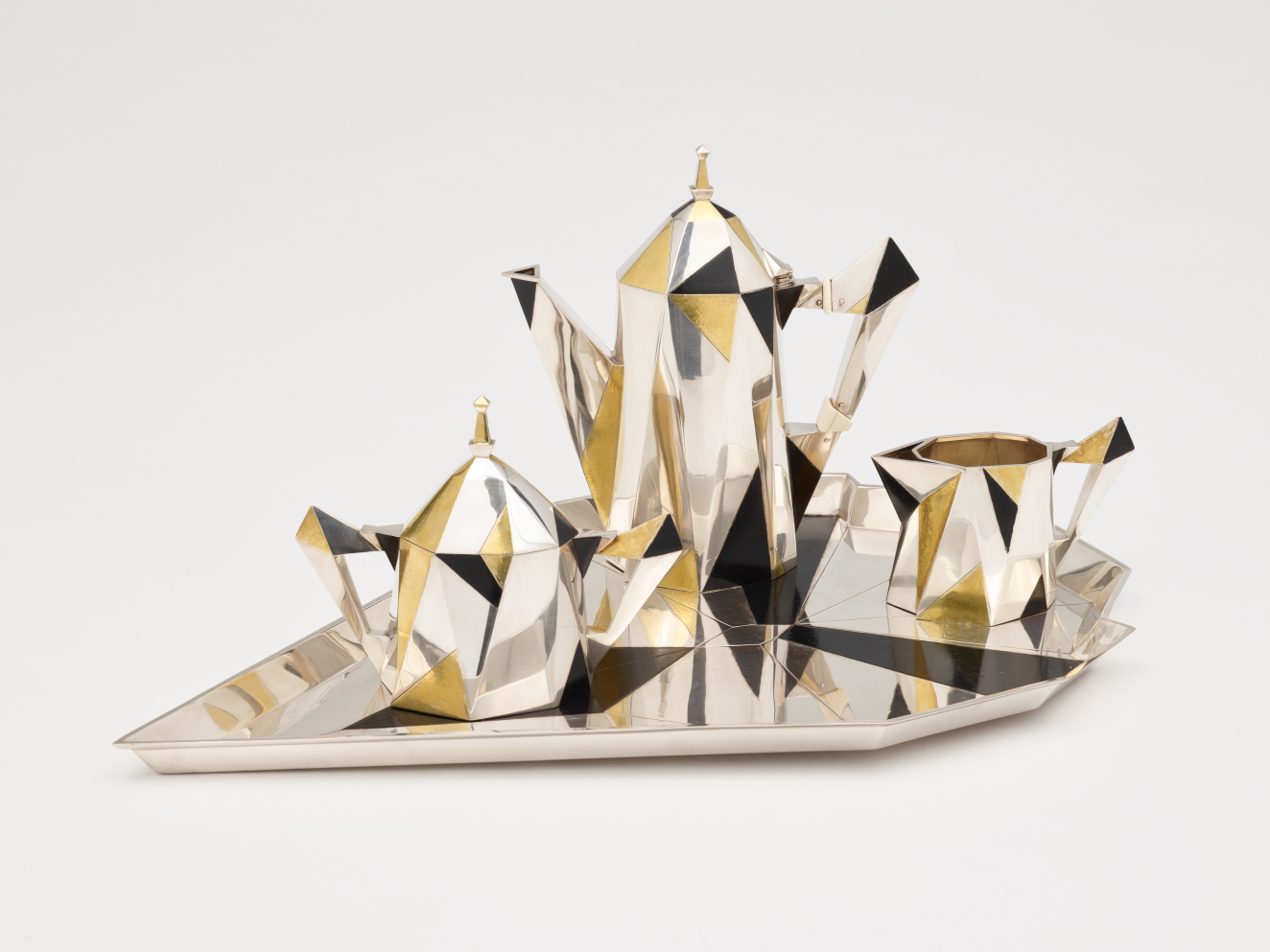
Erik Magnussen for Gorham, Cubic Coffee Service, 1927.
RISD Museum, The Gorham Collection. Gift of Textron Inc., 1991.126.488.
View the museum photographA 1928 pitcher: read the whole material description
The Metropolitan Museum of Art’s Pitcher, 1928, names Gorham as maker and Magnussen as artist. Made in Providence, Rhode Island, it combines silver and Bakelite. Accession 2013.959.2 measures 21.6 × 25.4 × 13.3 cm.
This is a useful companion to the coffee service because the catalog does not describe an all-metal object. Keep the nonmetal component in your notes. Total object weight and silver weight are not interchangeable.
When comparing a related pitcher, request full views, handle attachments, the interior and underside. Inspect the relationship between handle and vessel before focusing on a polished surface. A photograph can guide questions without establishing condition or usability.
A later pitcher: preserve the museum’s “probably”
RISD’s Pitcher, circa 1935, is credited to Magnussen alone. The record lists sterling silver and probably Los Angeles as the place of manufacture. Accession 2001.12 is 23.7 cm high. Do not quietly convert that qualified location into a certainty.
The underside record gives a cursive “Erik Magnussen / STERLING / 5” and an unidentified geometric design. RISD tentatively asks whether the latter is a manufacturer’s trademark; the profile leaves that question open.
Set the two pitchers’ records side by side. One credits Gorham and a named artist; the other names the silversmith without Gorham. The difference matters more than a broad stylistic resemblance when you write an attribution.
Candlesticks: initials belong inside a complete mark group
RISD’s Pair of Candlesticks, 1928, combines silver and turquoise. Its record credits Magnussen as designer and Gorham as manufacturer, accession 1991.126.182. The transcribed group reads “GORHAM EM [lion] [anchor] G / STERLING / 45.”
Treat that transcription as evidence for these candlesticks, not a universal Magnussen stamp. The letters, pictorial marks and number are useful together. A lone EM, or a seller’s identification of it, is not enough to authenticate an object.
The turquoise offers another way into the comparison: this designer’s work was not confined to the black-and-gold geometry of the Cubic service. Keep looking at different forms before deciding that one famous piece defines a whole career.
Names & chapters
How the story developed.
- 1909
A Danish studio
RISD records Magnussen opening his own studio.
- 1925
Joining Gorham
The American manufacturer hires the Danish silversmith.
- 1927
The Cubic service
The RISD service brings angular forms to the coffee table.
- Circa 1935
A later pitcher
RISD’s example is credited to Magnussen alone.
Follow an interest
What to explore.
A historical research profile of the Danish silversmith Erik Magnussen (1884–1961), not a current business listing. Museum object credits and qualifications are retained. No physical object has been examined or authenticated, and no signature or hallmark is redrawn.
Check the details
Before you buy.
Let the complete object, not a familiar name alone, lead the research.
Open the references
Research this name.
- Museum collection
Study the Cubic service
Compare the coordinated vessels and tray.
- Museum collection
See the drawing behind the conservation
Read how the original design informed treatment.
- Museum collection
Compare the Met’s 1928 pitcher
Check the paired maker and artist credits.
- Museum collection
Read the later pitcher’s record
Keep the uncertain location and mark interpretation.
- Museum collection
Inspect the candlestick attribution
Read the complete mark transcription.
- Related maker profile
Meet Gorham, the manufacturer
Follow the documented artist–manufacturer connection.
- Museum guide
Explore RISD’s silver collection
Plan further research through the museum and its collection.
- Collecting guide
Read the silver tea-set construction guide
Connect surface decoration, materials and construction.
- Collecting guide
Check a service’s components
Compare matching parts without assuming they began together.
- Related maker profile
Compare another approach to modern silver
Explore geometric tableware in a different design context; this is a comparison, not a claimed collaboration.
Sources & further reading
- Gorham Silver: Designing Brilliance 1850–1970, exhibition checklist, pp. 85–87 RISD Museum · Museum exhibition research: training, studio and Gorham career
- Cubic Coffee Service, 1927; 1991.126.488 RISD Museum · Object record: designer, manufacturer, materials, components and image terms
- Cubic Coffee Service Drawing, 1927; 2019.6 RISD Museum · Design record and conservation account
- Pitcher, 1928; 2013.959.2 The Metropolitan Museum of Art · Independent object record: artist, maker, place, materials and dimensions
- Pitcher, circa 1935; 2001.12 RISD Museum · Object record: later work, qualified location and marks
- Pair of Candlesticks, 1928; 1991.126.182 RISD Museum · Object record: paired attribution, materials and mark transcription
Museum sources checked November 11, 2026. Approximate dates and uncertain attributions retain their qualifications. Photograph: RISD Museum.